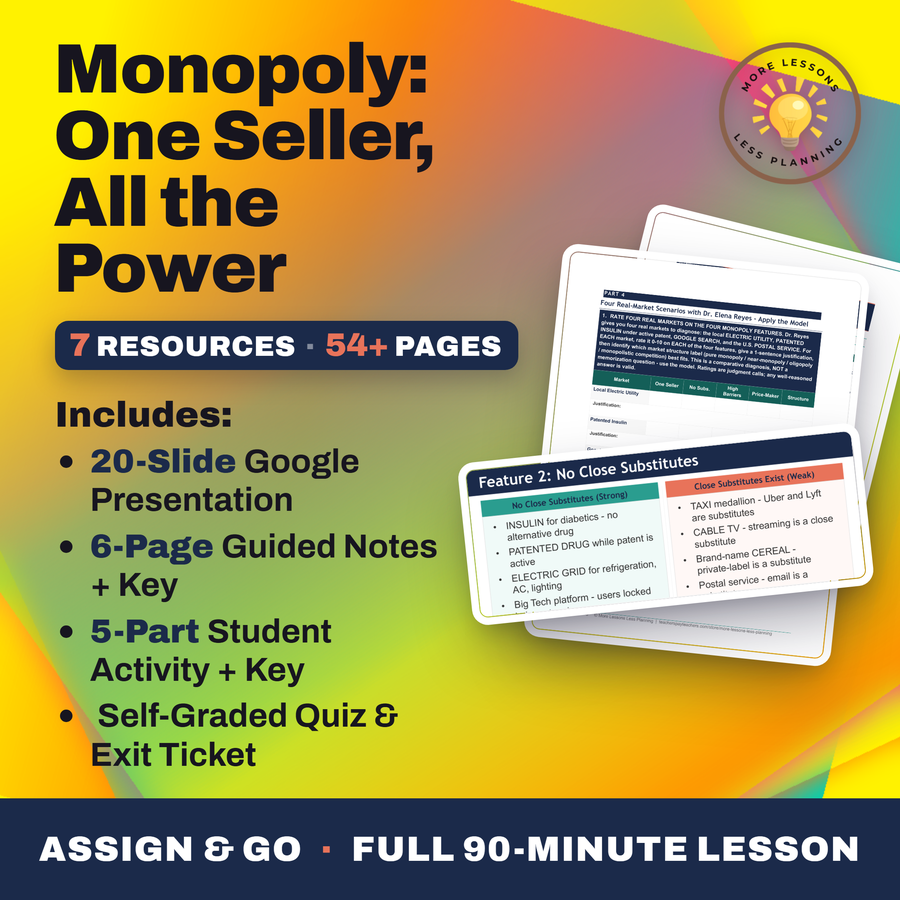

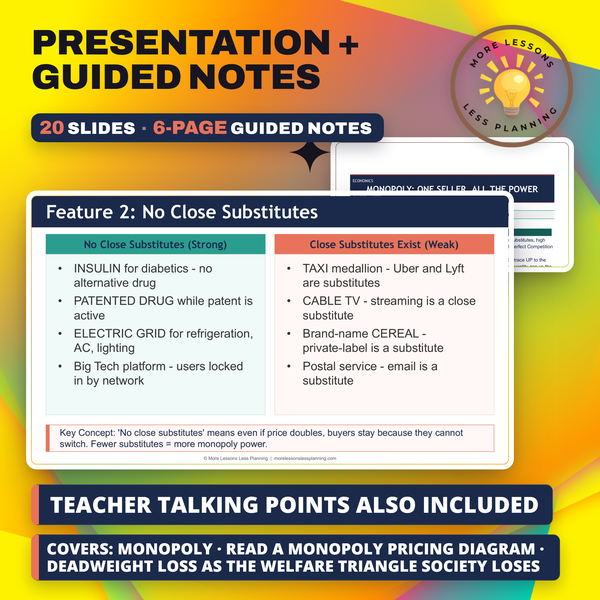
Monopoly: One Seller, All the Power
- Slide deck
- Guided notes
- Guided notes teacher key
- Activity + answer key
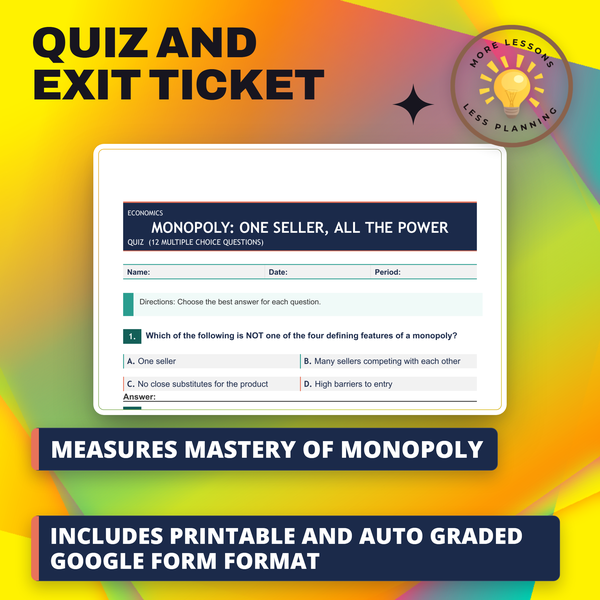
- Quiz + answer key
- Exit ticket + answer key
- Teacher guide
- Teacher presentation notes
Where should I send the next one?
Everything here is free and it stays that way. Leave your email and I'll send you the new lessons as they go up. You can unsubscribe from any one of them.
Every file in this toolkit
Related resources
Big Tech Antitrust - Google Apple Amazon Meta
Monopolistic Competition: Brand Wars

Why Your Internet Only Has One Provider

Credit Scores: The Number That Runs Your Life
Economic Systems - Capitalism vs Socialism vs Mixed
Externalities When Markets Hurt Others
What students do
- Define monopoly using its four features and contrast it with the perfect competition studied in the previous lesson
- Read a monopoly pricing diagram to find the quantity where marginal revenue equals marginal cost, then trace up to the price the demand curve will bear
- Calculate the deadweight loss triangle a monopoly creates compared to the competitive equilibrium
- Evaluate why the electric utility grid is regulated as a natural monopoly instead of broken into competing firms
What it covers
- The four defining features of monopoly, one seller, no substitutes, high barriers to entry, and price-maker pricing
- How a monopoly picks its price using the two-step MR equals MC rule
- Why utilities are treated as natural monopolies, and the real household cost, roughly $50 to $80 a year, of leaving one unregulated
Learning targets
- Define MONOPOLY using the four defining features (one seller, no close substitutes, high barriers to entry, price-maker firm) and contrast it with the four conditions of Perfect Competition from TK 21
- Read a monopoly pricing diagram - locate the QUANTITY where MR=MC, trace UP to the demand curve for the PRICE the monopoly charges, and compute the price/quantity gap vs the competitive equilibrium
- Explain DEADWEIGHT LOSS as the welfare triangle society loses to monopoly pricing, and distinguish REGULATED monopolies (utilities, patents) from UNREGULATED ones using real U.S. examples
From one teacher to another
Coming right after the perfect competition lesson, this one flips the script hard, one seller with real power to set price instead of thousands of price-takers. The electric utility example does the heavy lifting because it hands students a natural monopoly they're already paying into every month, and the deadweight loss number makes the cost of leaving one unregulated concrete instead of abstract. Once they can read the MR equals MC pricing rule off a diagram, the rest of Unit 3 gets a lot easier.
Every lesson on this site is free to download and use. If one of them saved you a prep period, you can chip in a few bucks toward my three kids' daycare fund. That's genuinely where tips go.