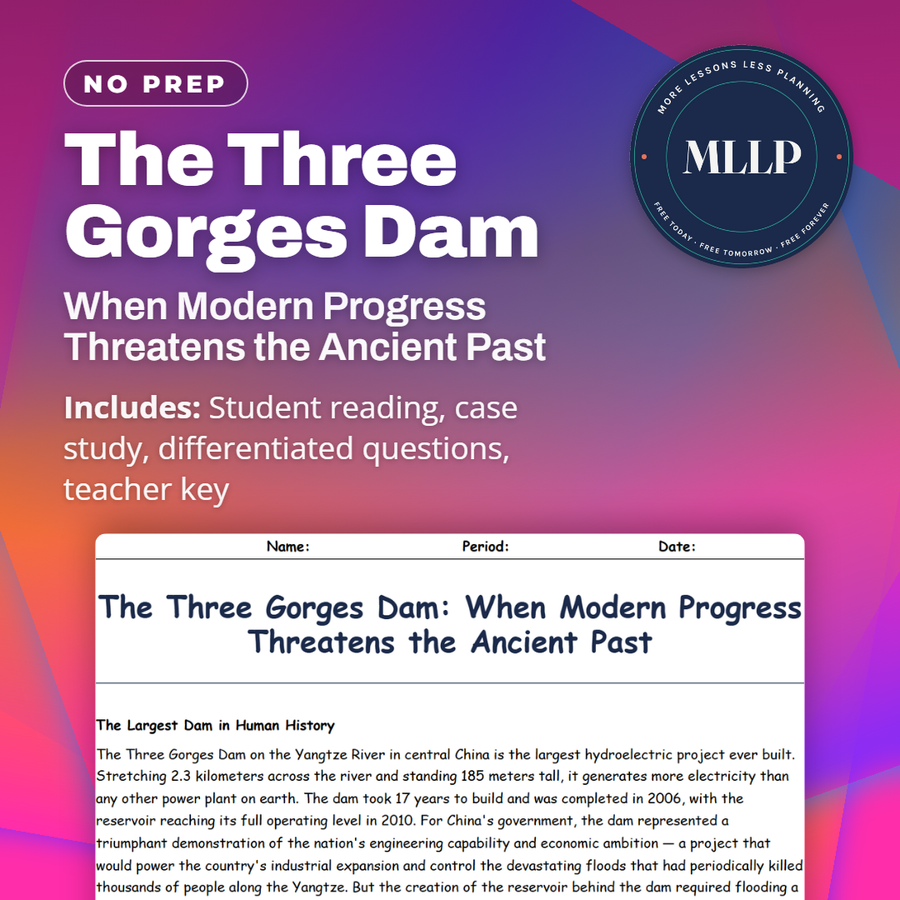
The Three Gorges Dam: When Modern Progress Threatens the Ancient Past
Quality reviewed September 2026
Facts verified September 21, 2026
- Subject
- Social Studies
- Grades
- Grades 9-12
- Length
- 9-page student worksheet
- Time
- About one 50-minute class period
- Great for
- Sub plans and independent work
- Includes
- Reading passage, comprehension questions + full answer key
- Format
- Print-and-go PDF
What students do
- Displacing a million people also meant flooding over 1,000 archaeological sites in one reservoir
- Sort what the salvage program actually saved from what went underwater unrecorded
- A six-week dig near Baidicheng raced a rising reservoir with only four assistants
- Explain why China and its critics disagreed about whether the dam was worth its cost
What it covers
- The salvage archaeology race against the rising Three Gorges reservoir
- What was lost, including Ba civilization sites and Paleolithic campsites
- The international debate over development versus heritage preservation
Start reading this worksheet
The Largest Dam in Human History
The Three Gorges Dam on the Yangtze River in central China is the largest hydroelectric project ever built. Stretching 2.3 kilometers across the river and standing 185 meters tall, it generates more electricity than any other power plant on earth. The dam took 17 years to build and was completed in 2006, with the reservoir reaching its full operating level in 2010. For China's government, the dam represented a triumphant demonstration of the nation's engineering capability and economic ambition: a project that would power the country's industrial expansion and control the devastating floods that had periodically killed thousands of people along the Yangtze. But the creation of the reservoir behind the dam required flooding a 600-kilometer-long gorge system that had been inhabited by humans for tens of thousands of years. More than 1.3 million people were relocated to make way for the rising water. Hundreds of towns and villages, farmland that families had cultivated for generations, temples and historic sites, and an extraordinary concentration of archaeological sites all went under water. The race to document and excavate as much of this heritage as possible before the water rose became one of the largest salvage archaeology operations ever conducted, and also one of the most controversial.
Salvage Archaeology on an Impossible Scale
Beginning in the mid-1990s, the Chinese government funded a massive salvage archaeology program in the Three Gorges reservoir area. Teams of archaeologists from universities and research institutes across China were dispatched to survey, excavate, and document as many sites as possible before the flooding began. The scale was staggering: more than 1,000 archaeological sites had been identified in the reservoir zone, ranging from Paleolithic campsites to Han Dynasty cities. Excavating all of them properly was never a realistic possibility. The salvage program did produce remarkable finds. Excavations at sites like Zhongxian and Fengjie revealed Han Dynasty settlement layers with ceramics, bronzes, and architectural remains. At Zigui, archaeologists uncovered evidence of human occupation dating back more than 50,000 years. Several previously unknown sites were identified through survey work that would not have been funded under normal circumstances. The pressure of the deadline (the water was coming whether the archaeology was done or not) produced both extraordinary efficiency and compromises in excavation quality that scholars still debate.
What Was Lost
Despite the salvage effort, the scale of what was lost is genuinely difficult to calculate. The Three Gorges area sits in the valley of a river that has been a center of human habitation for most of human history in China. Geological studies show that the region served as a refuge during ice ages when much of northern China was too cold for agriculture. This means the reservoir may have drowned archaeological sites representing periods of Chinese prehistory that are barely documented elsewhere: Paleolithic and Mesolithic campsites, early Neolithic settlements, and Bronze Age communities that developed somewhat differently from the cultures of the Yellow River heartland. Some specific losses are documented. The Ba people, an ancient civilization contemporary with the Shang Dynasty in the Yangtze valley, left archaeological traces throughout the gorge area. Many of these sites were excavated under emergency conditions or not at all. Temples and architectural monuments dating from the Han through the Qing Dynasty were photographed and partially dismantled, but few were successfully relocated. The Zhang Fei Temple was reassembled at a new location 30 meters above the old one, one of a handful of significant structures saved. Thousands of smaller sites, unmarked tombs, and everyday artifacts went under water unrecorded.
Like what you read? The full reading, the case study, and every question set are in the free download below, along with the answer key.
Why this matters
The Three Gorges story puts two real needs against each other, flood control and clean electricity for over a billion people against archaeological sites that can never be recovered once they are underwater, and there is no answer that satisfies both sides completely. The old man in the case study who remembers his father selling a bronze pot found in that same field is a reminder that the heritage being weighed in these decisions belongs to living families, well beyond museums or research papers. Students can use this reading to think through how any country, including their own, should decide what gets sacrificed when development and preservation cannot both win.
From one teacher to another
Displacing a million people to build the world's largest hydroelectric dam also meant flooding a 600 kilometer gorge system containing more than 1,000 identified archaeological sites, some representing tens of thousands of years of human habitation. Students read about the salvage archaeology program that raced the rising water through the 1990s and 2000s, recovering real finds like a 50,000 year old occupation layer at Zigui and Han Dynasty settlements at Zhongxian and Fengjie, while acknowledging that most sites could never be properly excavated in time. The reading also covers the Ba civilization, contemporaries of the Shang whose sites in the Yangtze valley were largely lost, and the international criticism China faced from UNESCO and heritage scholars over the tradeoff. A case study follows archaeologist Huang Min through the last six weeks of a dig near Baidicheng before the water arrives.
What you get
Download
Where should I send the next one?
Everything here is free and it stays that way. Leave your email and I'll send you the new lessons as they go up. You can unsubscribe from any one of them.
Related resources
Ancient China: An Overview of Dynasties, Power, and the Archaeological Record
Ancient Chinese Inventions: What Archaeology Proves
Han Dynasty Tombs: Buried Treasure and Beliefs About the Afterlife

Oracle Bones: Fortune-Telling That Became History
Sanxingdui: The Mysterious Bronze Civilization That Doesn't Fit
The Great Wall: Myth vs. Archaeological Reality
Every lesson on this site is free to download and use. If one of them saved you a prep period, you can chip in a few bucks toward my three kids' daycare fund. That's genuinely where tips go.