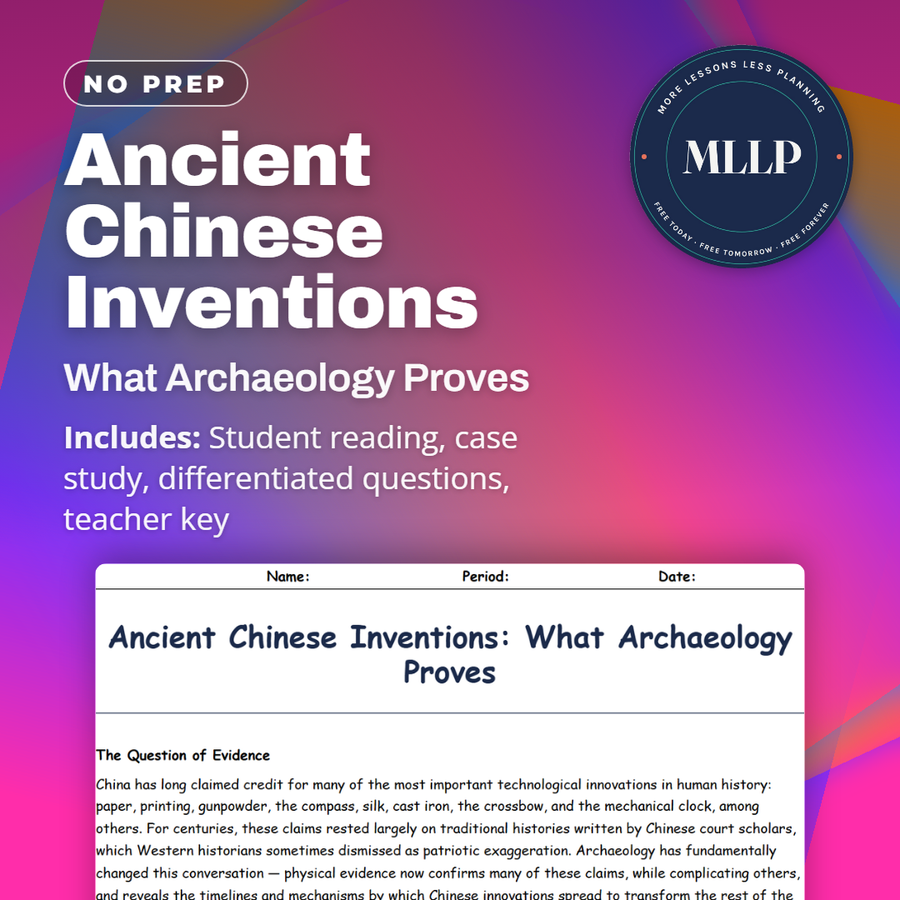
Ancient Chinese Inventions: What Archaeology Proves
Quality reviewed September 2026
Facts verified September 21, 2026
- Subject
- Social Studies
- Grades
- Grades 9-12
- Length
- 9-page student worksheet
- Time
- About one 50-minute class period
- Great for
- Sub plans and independent work
- Includes
- Reading passage, comprehension questions + full answer key
- Format
- Print-and-go PDF
What students do
- Chinese paper turns out to predate its supposed inventor Cai Lun by centuries, and the reading explains why
- Sort five ancient Chinese inventions by what accident or secret sits behind each one
- Gunpowder began as a failed search for an immortality potion, not a weapon
- Explain how silkworm eggs smuggled inside walking sticks ended a 2,000 year monopoly
What it covers
- The real archaeological dates behind paper, gunpowder, the compass, and silk
- How Taoist alchemists stumbled onto gunpowder while chasing immortality
- The difference between where a technology was invented and how it spread
Start reading this worksheet
The Question of Evidence
China has long claimed credit for many of the most important technological innovations in human history: paper, printing, gunpowder, the compass, silk, cast iron, the crossbow, and the mechanical clock, among others. For centuries, these claims rested largely on traditional histories written by Chinese court scholars, which Western historians sometimes dismissed as patriotic exaggeration. Archaeology has fundamentally changed this conversation. Physical evidence now confirms many of these claims, while complicating others, and reveals the timelines and mechanisms by which Chinese innovations spread to transform the rest of the world. The key distinction is between invention and diffusion. Archaeologists can now often establish with reasonable confidence not just that a technology existed in China but roughly when it first appeared, how it was developed over time, and through what routes it spread to other cultures. The story is rarely simple: 'China invented X and the world learned from China' is a significant oversimplification. Many technologies were independently developed in multiple places. Others were invented in China but improved beyond recognition elsewhere. The archaeological record tells a more nuanced story than national pride in any direction typically allows.
Paper: The Technology That Made Knowledge Portable
The traditional Chinese account credits a court official named Cai Lun with inventing paper in 105 CE during the Han Dynasty. Archaeological evidence has complicated this date significantly: excavations at Han Dynasty military sites along the northwestern frontier have recovered fragments of genuine paper (sheets made from plant fibers) dating to as early as the 2nd century BCE, predating Cai Lun by centuries. The oldest known paper, found at the Fangmatan tomb site in Gansu Province in 1986, dates to around 179–141 BCE. What Cai Lun apparently did was improve and standardize the paper-making process, making it practical for widespread use. Before him, paper existed but may have been inconsistent in quality. After his refinements (using a recipe involving bark, hemp, rags, and fishnets), paper became cheap, reliable, and available enough to begin replacing silk and bamboo as the standard writing material. The spread of paper technology westward through Central Asia, reaching the Arab world by the 8th century and Europe by the 12th, would eventually make the mass literacy of the modern world possible.
Gunpowder: An Accidental Discovery With Global Consequences
Gunpowder was not invented by a military engineer trying to create a weapon. Archaeological and textual evidence indicates it was discovered around the 9th century CE by Taoist alchemists who were trying to create an elixir of immortality. Ironically, one of the most lethal substances in human history was discovered by people searching for eternal life. The key ingredient was saltpeter (potassium nitrate), which alchemical texts began warning against mixing with charcoal and sulfur after several laboratory fires and explosions. Once discovered, Chinese engineers rapidly adapted gunpowder for military use. The archaeological record shows a progression of inventions: fire arrows by the 10th century, simple bombs and grenades by the 11th century, the first true guns (fire-lance devices) by the 12th century, and metal-barreled firearms by the 13th century. The technology spread westward along the Silk Road, reaching the Arab world by the 13th century and Europe by the 14th century, where it would eventually end the dominance of medieval castle warfare and transform the nature of military power globally.
Like what you read? The full reading, the case study, and every question set are in the free download below, along with the answer key.
Why this matters
The reading keeps drawing a line between inventing something and spreading it, and that distinction still matters anytime a new idea, medicine, or piece of software crosses from one country to another today. Students see that credit for a discovery rarely belongs to one person or one place, since paper existed in rough form before Cai Lun refined it and gunpowder came from a failed attempt at something else entirely. The silk story, an industry protected by execution for thousands of years until two monks reportedly walked out with silkworm eggs hidden in canes, gives students a concrete case for thinking about how trade secrets, patents, and technology transfer work in the world they live in now.
From one teacher to another
Chinese court scholars get credit in old histories for inventions that archaeology now dates earlier, sometimes centuries earlier, than the traditional stories claim. Students read about paper fragments recovered from a Han military site that predate the official inventor Cai Lun, a compass that started out as a divination tool long before anyone used it to sail, and a crossbow trigger from a tomb dated to 433 BCE. The reading also covers gunpowder, discovered by Taoist alchemists cooking up what they hoped was an immortality elixir, and the death penalty China once attached to revealing how silk was made. A case study follows an alchemist named Master Xu through the exact moment his formula goes wrong.
What you get
Download
Where should I send the next one?
Everything here is free and it stays that way. Leave your email and I'll send you the new lessons as they go up. You can unsubscribe from any one of them.
Related resources
Ancient China: An Overview of Dynasties, Power, and the Archaeological Record

Han Dynasty Tombs: Buried Treasure and Beliefs About the Afterlife
Oracle Bones: Fortune-Telling That Became History
Sanxingdui: The Mysterious Bronze Civilization That Doesn't Fit
The Great Wall: Myth vs. Archaeological Reality
The Shang Dynasty: Bronze, Power, and Ritual
Every lesson on this site is free to download and use. If one of them saved you a prep period, you can chip in a few bucks toward my three kids' daycare fund. That's genuinely where tips go.