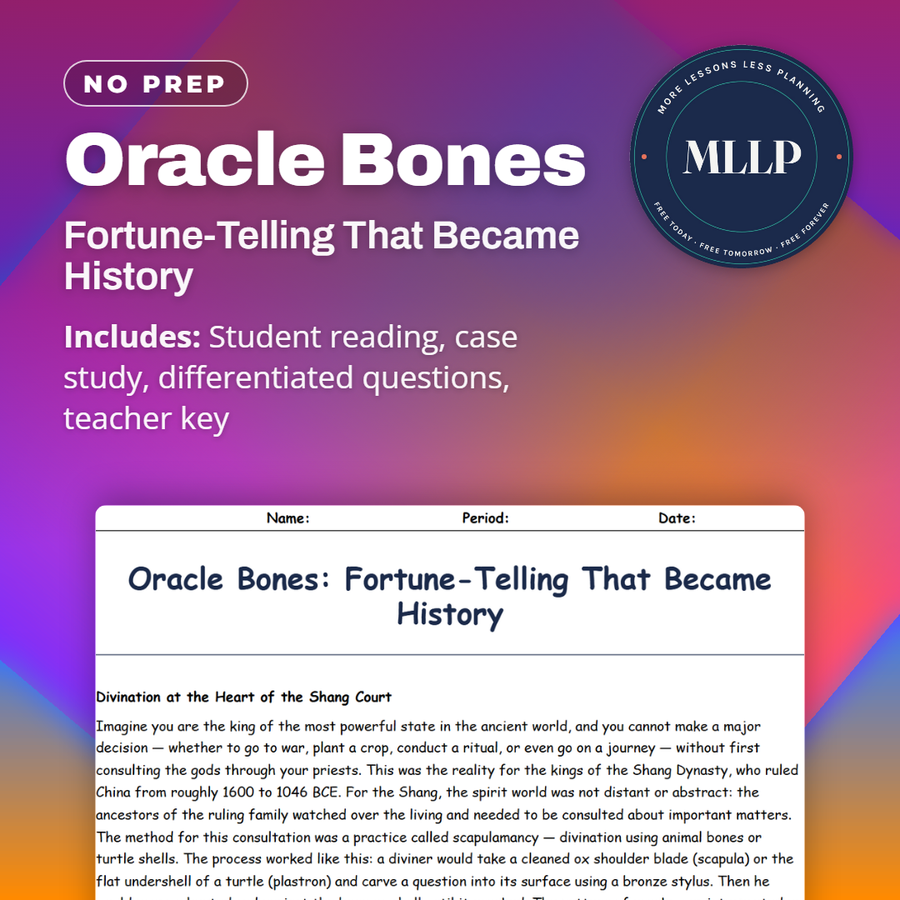
Oracle Bones: Fortune-Telling That Became History
Quality reviewed September 2026
Facts verified September 21, 2026
- Subject
- Social Studies
- Grades
- Grades 9-12
- Length
- 9-page student worksheet
- Time
- About one 50-minute class period
- Great for
- Sub plans and independent work
- Includes
- Reading passage, comprehension questions + full answer key
- Format
- Print-and-go PDF
What students do
- Shang kings would not go to war, plant a crop, or travel without cracking a heated bone first
- Fill in the blanks about scapulamancy, the divination method behind oracle bones
- A doctor's prescription led a sick scholar to notice writing on bones sold as dragon bone medicine
- Sort what oracle bone questions were actually about, from war to toothaches to weather
What it covers
- How scapulamancy worked and what Shang diviners actually asked the bones
- The 1899 discovery that turned ground-up dragon bones into ancient writing
- Why oracle bones function as an accidental historical record
Start reading this worksheet
Divination at the Heart of the Shang Court
Imagine you are the king of the most powerful state in the ancient world, and you cannot make a major decision (whether to go to war, plant a crop, conduct a ritual, or even go on a journey) without first consulting the gods through your priests. This was the reality for the kings of the Shang Dynasty, who ruled China from roughly 1600 to 1046 BCE. For the Shang, the spirit world was not distant or abstract: the ancestors of the ruling family watched over the living and needed to be consulted about important matters. The method for this consultation was a practice called scapulamancy: divination using animal bones or turtle shells. The process worked like this: a diviner would take a cleaned ox shoulder blade (scapula) or the flat undershell of a turtle (plastron) and carve a question into its surface using a bronze stylus. Then he would press a heated rod against the bone or shell until it cracked. The pattern of cracks was interpreted as the answer from the ancestors or gods. The diviner would read the cracks and record the interpretation alongside the original question, often noting whether the prediction turned out to be correct. These inscribed bones and shells are what we call oracle bones, and they are among the most important archaeological finds in Chinese history.
Discovery and Decipherment
Oracle bones were not 'discovered' in the modern archaeological sense. They were quietly dug up and sold by farmers near the village of Xiaotun for decades before scholars recognized their significance. Local people called them 'dragon bones' and ground them up for use in traditional medicine. It was not until 1899 that a Chinese scholar named Wang Yirong, suffering from malaria, looked closely at the 'dragon bones' prescribed by his pharmacist and noticed that the markings on the surface were not random scratches but actual writing. Wang immediately recognized their historical importance and began collecting them. His discovery triggered a scramble to find the source. By 1908, excavations at Anyang in Henan Province had located the site where most oracle bones originated: the last capital of the Shang Dynasty. Systematic excavation through the 1920s and 1930s yielded more than 100,000 oracle bone fragments, transforming what had been a largely legendary dynasty into a documented historical reality. Linguists spent decades deciphering the inscriptions, which turned out to be an early form of Chinese writing. This was the direct ancestor of the characters still used in China today.
What the Bones Say
Oracle bone inscriptions cover a remarkably wide range of topics. Many concern war: 'Will we defeat the Fang people in the next ten days?' Some ask about weather: 'Will it rain this week?' Others address illness: 'The king has a toothache. Is it caused by the ancestor who afflicts him?' There are bones that record astronomical observations, questions about harvests, and requests for guidance on which sacrifices to perform. Together they read like a diary of anxiety: a powerful king's worries about the uncertainties of ruling. Because diviners often recorded whether their predictions came true, oracle bones also function as a kind of early historical record. We know from the bones that the Shang conducted regular military campaigns against neighboring peoples, that kings suffered specific illnesses, and that certain ancestors were believed to be particularly powerful or dangerous. Historians have even reconstructed partial genealogies of Shang kings using oracle bone evidence, cross-referencing it with later historical texts to build a detailed picture of who ruled and when.
Like what you read? The full reading, the case study, and every question set are in the free download below, along with the answer key.
Why this matters
The reading calls oracle bones a diary of anxiety, since even the most powerful ruler in the region needed constant reassurance about war, weather, and health, and that idea gives students a way to think about how leaders have always managed uncertainty, whether through ancient divination or modern forecasting and polling. It also raises a real loss, unknown numbers of oracle bones were ground into medicine before anyone recognized their value, which is a useful case for talking about why misinformation about an object's worth can erase evidence before anyone knows what was there. Students can connect that same risk to how easily any historical record, digital or physical, can disappear before its importance is understood.
From one teacher to another
Shang kings would not make a major decision, war, planting, travel, even a toothache, without a diviner reading the cracks in a heated ox bone or turtle shell first. Students read how this practice, called scapulamancy, produced tens of thousands of inscribed bones that were later sold as dragon bone medicine for decades before anyone realized the markings were writing. A scholar named Wang Yirong, treating himself for malaria in 1899, is the one who finally noticed. The reading also traces what the bones actually recorded, weather, harvests, illness, and military campaigns, and how that writing system connects almost without a break to the Chinese characters used today. A case study follows a diviner named Bu Que through one reading that gets checked against real weather seven days later.
What you get
Download
Where should I send the next one?
Everything here is free and it stays that way. Leave your email and I'll send you the new lessons as they go up. You can unsubscribe from any one of them.
Related resources
Ancient China: An Overview of Dynasties, Power, and the Archaeological Record
Ancient Chinese Inventions: What Archaeology Proves
Han Dynasty Tombs: Buried Treasure and Beliefs About the Afterlife
Sanxingdui: The Mysterious Bronze Civilization That Doesn't Fit
The Great Wall: Myth vs. Archaeological Reality
The Shang Dynasty: Bronze, Power, and Ritual
Every lesson on this site is free to download and use. If one of them saved you a prep period, you can chip in a few bucks toward my three kids' daycare fund. That's genuinely where tips go.