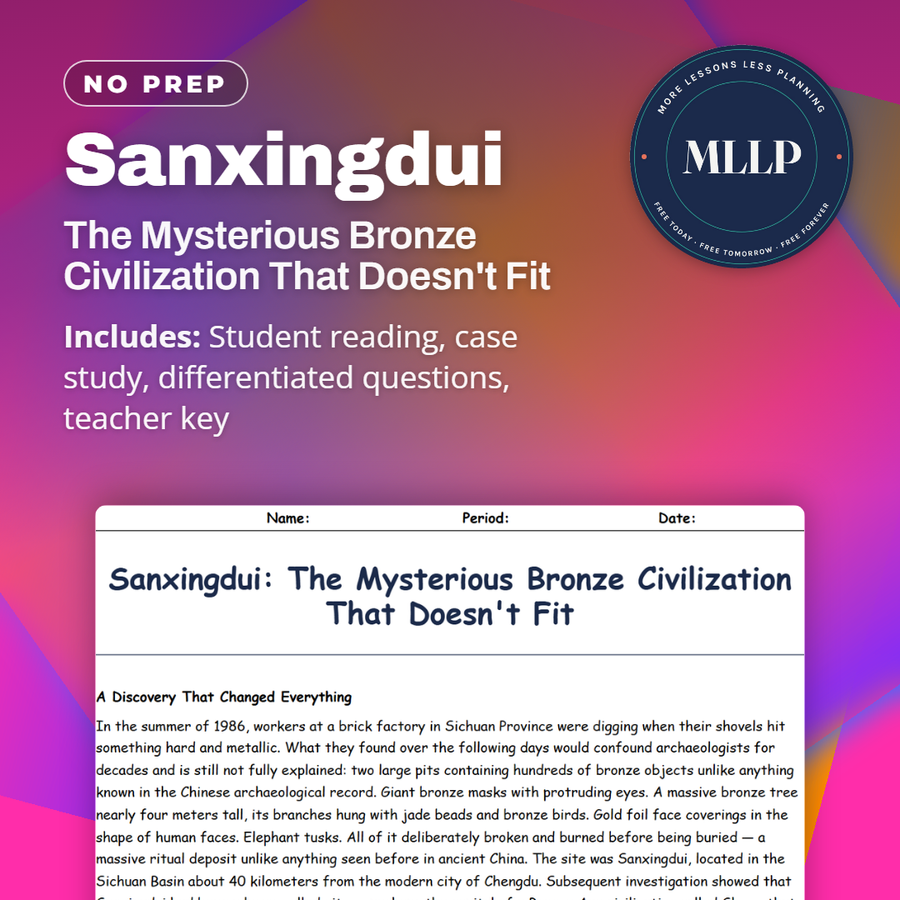
Sanxingdui: The Mysterious Bronze Civilization That Doesn't Fit
Quality reviewed September 2026
Facts verified September 21, 2026
- Subject
- Social Studies
- Grades
- Grades 9-12
- Length
- 9-page student worksheet
- Time
- About one 50-minute class period
- Great for
- Sub plans and independent work
- Includes
- Reading passage, comprehension questions + full answer key
- Format
- Print-and-go PDF
What students do
- Workers at a brick factory hit bronze in 1986 and uncovered a civilization no one had named before
- Match Sanxingdui's bronze objects to what archaeologists think each one was for
- The bronze masks have eyes that stick out 16 centimeters, and nothing like them exists anywhere else
- Explain why new pits found in 2019 and 2020 changed what scholars thought they knew
What it covers
- The bronze masks, sacred tree, and other objects found at Sanxingdui in 1986
- Why Sanxingdui does not match any known Shang or Chinese cultural pattern
- What the 2019 and 2020 pits revealed about contact with the Shang
Start reading this worksheet
A Discovery That Changed Everything
In the summer of 1986, workers at a brick factory in Sichuan Province were digging when their shovels hit something hard and metallic. What they found over the following days would confound archaeologists for decades and is still not fully explained: two large pits containing hundreds of bronze objects unlike anything known in the Chinese archaeological record. Giant bronze masks with protruding eyes. A massive bronze tree nearly four meters tall, its branches hung with jade beads and bronze birds. Gold foil face coverings in the shape of human faces. Elephant tusks. All of it deliberately broken and burned before being buried, a massive ritual deposit unlike anything seen before in ancient China. The site was Sanxingdui, located in the Sichuan Basin about 40 kilometers from the modern city of Chengdu. Subsequent investigation showed that Sanxingdui had been a large walled city (perhaps the capital of a Bronze Age civilization called Shu) that flourished roughly between 1700 and 1100 BCE, overlapping with the Shang Dynasty in northern China. But while the Shang left oracle bones, ritual bronze vessels, and a recognizable cultural vocabulary, Sanxingdui left objects that match nothing in the Shang or any other known Chinese culture. It was, in short, a civilization that had been completely unknown until workers accidentally drove shovels through it.
The Bronze Masks: What Were They For?
The most striking objects from Sanxingdui are the bronze masks and heads. Some have enormous eyes that protrude as much as 16 centimeters from the face: a feature so distinctive that no parallel exists in any other ancient culture anywhere in the world. The largest bronze head recovered from the pits stands 65 centimeters tall and weighs 8 kilograms; the largest mask is nearly 140 centimeters wide and weighs 180 kilograms. The technical skill required to cast these objects was extraordinary, comparable to the best Shang bronzework, but in an entirely different artistic style. What were these objects for? Archaeologists have proposed several theories. The masks may have been ritual objects used in ceremonies involving communication with supernatural beings. The protruding eyes might represent divine sight or the ability to see things invisible to ordinary humans. Some researchers have suggested the eyes represent the sun, a solar deity worshipped by the Shu people. Others have proposed they were mounted on wooden statues that have since decayed. Without written records from Sanxingdui (and there are none), these questions may never be definitively answered.
The Bronze Sacred Tree
Among the most remarkable objects recovered from Sanxingdui is a massive bronze tree, reconstructed from hundreds of fragments to stand nearly four meters tall. Its trunk rises from a base decorated with dragons, and its branches hold 27 bronze fruits and birds. At the top, a stylized bird (possibly a sun-bird or divine messenger) perches on a platform. A dragon coils down one side of the trunk. This 'sacred tree' resonates with ancient Chinese mythological traditions about trees connecting heaven, earth, and the underworld. The Shu region has its own mythological tradition recorded much later in texts, featuring a divine figure called Cancong (described as having protruding eyes) who was the first king of Shu. Whether the Sanxingdui masks represent Cancong or another supernatural figure, their connection to these later myths suggests a cultural memory reaching back to the Bronze Age, even if the specific meanings changed over the centuries.
Like what you read? The full reading, the case study, and every question set are in the free download below, along with the answer key.
Why this matters
Sanxingdui forces a rethink of a story students often absorb without noticing, that one river valley or one capital city explains an entire ancient civilization. The reading shows that a whole Bronze Age culture with sophisticated metalworking sat undiscovered in the Sichuan Basin for over 3,000 years, invisible to historians simply because no survey had reached it and no text described it. That gap is worth sitting with, since it means huge pieces of human history can be sitting under a field somewhere right now, and it gives students a real reason to question any account of the past that claims to be complete.
From one teacher to another
Workers at a brick factory in Sichuan Province hit bronze with their shovels in 1986 and opened two pits packed with objects that match nothing else in the Chinese archaeological record. Students read about the bronze masks with eyes that protrude as far as 16 centimeters, a nearly four meter bronze tree hung with birds and jade beads, and a walled city that may have belonged to a civilization called Shu, one that left no writing behind at all. The reading also covers six new pits found in 2019 and 2020 that contained objects blending Sanxingdui's own style with motifs recognizably from the Shang, hinting that the two very different cultures were somehow in contact. A case study follows an archaeologist named Dr. Chen as she tries to make sense of an altar that does not fit either tradition cleanly.
What you get
Download
Where should I send the next one?
Everything here is free and it stays that way. Leave your email and I'll send you the new lessons as they go up. You can unsubscribe from any one of them.
Related resources
Ancient China: An Overview of Dynasties, Power, and the Archaeological Record
Ancient Chinese Inventions: What Archaeology Proves
Han Dynasty Tombs: Buried Treasure and Beliefs About the Afterlife
Oracle Bones: Fortune-Telling That Became History
The Great Wall: Myth vs. Archaeological Reality
The Shang Dynasty: Bronze, Power, and Ritual
Every lesson on this site is free to download and use. If one of them saved you a prep period, you can chip in a few bucks toward my three kids' daycare fund. That's genuinely where tips go.