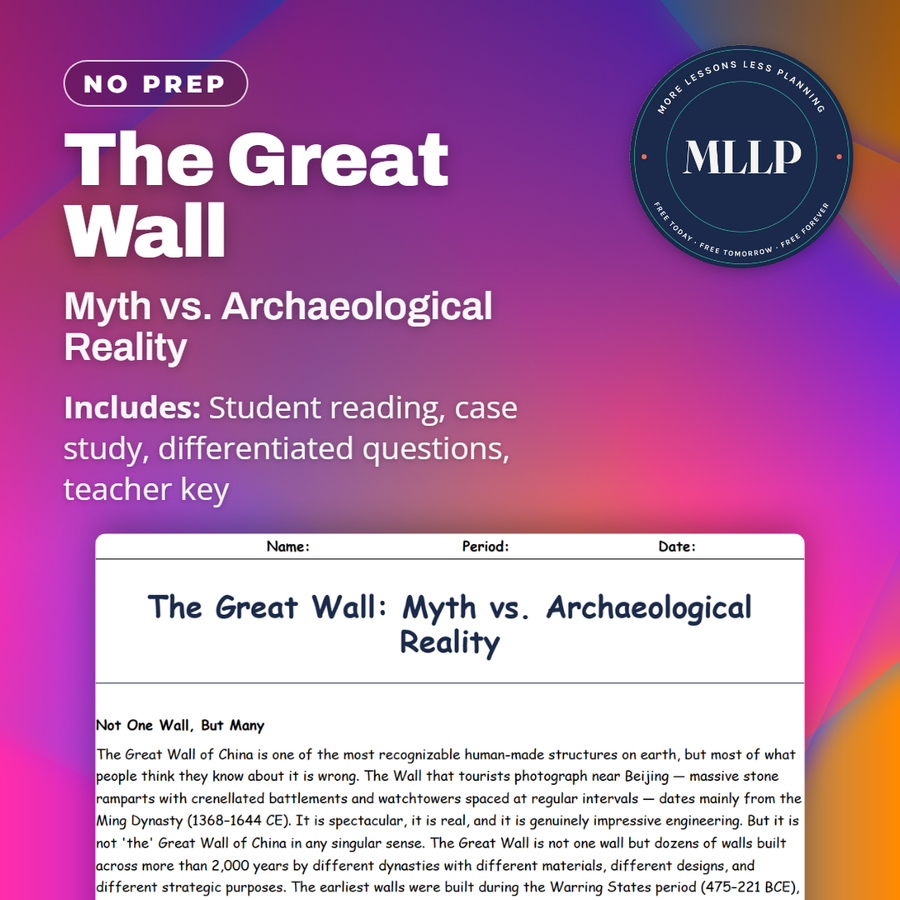
The Great Wall: Myth vs. Archaeological Reality
Quality reviewed September 2026
Facts verified September 21, 2026
- Subject
- Social Studies
- Grades
- Grades 9-12
- Length
- 9-page student worksheet
- Time
- About one 50-minute class period
- Great for
- Sub plans and independent work
- Includes
- Reading passage, comprehension questions + full answer key
- Format
- Print-and-go PDF
What students do
- Most people picture one continuous wall, but the reading breaks down at least three separate versions
- Sort wall sections by dynasty and by whether they were built from rammed earth, brick, or stone
- A soldier's undelivered letter, still legible after 2,100 years, describes frontier boredom and cold
- Answer questions on what LiDAR survey revealed about the wall's true length
What it covers
- The separate Qin, Han, and Ming wall projects and what each was built from
- Skeletal remains and Han wooden tablets that reveal the human cost of construction
- How LiDAR survey found the wall's real length and its border checkpoint function
Start reading this worksheet
Not One Wall, But Many
The Great Wall of China is one of the most recognizable human-made structures on earth, but most of what people think they know about it is wrong. The Wall that tourists photograph near Beijing (massive stone ramparts with crenellated battlements and watchtowers spaced at regular intervals) dates mainly from the Ming Dynasty (1368–1644 CE). It is spectacular, it is real, and it is genuinely impressive engineering. But it is not 'the' Great Wall of China in any singular sense. The Great Wall is not one wall but dozens of walls built across more than 2,000 years by different dynasties with different materials, different designs, and different strategic purposes. The earliest walls were built during the Warring States period (475–221 BCE), when rival Chinese kingdoms constructed defensive barriers against each other and against nomadic peoples from the north. When Qin Shi Huang unified China in 221 BCE, he ordered his general Meng Tian to connect and extend these existing walls into a single continuous barrier along the northern frontier. This Qin-era wall was not made of stone but of rammed earth: soil pounded into wooden frames until it was as hard as concrete. Little of it survives today because rammed earth erodes far more easily than stone, but archaeological survey has traced its course across thousands of kilometers of northern China.
Construction: What It Actually Took
Building the Qin wall required conscripted labor on a massive scale. Historical records suggest that as many as 300,000 soldiers and 500,000 civilian laborers worked on the project, drawn from across China's newly unified territory. Workers in northern China were building through extreme conditions: scorching summers, freezing winters, and difficult terrain ranging from desert to mountain. Ancient texts record that so many workers died during construction that the wall was sometimes called 'the longest cemetery on earth.' Archaeological excavations along the wall's course have recovered skeletal remains of workers buried in or near the wall itself, confirming these accounts. Some remains show evidence of trauma consistent with hard labor: worn joints, healed fractures, nutritional deficiencies. Archaeologists have also found worker camps, supply depots, and logistical infrastructure that reveal the organizational sophistication required to feed and equip hundreds of thousands of workers spread across thousands of kilometers of difficult terrain.
Han Expansion and the Silk Road Connection
The Han Dynasty (206 BCE–220 CE) extended the wall westward into Central Asia along the lines of what would become the Silk Road, creating a fortified corridor through the Gobi Desert. These Han-era sections were again built of rammed earth, sometimes reinforced with layers of tamarisk branches and reeds that acted as internal reinforcement, a desert-adapted building technique. Han garrison sites along the wall have yielded remarkable finds: wooden tablets recording supply requests, personal letters, military orders, and even complaints from soldiers about the cold and the boredom of frontier duty. These Han wooden tablets are among the most humanizing documents from ancient China. Unlike official court histories that record kings and battles, the tablets record the mundane reality of ordinary soldiers' lives: requests for additional wool clothing, notes about horses that had gone lame, lists of rations received and supplies needed. They tell us that the wall was not an abstract military project but a lived human experience. It was often uncomfortable, sometimes dangerous, and frequently very dull.
Like what you read? The full reading, the case study, and every question set are in the free download below, along with the answer key.
Why this matters
The wall's real story is less about keeping people out and more about managing who and what crossed a border, taxing legal trade while making illegal crossing harder, which is a version of border policy still argued about today. The soldiers' letters recovered from Han garrisons also matter because they are personal complaints about cold, boredom, and missing supplies rather than official military reports, giving students access to what ordinary frontier life actually felt like instead of only what emperors wanted remembered. Comparing what official histories chose to record against what archaeology dug up gives students a habit worth keeping for any historical source they read from now on.
From one teacher to another
Say Great Wall and almost everyone pictures the brick and stone rampart near Beijing, but that section is Ming Dynasty work, and it is only one of dozens of walls built across more than 2,000 years by different rulers with different materials. Students read about the Qin version, made of rammed earth and built by hundreds of thousands of conscripted laborers under conditions harsh enough that ancient texts called it the longest cemetery on earth, and the Han extension into Central Asia, where garrison sites preserved wooden tablets full of soldiers' actual complaints about the cold. The reading closes with modern LiDAR survey, which found the wall's true combined length runs past 21,000 kilometers and functioned less like a solid barrier and more like a border checkpoint controlling trade. A case study follows a soldier named Zheng Chong writing a letter home that never got delivered.
What you get
Download
Where should I send the next one?
Everything here is free and it stays that way. Leave your email and I'll send you the new lessons as they go up. You can unsubscribe from any one of them.
Related resources
Ancient China: An Overview of Dynasties, Power, and the Archaeological Record
Ancient Chinese Inventions: What Archaeology Proves

Han Dynasty Tombs: Buried Treasure and Beliefs About the Afterlife

Oracle Bones: Fortune-Telling That Became History
Sanxingdui: The Mysterious Bronze Civilization That Doesn't Fit
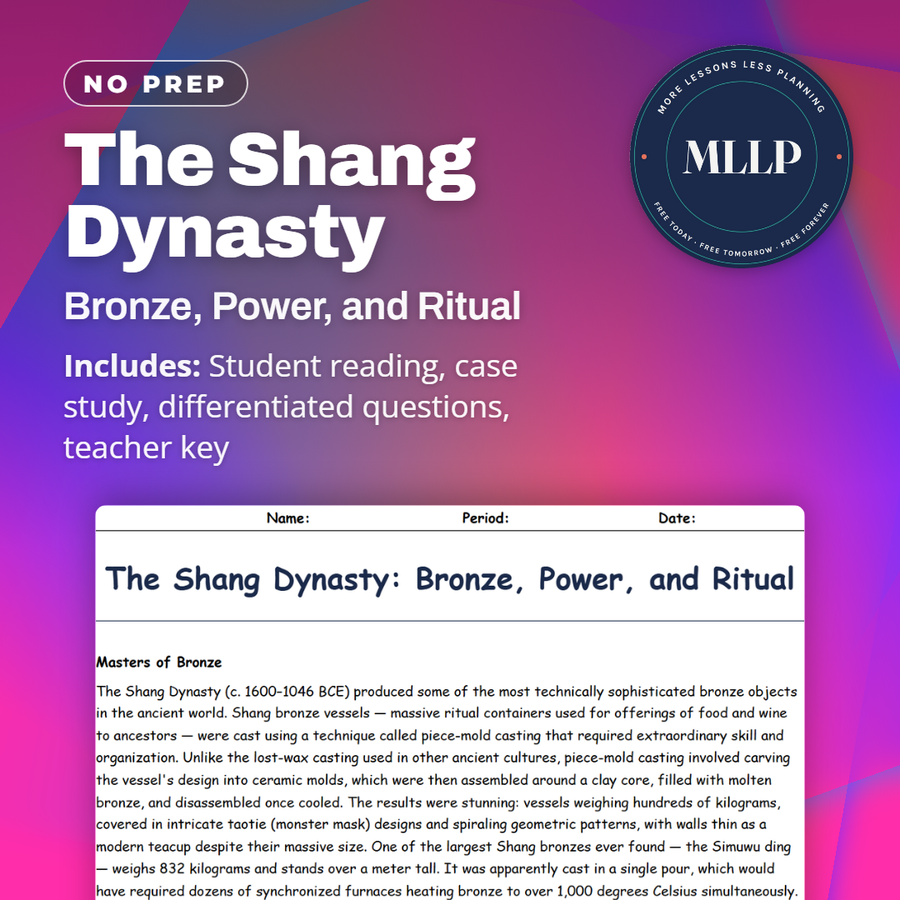
The Shang Dynasty: Bronze, Power, and Ritual
Every lesson on this site is free to download and use. If one of them saved you a prep period, you can chip in a few bucks toward my three kids' daycare fund. That's genuinely where tips go.