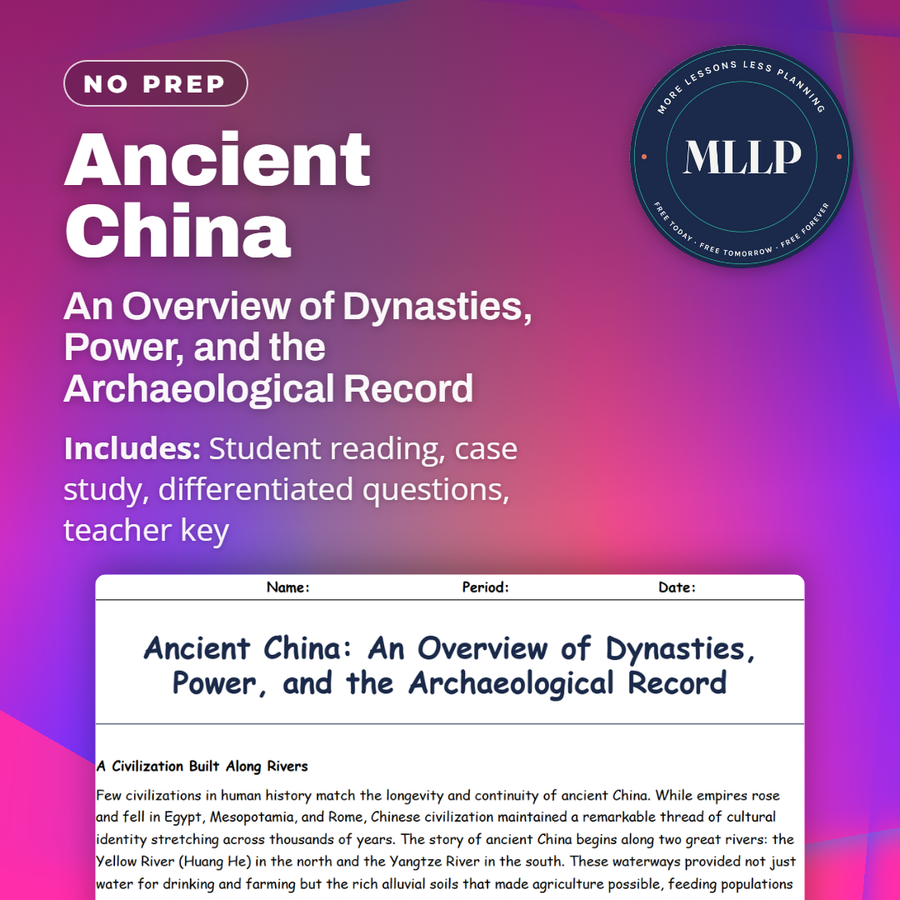
Ancient China: An Overview of Dynasties, Power, and the Archaeological Record
Quality reviewed September 2026
Facts verified September 21, 2026
- Subject
- Social Studies
- Grades
- Grades 9-12
- Length
- 9-page student worksheet
- Time
- About one 50-minute class period
- Great for
- Sub plans and independent work
- Includes
- Reading passage, comprehension questions + full answer key
- Format
- Print-and-go PDF
What students do
- The Mandate of Heaven explains why a flood or a lost battle could mean a dynasty had lost its right to rule
- Match the dynastic cycle, the oracle bone, and the Yellow River to what each one meant to Chinese rulers
- Farmer Wei Zhongyi's well digging near Lintong turns into the discovery that opens the case study
- Answer questions on why Chinese court texts and archaeological finds do not always agree
What it covers
- The Mandate of Heaven and the dynastic cycle that repeats through Chinese history
- Why excavations at Anyang and Mawangdui sometimes contradict the official written record
- The 1974 well-digging discovery that led to the Terracotta Army
Start reading this worksheet
A Civilization Built Along Rivers
Few civilizations in human history match the longevity and continuity of ancient China. While empires rose and fell in Egypt, Mesopotamia, and Rome, Chinese civilization maintained a remarkable thread of cultural identity stretching across thousands of years. The story of ancient China begins along two great rivers: the Yellow River (Huang He) in the north and the Yangtze River in the south. These waterways provided not just water for drinking and farming but the rich alluvial soils that made agriculture possible, feeding populations large enough to build some of the ancient world's most impressive structures. The Yellow River region is often called the 'Cradle of Chinese Civilization' because some of the earliest Chinese settlements appeared there around 5000 BCE. The people of the Yangshao and Longshan cultures farmed millet, kept pigs, and created distinctive painted pottery long before the first recognized Chinese dynasty appeared. By around 1600 BCE, the Shang Dynasty had emerged: the first Chinese dynasty that archaeologists can confirm through both written records and physical evidence. Shang bronze vessels, oracle bones, and city remains give us our earliest clear picture of organized Chinese society.
The Dynastic Cycle and the Mandate of Heaven
To understand Chinese history, you must understand the Mandate of Heaven, the belief that the gods granted rulers the right to govern, but could withdraw that right if a ruler became corrupt or incompetent. When floods, famines, or military defeats struck, people interpreted them as signs that a dynasty had lost the Mandate of Heaven. This provided a philosophical explanation for the recurring cycle of Chinese history: a dynasty rises, rules effectively for generations, grows corrupt, collapses, and is replaced by a new dynasty that claims the Mandate for itself. This pattern (called the dynastic cycle) shaped more than 2,000 years of Chinese history. Major dynasties followed one after another: Shang (c. 1600–1046 BCE), Zhou (1046–256 BCE), Qin (221–206 BCE), Han (206 BCE–220 CE), and many more that followed. Each dynasty left its own archaeological signature: different ceramic styles, different architectural forms, different burial traditions. For archaeologists, tracking these changes across time and space is like reading chapters in a very long book about how one of history's greatest civilizations evolved.
What Archaeology Has Revealed About Ancient China
For much of the 20th century, Western historians relied mainly on ancient Chinese texts to understand Chinese history. The problem is that texts written by scholars serving an emperor's court often glorified the ruling dynasty and omitted or distorted inconvenient facts. Archaeology has added a crucial corrective layer. Excavations at Anyang, the last Shang capital, revealed massive royal tombs, evidence of ritual sacrifice, and tens of thousands of oracle bones that let us read actual Shang-era writing for the first time. The discovery of the Terracotta Army in 1974 showed the world a side of Qin Shi Huang's tomb complex that no text had fully described. Excavations of Han Dynasty tombs like Mawangdui have produced preserved bodies, silk manuscripts, and lacquered objects of extraordinary quality. These finds do not just confirm what written sources say. They frequently challenge or complicate the official version of events. The woman buried at Mawangdui, for example, was preserved in a way that revealed details about her diet, health, and even her ailments that no historian had recorded.
Like what you read? The full reading, the case study, and every question set are in the free download below, along with the answer key.
Why this matters
China's government treats its ancient sites as proof of an unbroken national story, which is why the reading spends real time on the tension between wanting fast, headline-ready discoveries and doing careful science. That same pull between pride and patience shows up whenever any country, including ours, decides how to fund and publicize its own history. Comparing China's solutions, a Mandate of Heaven instead of a Roman senate, a dynastic cycle instead of a slow decline, to how Egypt or Rome explained their own rulers gives students a concrete way to see that every civilization answers the same basic questions about power in its own way.
From one teacher to another
Ancient China's written histories were composed by scholars serving the very emperors they wrote about, so the reading pairs those court records against what archaeologists actually dug out of the ground. Students trace the Mandate of Heaven, the belief that floods, famines, and lost battles could mean the gods had withdrawn their approval from a ruling family, and see how that idea powered the rise and fall of the Shang, Zhou, Qin, and Han dynasties. The reading covers the oracle bones and royal tombs found at Anyang, the preserved body and silk manuscripts from the Mawangdui tomb, and the well-digging accident near Lintong that turned into one of the biggest archaeological finds in history. A short case study follows a farmer named Wei Zhongyi through the morning his shovel hit something that was not rock.
What you get
Download
Where should I send the next one?
Everything here is free and it stays that way. Leave your email and I'll send you the new lessons as they go up. You can unsubscribe from any one of them.
Related resources
Ancient Chinese Inventions: What Archaeology Proves
Han Dynasty Tombs: Buried Treasure and Beliefs About the Afterlife
Oracle Bones: Fortune-Telling That Became History
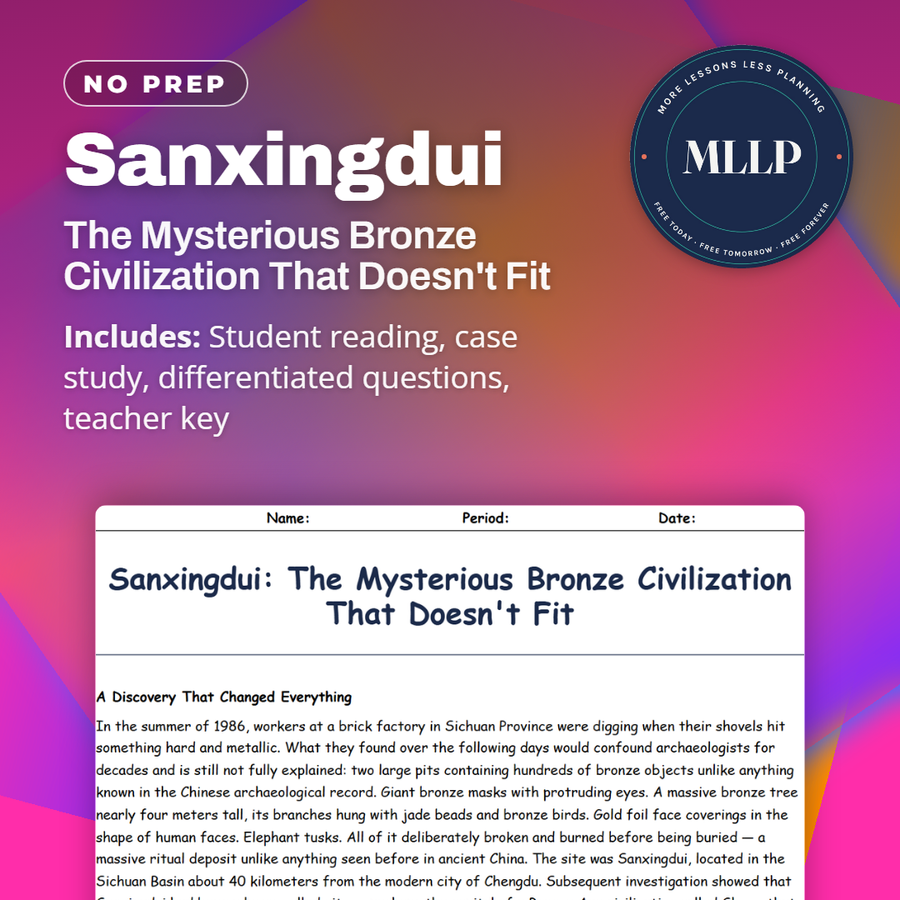
Sanxingdui: The Mysterious Bronze Civilization That Doesn't Fit
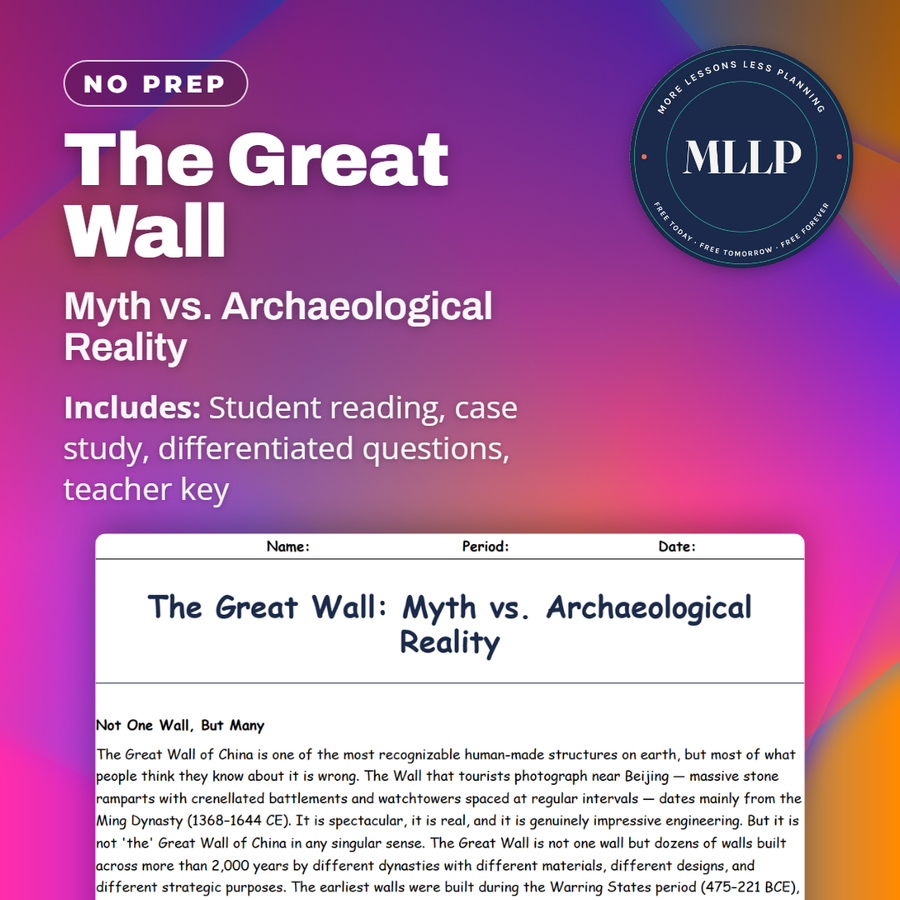
The Great Wall: Myth vs. Archaeological Reality
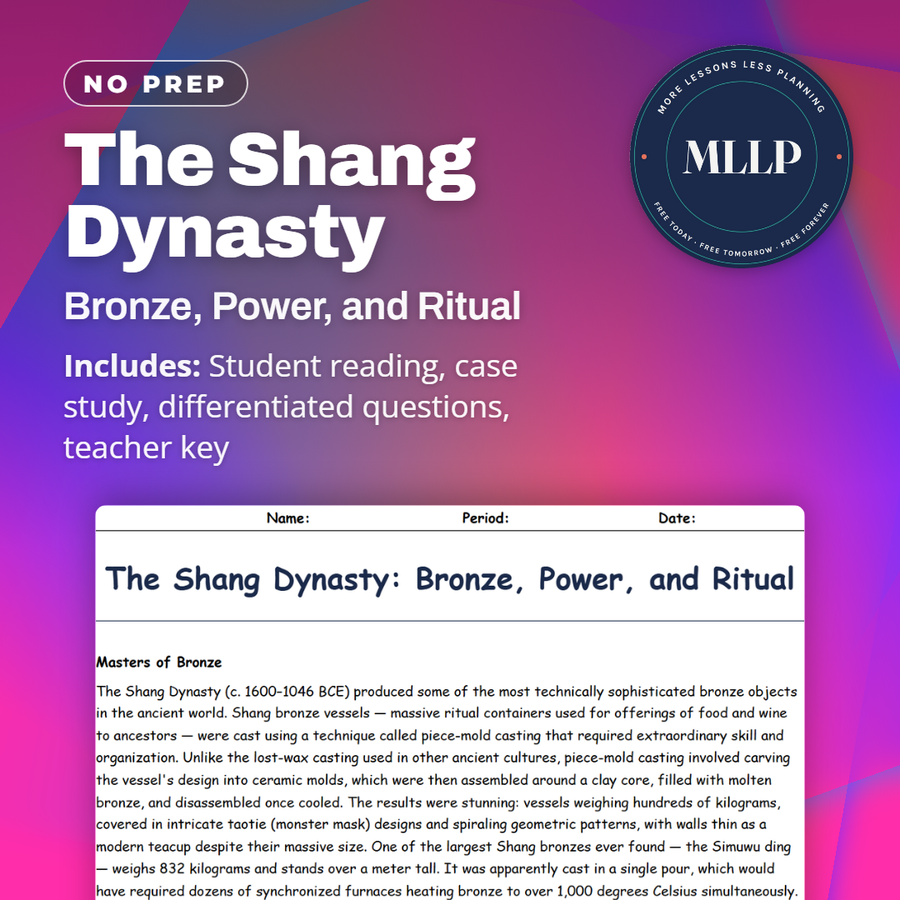
The Shang Dynasty: Bronze, Power, and Ritual
Every lesson on this site is free to download and use. If one of them saved you a prep period, you can chip in a few bucks toward my three kids' daycare fund. That's genuinely where tips go.