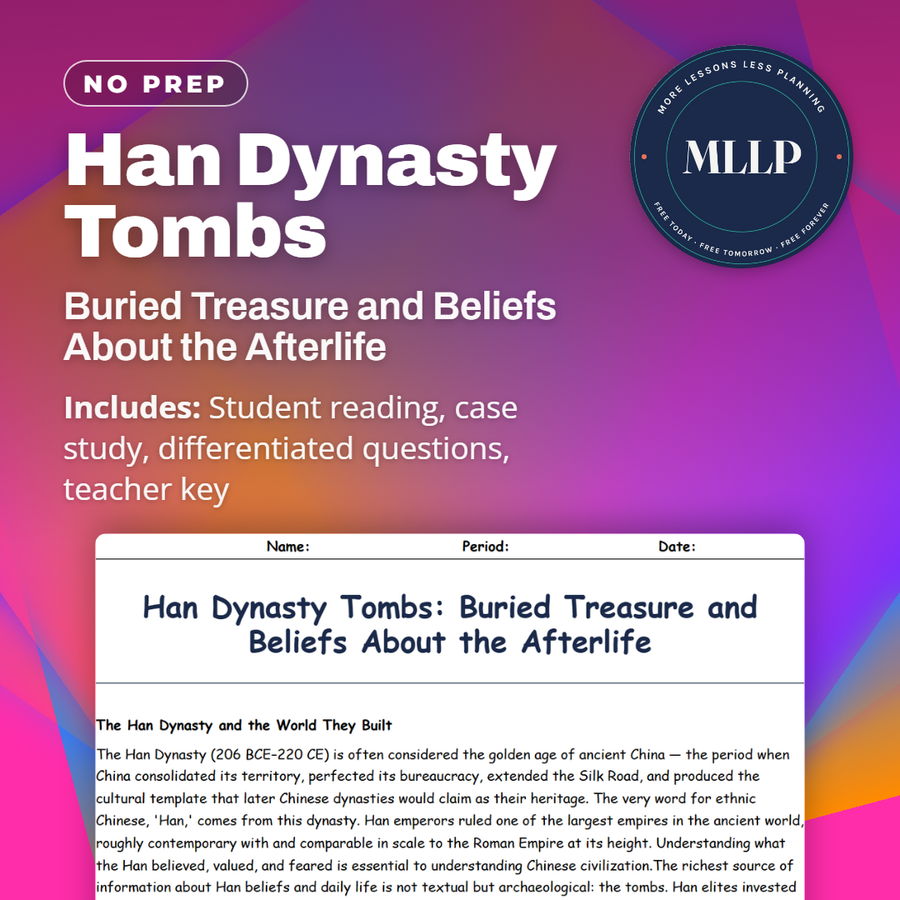
Han Dynasty Tombs: Buried Treasure and Beliefs About the Afterlife
Quality reviewed September 2026
Facts verified September 21, 2026
- Subject
- Social Studies
- Grades
- Grades 9-12
- Length
- 9-page student worksheet
- Time
- About one 50-minute class period
- Great for
- Sub plans and independent work
- Includes
- Reading passage, comprehension questions + full answer key
- Format
- Print-and-go PDF
What students do
- Jade burial suits were supposed to stop a body from decaying, and the reading explains why that belief mattered even though it failed
- Trace what the ceramic models called mingqi reveal about an ordinary wealthy Han household
- Lady Dai's autopsy turned up a bad heart, parasites, and a last meal of melon
- Write short answers connecting Han burial beliefs to what archaeologists actually found in the ground
What it covers
- Why jade burial suits failed at preservation but still tell us about Han beliefs
- What ceramic tomb models called mingqi reveal about daily Han life
- The 1972 discovery of Lady Dai's remarkably preserved body at Mawangdui
Start reading this worksheet
The Han Dynasty and the World They Built
The Han Dynasty (206 BCE–220 CE) is often considered the golden age of ancient China: the period when China consolidated its territory, perfected its bureaucracy, extended the Silk Road, and produced the cultural template that later Chinese dynasties would claim as their heritage. The very word for ethnic Chinese, 'Han,' comes from this dynasty. Han emperors ruled one of the largest empires in the ancient world, roughly contemporary with and comparable in scale to the Roman Empire at its height. Understanding what the Han believed, valued, and feared is essential to understanding Chinese civilization.The richest source of information about Han beliefs and daily life is not textual but archaeological: the tombs. Han elites invested enormous resources in constructing and furnishing their tombs because they believed the afterlife was a direct continuation of earthly life. A high official expected to maintain his status, enjoy his favorite foods, be served by his household staff, and continue using his possessions after death. This belief system, sometimes called 'the cult of the dead' by scholars, drove the production of extraordinary funerary objects that now fill the museums of China.
Jade Suits: A Literal Suit of Armor Against Death
The most visually striking Han funerary objects are the jade burial suits: full-body garments made from thousands of small jade tablets sewn together with wire. The ancient Chinese believed jade had preservative properties: that a body encased in jade would not decay and the soul would not escape. The wire holding the tablets together was made of gold (for members of the royal family), silver (for princes and high nobles), or bronze (for lower-ranking nobles). Constructing a single jade suit required thousands of jade tablets, each carefully shaped, drilled, and polished. This was a project that could take an army of craftsmen years to complete. When archaeologists opened Han tombs containing jade suits, they found something disheartening: the bodies inside had decayed completely despite the jade. The preservation theory simply didn't work. But the failure of the practice doesn't diminish its cultural significance: it shows us that the Han believed it would work, invested enormous resources based on that belief, and organized their entire funerary industry around it. The suits themselves, whatever their practical effect, are stunning works of craftsmanship that tell us about Han beliefs, technology, and wealth.
Tomb Models: A Miniature World
Alongside jade suits, Han tombs typically contained elaborate models of everything the deceased would need in the afterlife: ceramic houses complete with courtyards and servants, models of granaries, pigsties, duck ponds, and watchtowers, ceramic entertainers frozen in mid-dance, ceramic cooks preparing food, and ceramic soldiers standing guard. These mingqi ('spirit vessels') gave archaeologists something the written record rarely provides: a detailed picture of what an ordinary wealthy Han household looked like, complete with its farm buildings, animals, and domestic staff. The models are so detailed that archaeologists can identify the specific species of pigs being raised, the design of Han kitchens, the style of Han musical instruments, and the varieties of food the elite ate. One tomb model even shows a multistory watchtower with guards peering from the top, the kind of private security installation that tells us something about the anxiety wealthy Han families felt about social instability. Taken together, the mingqi from thousands of Han tombs form an accidental encyclopedia of daily life in one of history's great civilizations.
Like what you read? The full reading, the case study, and every question set are in the free download below, along with the answer key.
Why this matters
Han families spent fortunes preparing for an afterlife that mirrored their earthly one, which raises a question students can apply well beyond ancient China, how much a culture is willing to spend on ritual and status even when the practical benefit is questionable. Lady Dai's autopsy also turns a 2,000 year old burial into a real medical record, showing that heart disease and parasites affected even the wealthiest people in the ancient world, not only modern populations with modern diets. That combination of belief, wealth, and biology gives students a way to think about what any society, including their own, chooses to bury with its dead and why.
From one teacher to another
Han elites believed the afterlife was simply their earthly life continued, so they buried themselves with everything a household would need to keep functioning after death. Students read about jade burial suits stitched together from thousands of tablets, supposedly able to stop a body from decaying, and the ceramic models called mingqi that recreated a wealthy family's house, servants, animals, and even a watchtower with guards on top. The centerpiece is Mawangdui, the tomb complex near Changsha where archaeologists opened Lady Dai's coffin in 1972 and found a body so well preserved that doctors could examine her organs and diagnose the disease she died with. A case study follows an artisan named Liu Ban as he fills a rich family's order for tomb figures.
What you get
Download
Where should I send the next one?
Everything here is free and it stays that way. Leave your email and I'll send you the new lessons as they go up. You can unsubscribe from any one of them.
Related resources
Ancient China: An Overview of Dynasties, Power, and the Archaeological Record
Ancient Chinese Inventions: What Archaeology Proves
Oracle Bones: Fortune-Telling That Became History
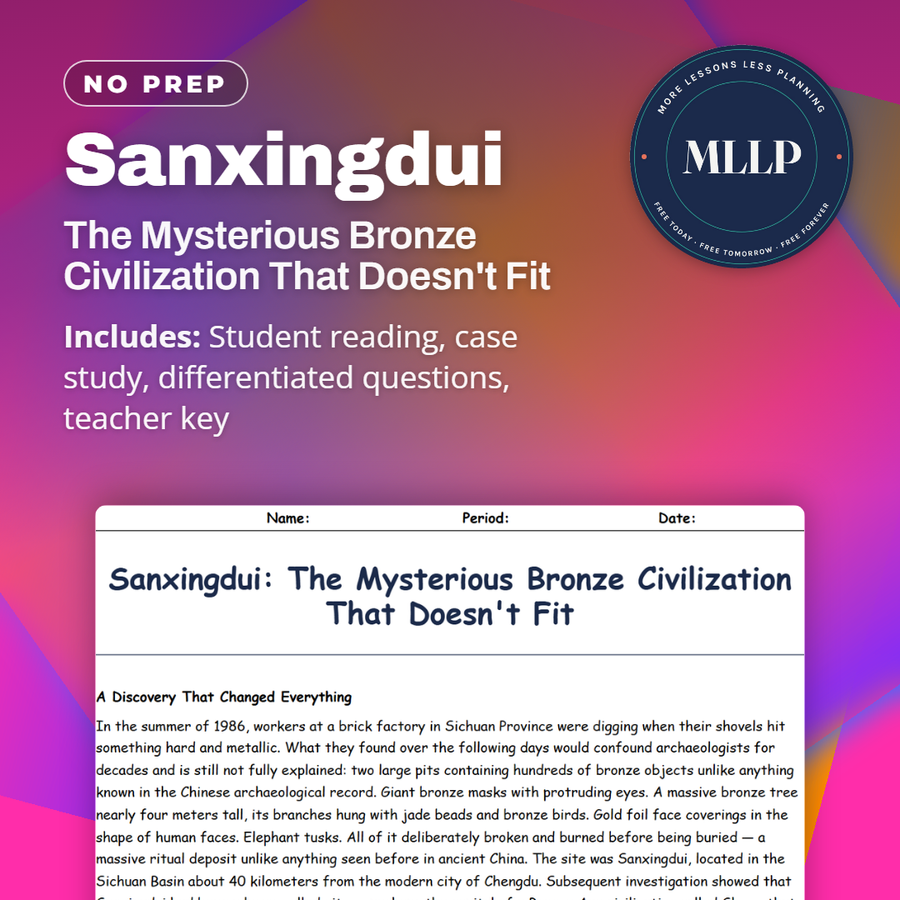
Sanxingdui: The Mysterious Bronze Civilization That Doesn't Fit
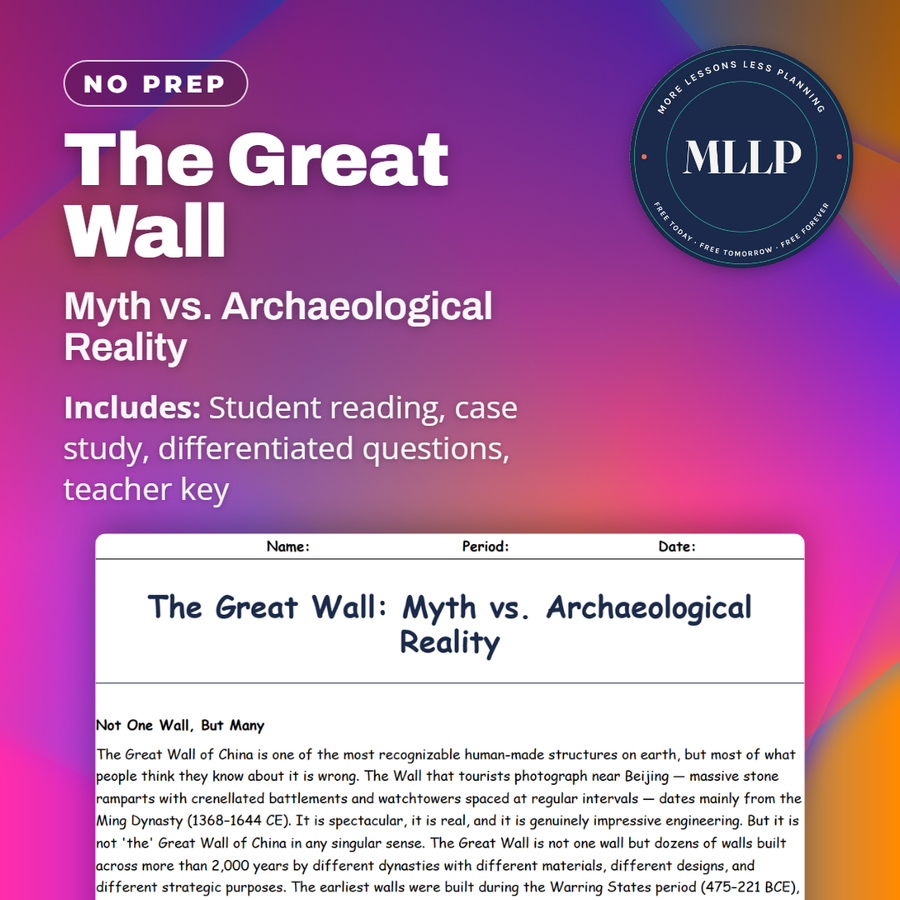
The Great Wall: Myth vs. Archaeological Reality
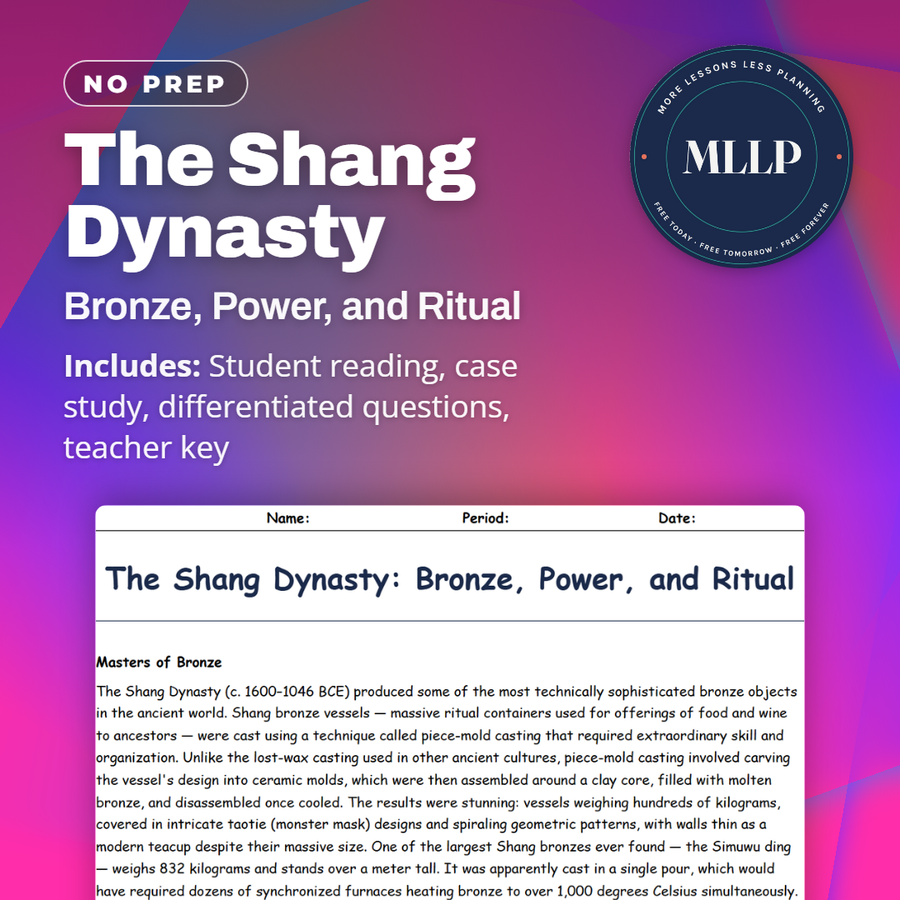
The Shang Dynasty: Bronze, Power, and Ritual
Every lesson on this site is free to download and use. If one of them saved you a prep period, you can chip in a few bucks toward my three kids' daycare fund. That's genuinely where tips go.