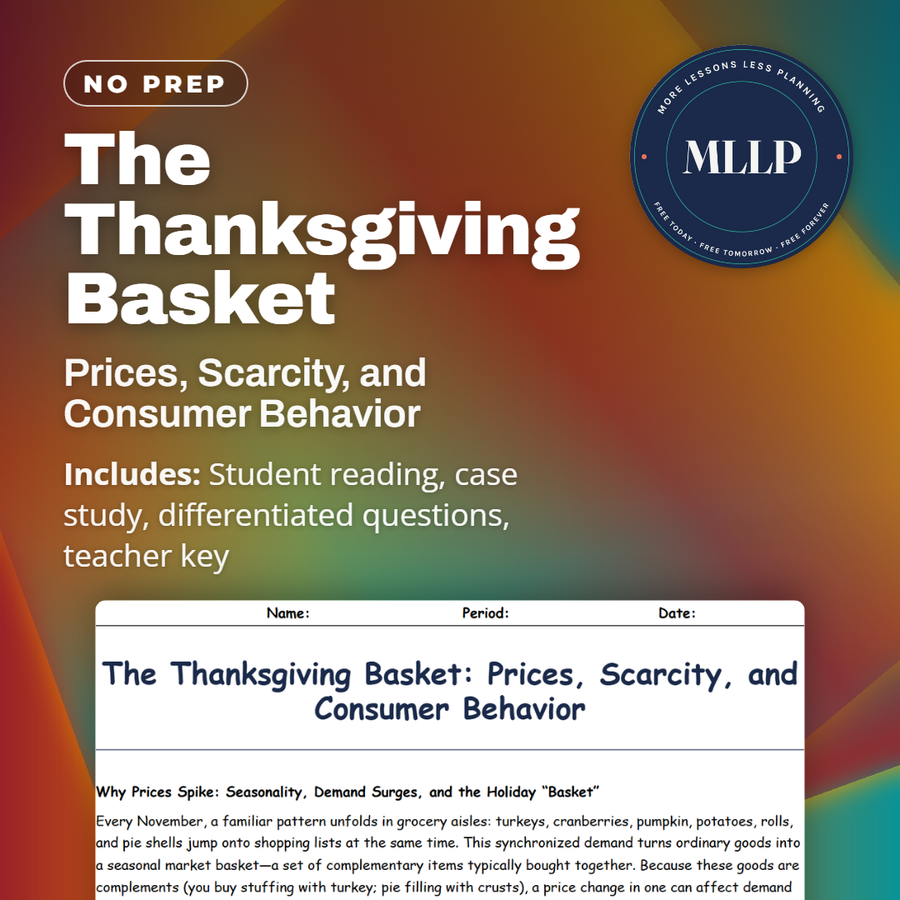
The Thanksgiving Basket: Prices, Scarcity, and Consumer Behavior
Quality reviewed September 2026
Facts verified September 9, 2026
- Subject
- Career & Life Skills
- Grades
- Grades 9-12
- Length
- 9-page student worksheet
- Time
- About one 50-minute class period
- Great for
- Sub plans and independent work
- Includes
- Reading passage, comprehension questions + full answer key
- Format
- Print-and-go PDF
What students do
- Apply price elasticity and loss-leader strategy to holiday baskets
- Identify how anchoring, loss aversion, and choice architecture shape spending
- Use unit-price comparison and substitution planning to control costs
- Analyze weather and transportation shocks on localized supply and prices
What it covers
- Seasonal demand surges and complementary goods
- Inelastic demand, scarcity, and reservation prices
- Anchoring, loss aversion, and behavioral nudges in retail
Start reading this worksheet
Why Prices Spike: Seasonality, Demand Surges, and the Holiday “Basket”
Every November, a familiar pattern unfolds in grocery aisles: turkeys, cranberries, pumpkin, potatoes, rolls, and pie shells jump onto shopping lists at the same time. This synchronized demand turns ordinary goods into a seasonal market basket: a set of complementary items typically bought together. Because these goods are complements (you buy stuffing with turkey; pie filling with crusts), a price change in one can affect demand for the others. The surge is predictable, but the market still feels tight because capacity (from farm output to cold storage and truck routes) can’t instantly expand. Even if producers anticipate the season, they must make decisions months in advance about flock size, planting acreage, and processing schedules. Retailers respond with classic pricing strategies. Some offer a “loss leader” turkey (priced very low) to attract shoppers who will buy the rest of the basket at normal margins. Others bundle savings (for example, “Spend $50 and get a turkey for 99 cents per pound”), using bundling to lift the average transaction. Meanwhile, consumers compare unit prices (the per-pound or per-ounce cost) hoping to stretch budgets. Yet the intense time window compresses competition: families don’t want to drive to five stores the day before Thanksgiving. That makes the reservation price (the most you’re willing to pay) rise under time pressure. Add in stockouts (empty shelves for a single key item), and even patient shoppers may pay more for substitutes or higher-end brands. The result is a brief but powerful shift in market equilibrium, with higher quantity demanded colliding with constrained short-run supply.
Scarcity, Elasticity, and Substitutes in a Holiday Market
In textbook terms, price elasticity of demand measures how sensitive quantity demanded is to a price change. For many Thanksgiving staples, short-run demand is relatively inelastic: even if the price of turkey or cranberries nudges up, families often buy them anyway because the holiday ritual matters. Inelastic demand lets retailers hold margins, except where competition is fierce or a chain deliberately uses doorbuster prices. For more peripheral items, such as sparkling drinks and specialty cheeses, demand can be more elastic, and shoppers switch to substitutes easily. Scarcity can be real (a poor cranberry harvest) or perceived (social media rumors about turkey shortages). Either way, if shoppers expect scarcity, they may buy early or hoard, pulling demand forward and tightening supply later. The presence of good substitutes moderates price spikes: if sweet potatoes substitute for potatoes, or chicken for turkey in some households, the pressure eases. But some items feel “non-negotiable,” making them closer to necessities in context. On the cost side, farms face input prices, such as feed, fuel, and fertilizer, that can shift supply curves left or right. Transportation costs matter too: even when fields are abundant, a bottleneck in trucking or cold-chain logistics can make store prices jump. Finally, leftover inventory risk pushes suppliers to be cautious. Overproduce and you eat losses; underproduce and you leave money (and holiday goodwill) on the table. The equilibrium that emerges is a product of biology, logistics, psychology, and calendars, not just a simple price tag.
Behavioral Economics in the Aisle: Anchors, Loss Aversion, and the Race for Deals
Holiday shopping is a perfect lab for behavioral economics. First, anchoring: the first price you see (say, “$1.99/lb for turkey”) becomes a reference point, shaping what feels like a “deal.” Ads exploit this by presenting a high suggested retail and a dramatic markdown, even if another store quietly offers a lower everyday price. Second, loss aversion: people dislike losses more than they like equivalent gains, so missing the “best price” feels painful. This motivates doorbuster lines and rapid decisions, sometimes at the expense of careful unit price comparisons. Third, present bias and time pressure: when a recipe calls for heavy cream and the shelf is nearly empty, the “future me” who could comparison-shop tomorrow loses to the “now me” who pays more to avoid anxiety. Retailers also use choice architecture, such as endcap displays, limited-time signage, and “only 3 left” tags, to heighten urgency. Loyalty programs can obscure per-unit costs with point multipliers, making it harder to compare across stores. Meanwhile, households try tactics of their own: buying private labels, splitting bulk packs, or planning menus around substitutes (roasted vegetables instead of a second pie). All of these micro-decisions affect consumer surplus: the difference between what a shopper would have paid and what they actually pay. Educated consumers improve outcomes by setting a budget in advance, reading unit labels, and watching for bundled promotions that truly fit their basket rather than pushing unnecessary extras. In short, the holiday aisle is a tug-of-war between pricing design and shopper strategy.
Like what you read? The full reading, the case study, and every question set are in the free download below, along with the answer key.
Why this matters
Maya's goal was a Thanksgiving dinner for six for fifty bucks, and the store handed her a trap: turkey at 99 cents per pound, but only with a fifty-dollar purchase. That anchor made fifty feel like the price to beat even after a cream shortage pushed her toward substitutions.
Most students blame an expensive holiday meal on inflation alone, but this case study shows anchoring, loss aversion, and an "only 3 left" tag doing just as much work. Maya finished at fifty-four dollars, over her target, but still sixty percent less than someone chasing the anchor price.
From one teacher to another
The case study hands students a spreadsheet and a goal: buy a Thanksgiving dinner for six for fifty bucks. Maya sees the loss leader, turkey at 99 cents per pound, but only with a fifty-dollar purchase. Anchoring makes her think that's the price to beat. Loss aversion tempts her to hoard cranberries when a shortage rumor hits. A Black Friday storm thins the cream shelf, forcing a choice between expensive premium or a smaller carton and tweaked dessert. Students trace her wins: comparing unit prices across stores, planning an orange-apple relish substitute, and spreadsheet discipline. The final tally is fifty-four dollars, over target, but sixty percent less than someone who chased the anchor price and filled the rest of the basket at higher markups. The answer key names anchoring, loss aversion, behavioral nudges (endcap displays, "only 3 left" tags), and how educated consumers outmaneuver them. It's not that Thanksgiving isn't expensive; it's that strategy matters.
What you get
Download
Where should I send the next one?
Everything here is free and it stays that way. Leave your email and I'll send you the new lessons as they go up. You can unsubscribe from any one of them.
Related resources
Black Friday Forensics: Shoplifting, Organized Theft, and Crowd Violence
Black Friday Smart Shopper: Economics and Personal Finance in Action
Black Friday: Are the “Deals” Actually Good for Shoppers?
Black Friday’s Economic Impact: Who Gains, Who Pays, and What It Means for the Economy
Budget a Feast: Unit Prices, Deals, and Receipts
Colonial Foodways: Indigenous Knowledge and European Adaptation
Every lesson on this site is free to download and use. If one of them saved you a prep period, you can chip in a few bucks toward my three kids' daycare fund. That's genuinely where tips go.