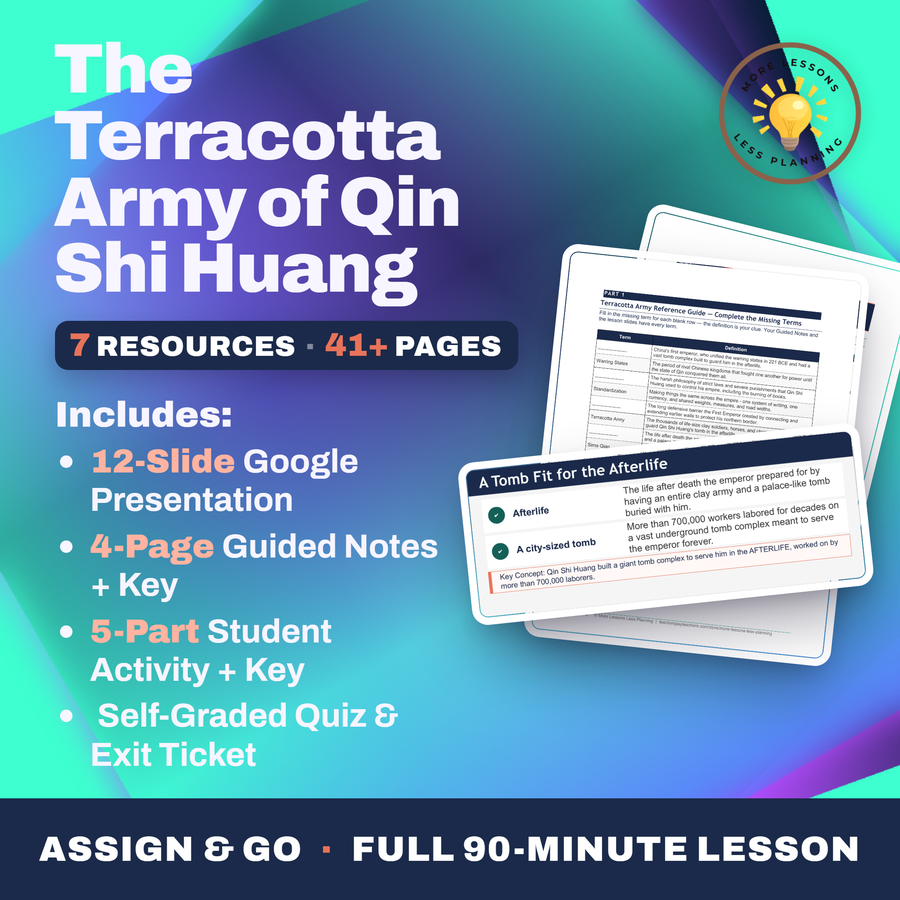

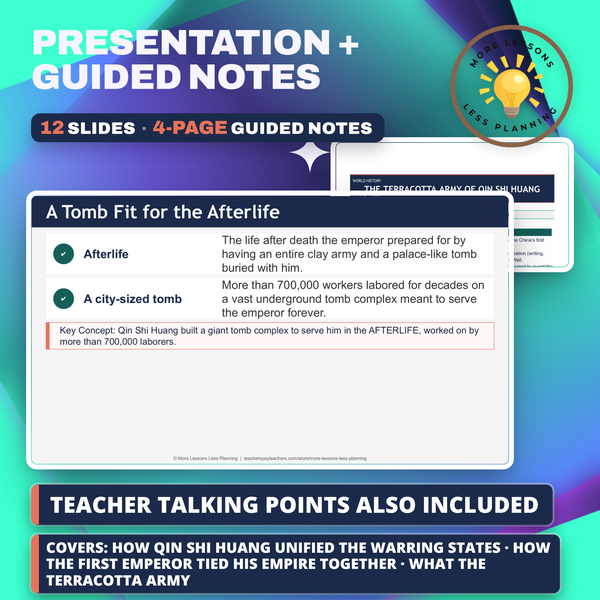
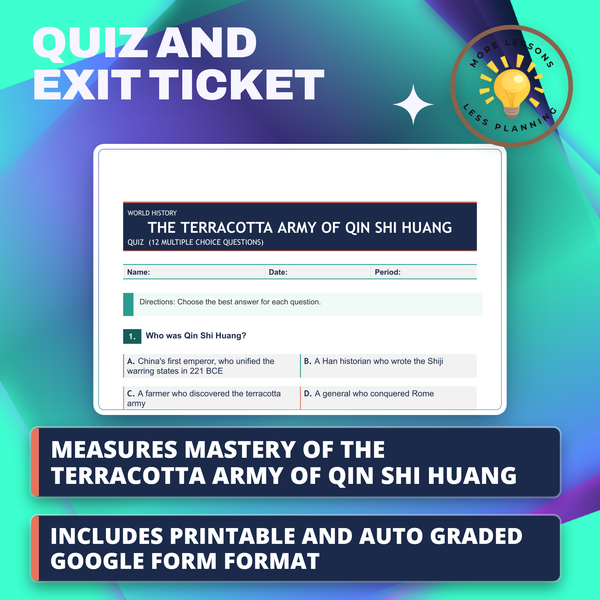
The Terracotta Army of Qin Shi Huang
Quality reviewed September 2026
- Subject
- World History
- Grades
- Grades 9-12
- Time
- About two 50-minute class periods
- Includes
- 11 ready-to-teach files
- Format
- Word (.docx) · PowerPoint (.pptx)
- Slide deck
- Guided notes
- Guided notes teacher key
- Activity + answer key
- Quiz + answer key
- Exit ticket + answer key
- Teacher guide
- Teacher presentation notes
What students do
- Explain how the ruler of Qin unified the warring states in 221 BCE and controlled his empire through Legalism
- Describe standardization and the early Great Wall as two ways the First Emperor tied his territory together
- Read Sima Qian's Shiji account of the tomb's mercury rivers and hidden crossbows and notice what it never mentions
- Write a museum exhibit panel explaining the terracotta army's 1974 discovery and why the ancient text is a source to question
What it covers
- How the ruler of Qin unified the warring states in 221 BCE and held the empire together through Legalism
- Standardized writing and currency, and an early Great Wall built from connected existing walls
- Sima Qian's Shiji account of the tomb's mercury rivers and hidden crossbows, written a century after the emperor died
- The 1974 discovery near Xi'an that proved the terracotta army existed, since the Shiji text never mentions it
Learning targets
- Explain how Qin Shi Huang unified the warring states in 221 BCE to become China's first emperor, and how he ruled through Legalism.
- Describe how the First Emperor tied his empire together through standardization (writing, currency, weights, roads) and by connecting earlier walls into an early Great Wall.
- Explain what the terracotta army was - thousands of life-size clay soldiers buried to guard the emperor in the afterlife - and how farmers and archaeology revealed it in 1974.
- Analyze the ancient Shiji account of the tomb's construction, distinguishing what the source describes (mercury rivers, crossbows, sealed workmen) from what it does NOT mention (the terracotta army), and judging it as a historical source rather than proven fact.
Peek inside
1. Who was China’s first emperor, the ruler who unified the warring states in 221 BCE and had the terracotta army built? (three words)
Why this matters
Writing and currency in China did not use to match from one warring state to the next, and that mismatch is what a newly unified empire under Qin actually had to fix first in 221 BCE, using standardized systems and Legalism's strict laws to hold together territory that had never operated as one place before.
Legalism held the empire together through harsh law, but I find the same Great Wall project shows a second method working alongside it: engineers connected walls that already existed instead of building one from scratch. Comparing law and construction as two different tools for unification gives students a question to weigh, not just a fact to memorize.
From one teacher to another
The hook I use for this one is a real puzzle: how do we know anything about a tomb nobody has ever opened? Students trace how the ruler of Qin conquered the last of the warring states in 221 BCE and then held his empire together through Legalism's harsh laws, standardized writing and currency, and an early version of the Great Wall built by connecting existing walls. Then comes the part I care about most, Sima Qian's actual Shiji account of the tomb, written about a hundred years after the emperor died, describing rivers of mercury, automatic crossbows, and workmen sealed inside forever, and I make students notice on their own that this famous ancient text never once mentions the terracotta army. That army stayed completely unknown for over two thousand years until farmers digging a well near Xi'an struck a clay figure in 1974, which means it was archaeology, not any written record, that proved the buried soldiers existed. Students finish by writing a museum exhibit panel that has to hold that honest tension: treating the Shiji as real evidence worth reading closely, while still naming it a source to question rather than proven fact, especially since the tomb mound itself has never been excavated.
Every file in this toolkit
Download
Where should I send the next one?
Everything here is free and it stays that way. Leave your email and I'll send you the new lessons as they go up. You can unsubscribe from any one of them.
Related resources
Ashoka and the Edicts of a Warrior King
Chavín de Huántar and Early Andean Civilization
Indian Mathematics and the Invention of Zero
Paper and Papermaking in Han China
The Golden Age of the Gupta Empire
The Han Dynasty and Confucian Government
Every lesson on this site is free to download and use. If one of them saved you a prep period, you can chip in a few bucks toward my three kids' daycare fund. That's genuinely where tips go.