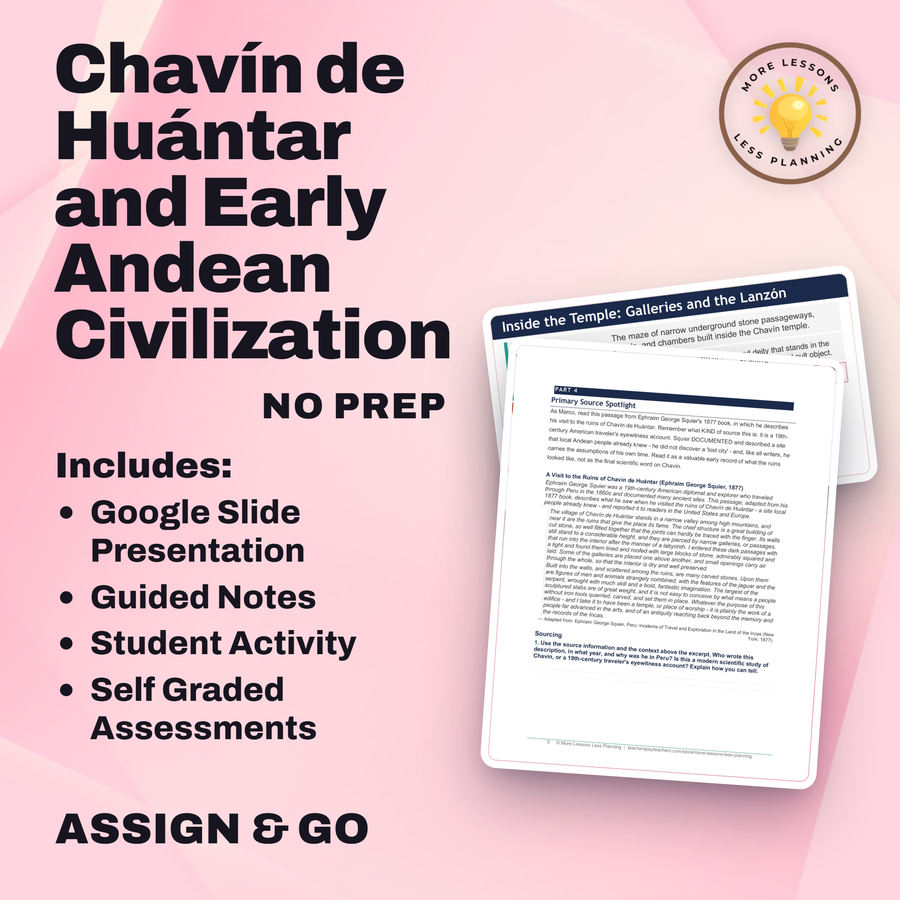
Chavín de Huántar and Early Andean Civilization
Quality reviewed September 2026
- Grades
- Grades 9-12
- Time
- About two 50-minute class periods
- Includes
- 11 ready-to-teach files
- Format
- Word (.docx) · PowerPoint (.pptx)
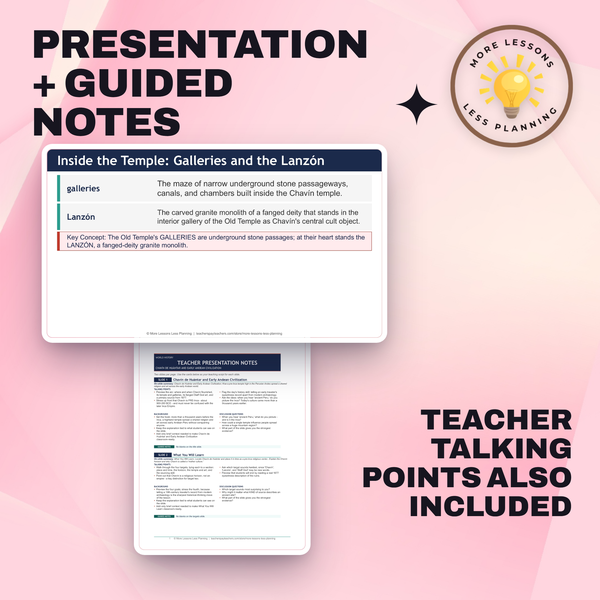
- Slide deck
- Guided notes
- Guided notes teacher key
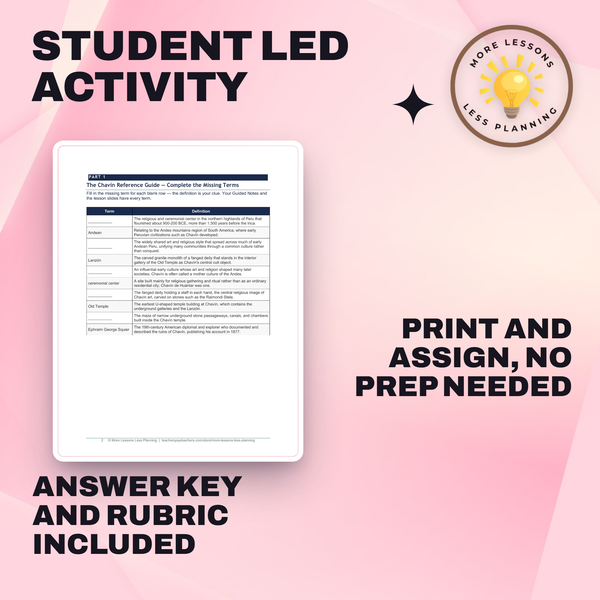
- Activity + answer key
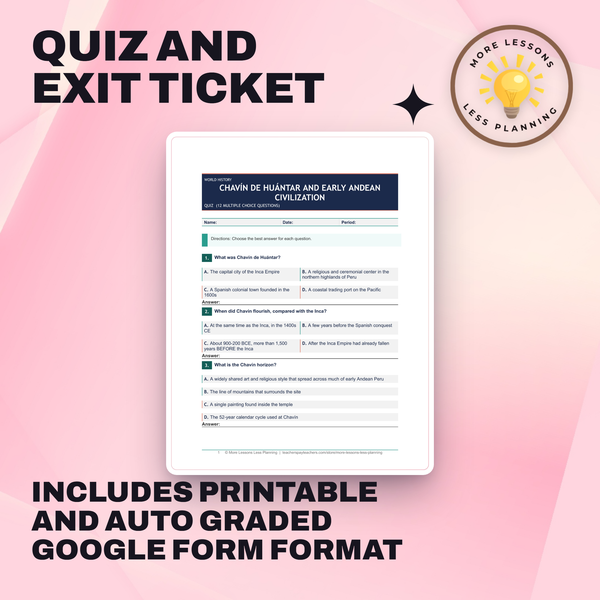
- Quiz + answer key
- Exit ticket + answer key
- Teacher guide
- Teacher presentation notes
What students do
- Locate Chavín de Huántar in the Peruvian highlands and place it more than 1,500 years before the Inca
- Read Ephraim George Squier's 1877 description of the ruins and separate his eyewitness record from what archaeologists know today
- Explain why historians call Chavín a "mother culture" that spread through shared art and religion, not conquest
- Trace the Lanzón and the Staff God imagery from the underground galleries to stones like the Raimondi Stela
What it covers
- Chavín de Huántar as a ceremonial center, not a city, that flourished roughly 900-200 BCE
- The Chavín horizon, the shared art and religious style found across sites that Chavín never conquered
- The Lanzón and the fanged Staff God carved on the Raimondi Stela
- Squier's 1877 account of the ruins and why a 19th-century traveler's record isn't the same as modern archaeology
Learning targets
- Locate Chavín de Huántar in the northern highlands of Peru and describe it as a pre-Inca religious/ceremonial center that flourished about 900-200 BCE, more than 1,500 years before the Inca.
- Explain the Chavín horizon - the widely shared art and religious style that spread across early Andean Peru - and why Chavín is called an influential 'mother culture' rather than a conquering empire.
- Describe Chavín's monumental architecture and religious art, including the Old Temple, the underground galleries, the Lanzón, and the fanged Staff God iconography seen on stones like the Raimondi Stela.
- Analyze a primary source (Ephraim George Squier's 1877 description of the ruins) and distinguish a valuable but 19th-century traveler's eyewitness record from the modern archaeological understanding of Chavín.
Peek inside
Where: highland Peru
In the northern highlands of Peru, in the Andes mountains.
In a narrow valley about 3,150 meters (10,000+ ft) up.
An Andean site - of the Andes region of South America.
When: c. 900-200 BCE
Why this matters
Spreading across an entire region without raising an army is rare in ancient history, and Chavin de Huantar managed exactly that. Its religious art and style, centered on the fanged Staff God, reached sites far from the temple itself for centuries while Chavin stayed a ceremonial center rather than a city or an empire.
Placing this site more than 1,500 years before the Inca resets a student's whole timeline of Peru, and once that order is fixed, the harder question becomes how an idea like the Staff God spread across the Andes without a single conquest behind it.
From one teacher to another
My students hear "ancient Peru" and picture the Inca, so I start by making them place Chavín de Huántar more than 1,500 years earlier, a ceremonial center high in the Andes with no army and no conquered territory, just a style of religious art that spread on its own. Reading Ephraim Squier's 1877 account of the ruins gives them a real eyewitness voice, and I make them separate what Squier actually saw from what modern archaeology has since figured out about the Lanzón and the underground galleries. Once they can trace the fanged Staff God from the temple stones to the Raimondi Stela, the label "mother culture" stops being empty vocabulary.
Every file in this toolkit
Download
Where should I send the next one?
Everything here is free and it stays that way. Leave your email and I'll send you the new lessons as they go up. You can unsubscribe from any one of them.
Related resources
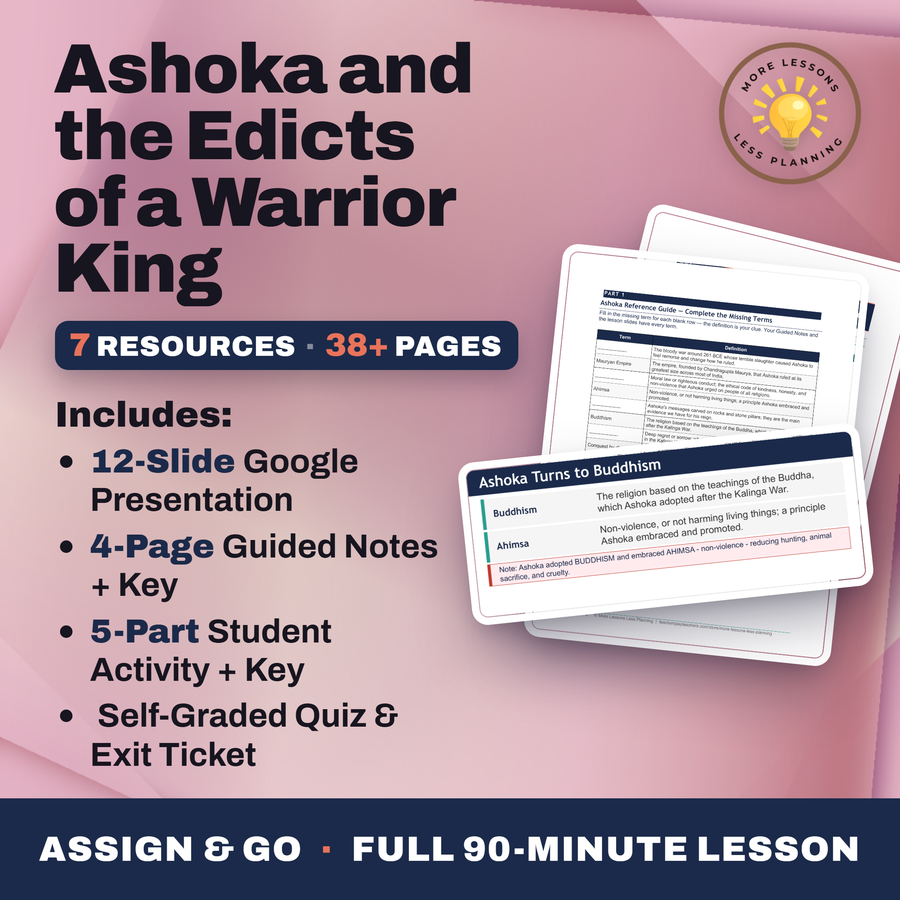
Ashoka and the Edicts of a Warrior King
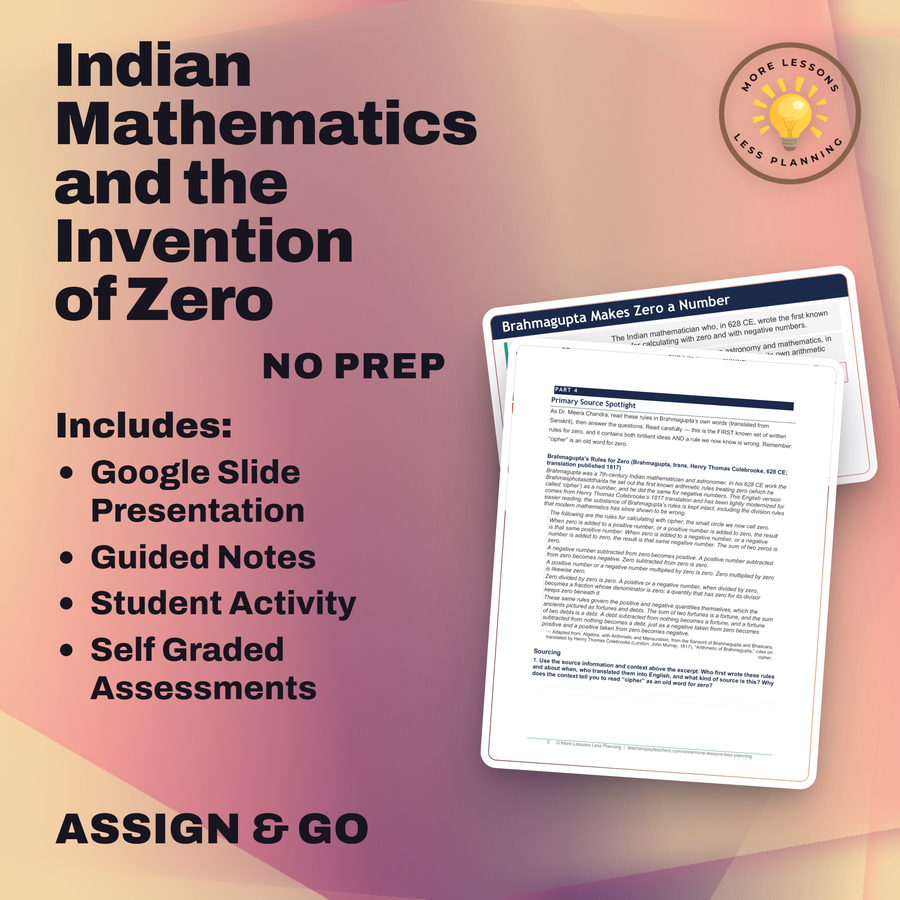
Indian Mathematics and the Invention of Zero
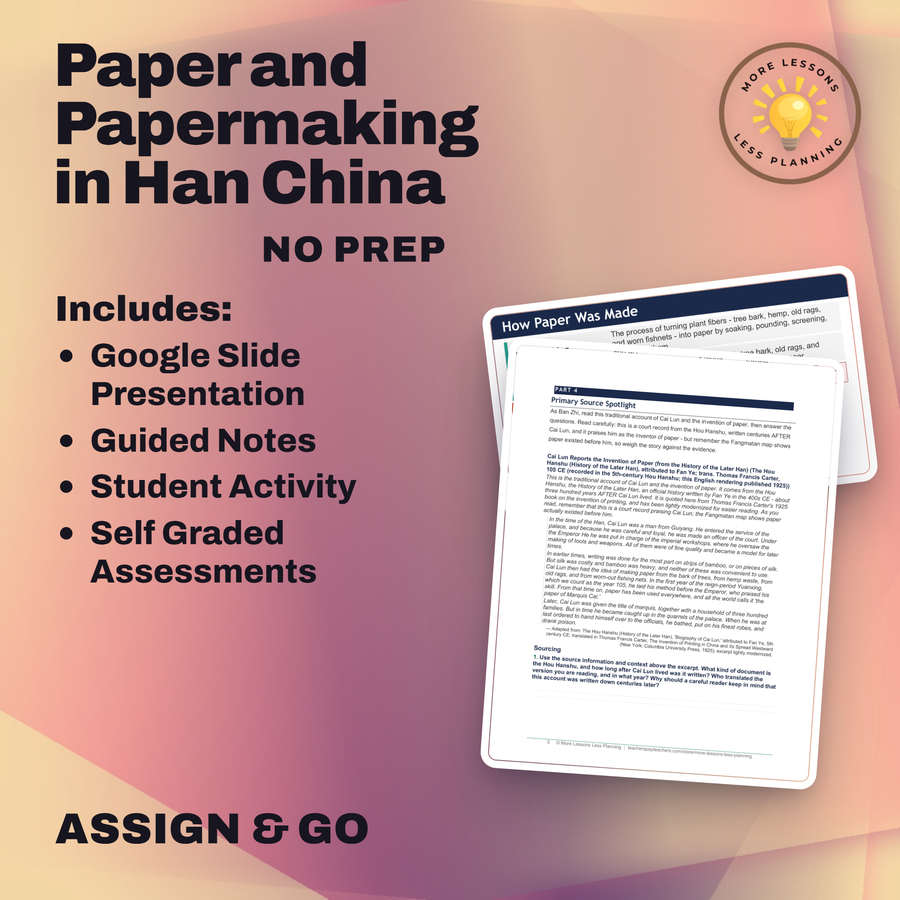
Paper and Papermaking in Han China

The Golden Age of the Gupta Empire
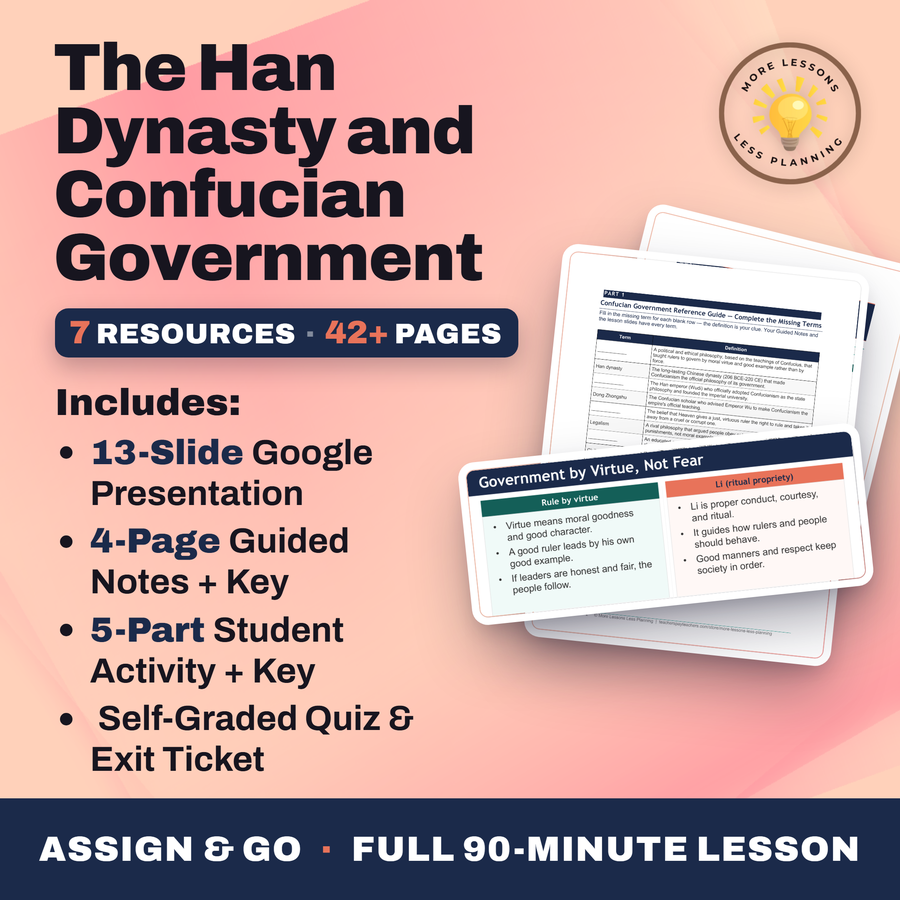
The Han Dynasty and Confucian Government
The Maya Calendar and Astronomy
Every lesson on this site is free to download and use. If one of them saved you a prep period, you can chip in a few bucks toward my three kids' daycare fund. That's genuinely where tips go.