Ashoka and the Edicts of a Warrior King
Quality reviewed September 2026
- Subject
- World History
- Grades
- Grades 9-12
- Time
- About two 50-minute class periods
- Includes
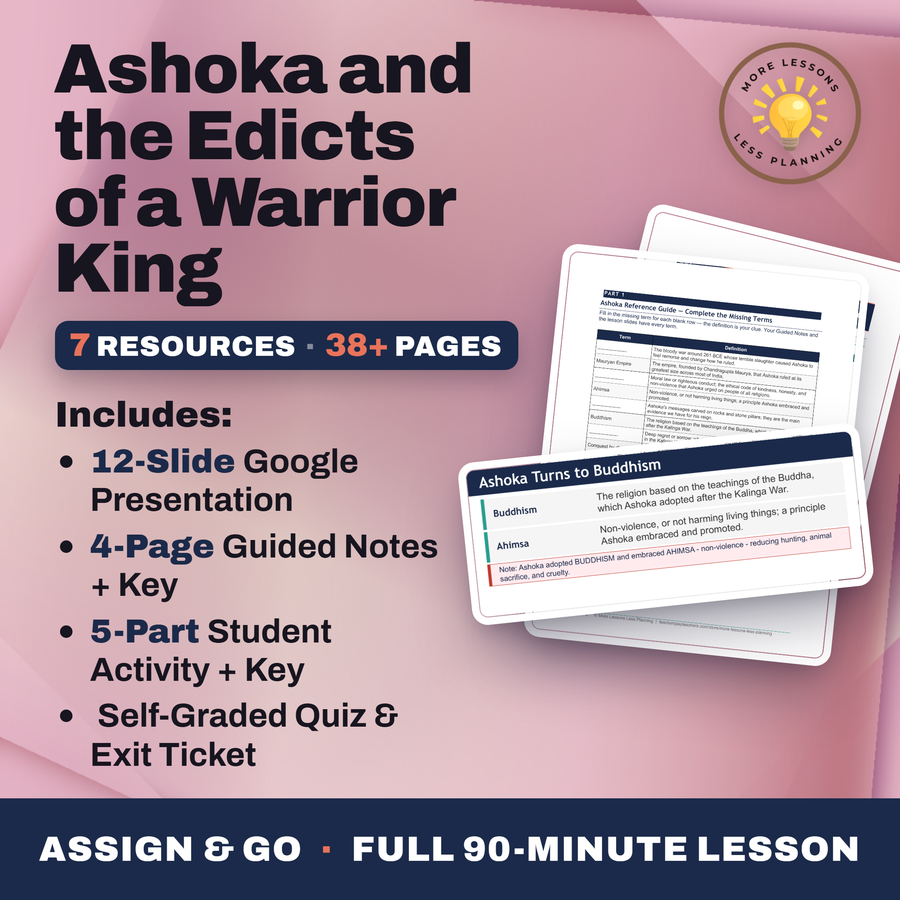
- 11 ready-to-teach files
- Format
- Word (.docx) · PowerPoint (.pptx)
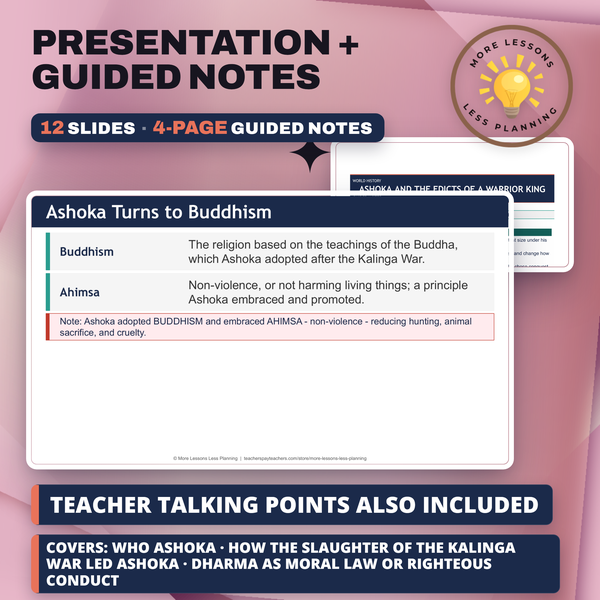
- Slide deck
- Guided notes
- Guided notes teacher key
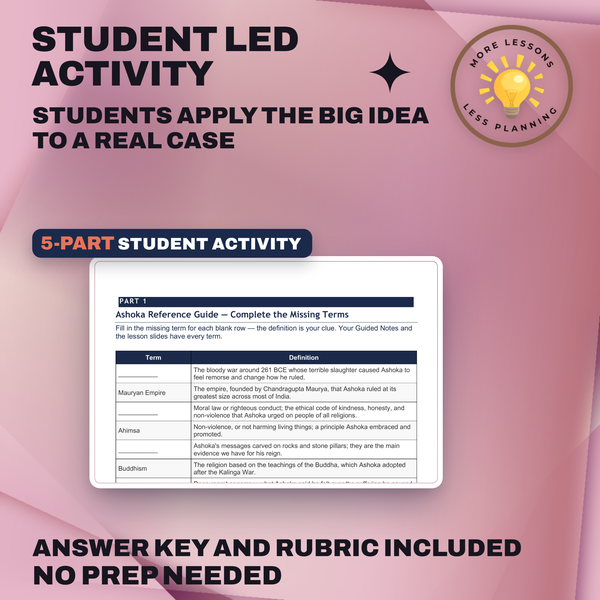
- Activity + answer key
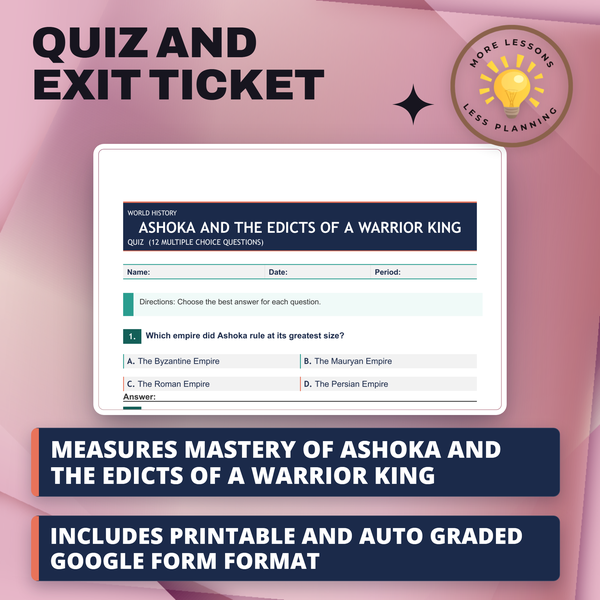
- Quiz + answer key
- Exit ticket + answer key
- Teacher guide
- Teacher presentation notes
What students do
- Trace how the brutal Kalinga War (c. 261 BCE) filled Ashoka with remorse and turned him from conquest to dharma
- Read Ashoka's own words in Rock Edict XIII and separate sourcing, comprehension, and analysis
- Explain what dharma meant for Ashoka and why it was not forced conversion to Buddhism
- Write a museum-panel report on Ashoka's legacy, citing edict evidence and lesson vocabulary
What it covers
- The Kalinga War casualty numbers, about 100,000 killed and 150,000 deported, as Ashoka's own claim
- Ashoka's turn to Buddhism, ahimsa, and "conquest by dharma" instead of the sword
- Why dharma was moral law for people of all religions, not a demand to convert
- The Lion Capital at Sarnath, now India's national emblem, and the edicts as our main evidence for his reign
Learning targets
- Explain who Ashoka was and how the Mauryan Empire reached its greatest size under his rule.
- Describe how the slaughter of the Kalinga War led Ashoka to feel remorse and change how he ruled.
- Define dharma as moral law or righteous conduct and explain how Ashoka chose conquest by dharma instead of the sword.
- Explain why Ashoka's edicts and the Lion Capital are our main evidence for his reign, and analyze a primary source by considering who wrote it and when.
Peek inside
1. What is the name of the bloody war around 261 BCE whose slaughter caused Ashoka's change of heart? (two words)
Why this matters
A stone lion carved on Ashoka's orders is still India's national emblem, which means a ruler's attempt to broadcast his change of heart across an empire is something people in India still recognize on sight, centuries later. Most ancient rulers leave only ruins behind; this one left a symbol that outlived the empire itself.
A conqueror reporting his own war's death toll is not a neutral source, and getting students to hold onto that doubt even while taking the numbers seriously is the harder skill this lesson is really after, since sympathy for Ashoka's later turn can make them forget to question the man doing the counting.
From one teacher to another
I open this one with the hook I use every year: a conqueror who won his biggest war and then said, in his own stone-carved words, that he regretted it. Students read an actual excerpt from Rock Edict XIII, in Vincent A. Smith's 1901 translation, where Ashoka describes the Kalinga dead and deportees by his own count, and I make them source it before they trust it, asking who's speaking, when it was carved, and why a ruler describing his own war might not be a neutral witness. The dharma piece is the part I'm strictest about, because kids default to assuming Ashoka forced everyone to become Buddhist, so the whole lesson is built to correct that, ending with a museum-panel report that has to name the Kalinga War, the edicts, and the Lion Capital as evidence.
Every file in this toolkit
Download
Where should I send the next one?
Everything here is free and it stays that way. Leave your email and I'll send you the new lessons as they go up. You can unsubscribe from any one of them.
Related resources
Chavín de Huántar and Early Andean Civilization
Indian Mathematics and the Invention of Zero
Paper and Papermaking in Han China
The Golden Age of the Gupta Empire
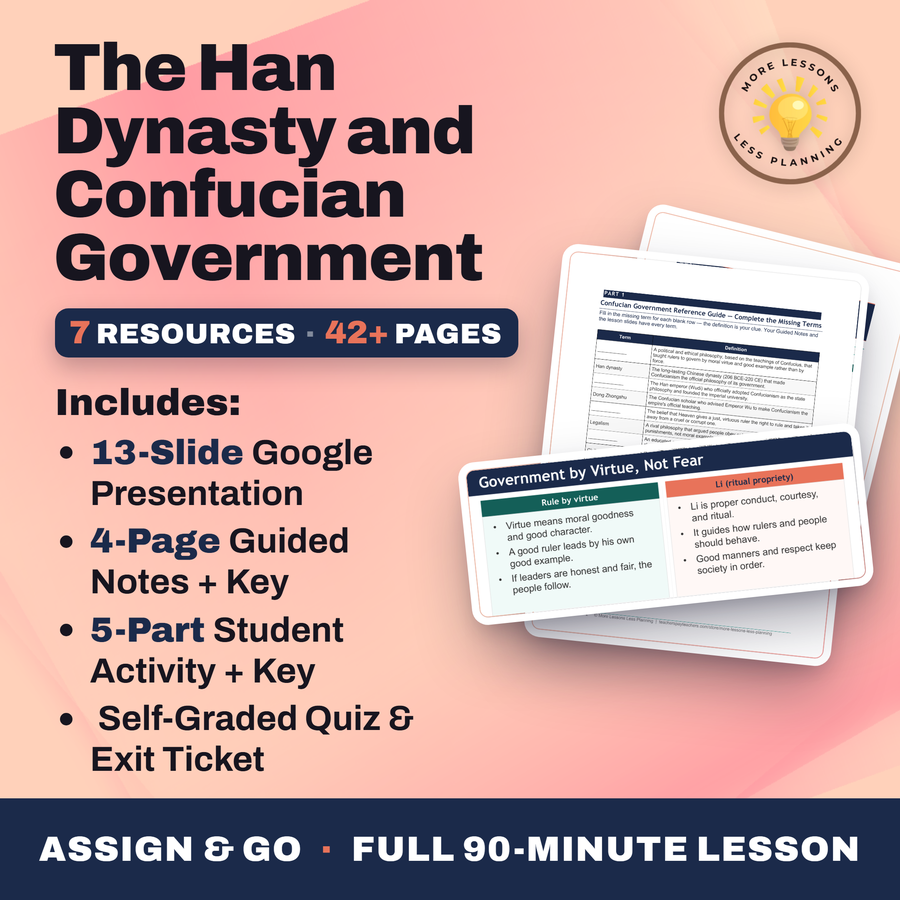
The Han Dynasty and Confucian Government
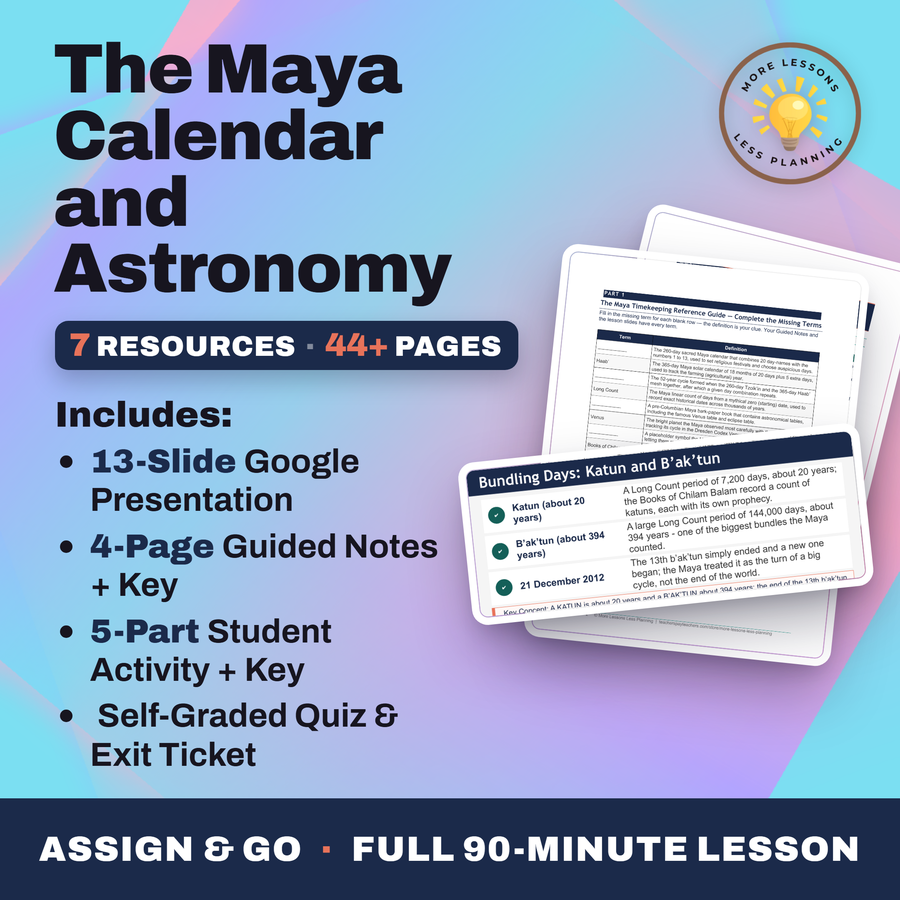
The Maya Calendar and Astronomy
Every lesson on this site is free to download and use. If one of them saved you a prep period, you can chip in a few bucks toward my three kids' daycare fund. That's genuinely where tips go.