
The Han Dynasty and Confucian Government
Quality reviewed September 2026
- Subject
- World History
- Grades
- Grades 9-12
- Time
- About two 50-minute class periods
- Includes
- 11 ready-to-teach files
- Format
- Word (.docx) · PowerPoint (.pptx)
- Slide deck
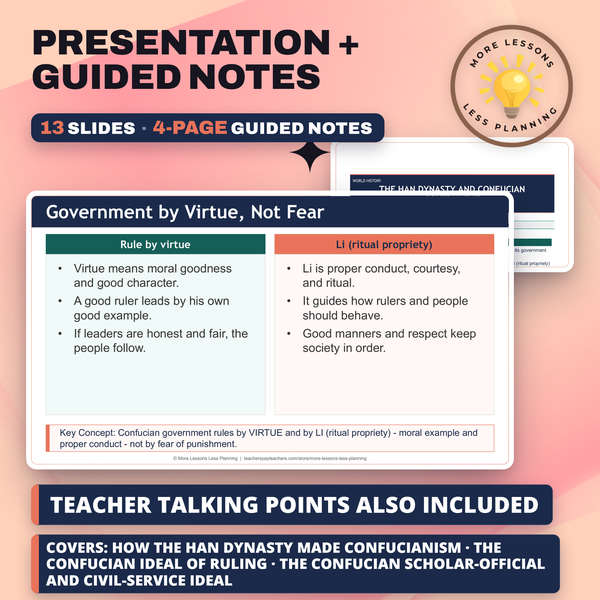
- Guided notes
- Guided notes teacher key
- Activity + answer key
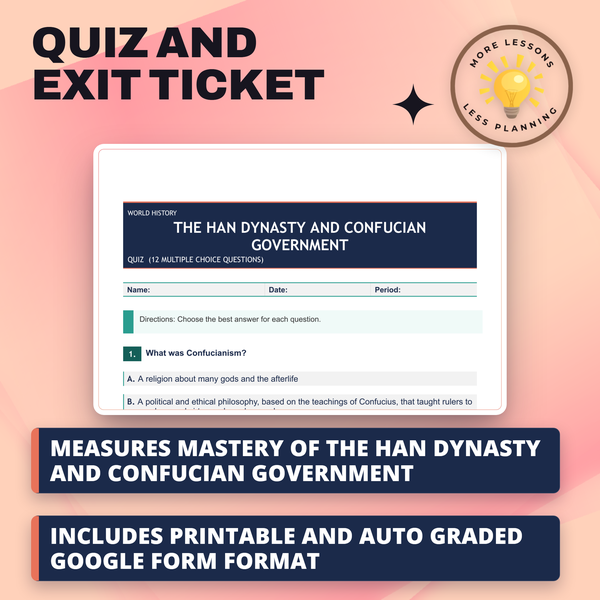
- Quiz + answer key
- Exit ticket + answer key
- Teacher guide
- Teacher presentation notes
What students do
- Analyze Confucius's Analects for how he describes the duties of a ruler
- Compare Confucian rule by virtue against Legalist rule by strict law and punishment
- Argue whether the Han's scholar-official system lived up to its own merit ideal
- Explain how the Mandate of Heaven tied a ruler's legitimacy to his virtue
What it covers
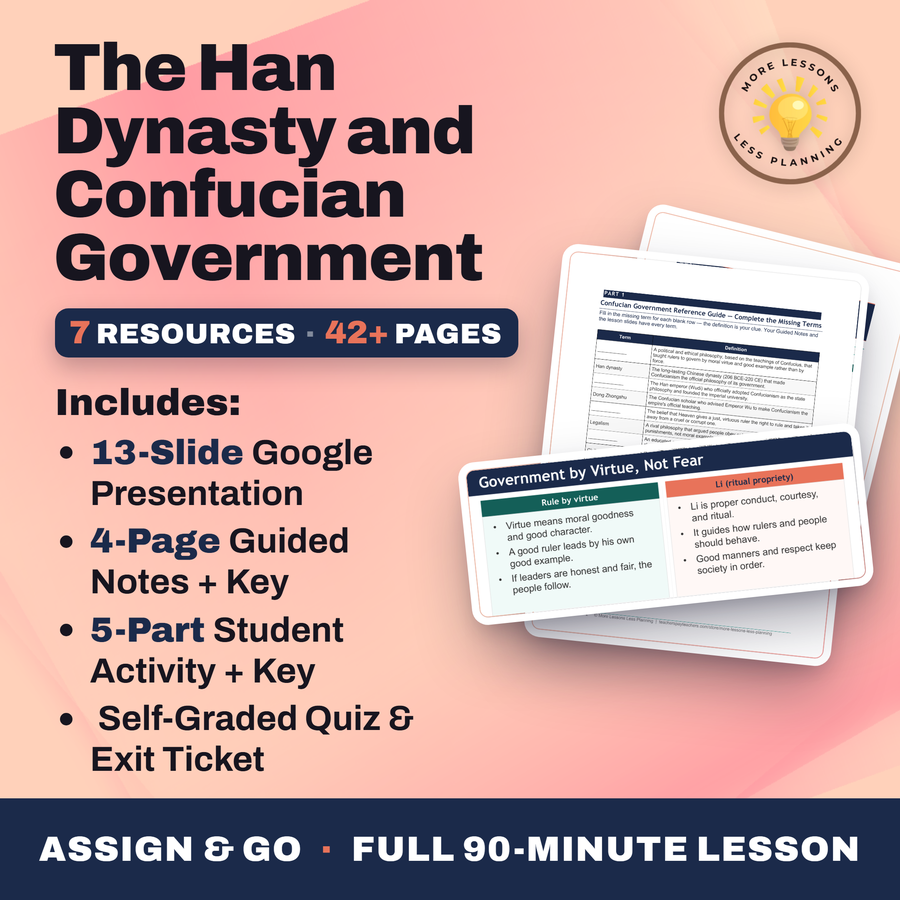
- Emperor Wu's adoption of Confucianism on Dong Zhongshu's advice, and the 124 BCE imperial university
- Li, or ritual propriety, and what governing by moral example meant in practice
- Why the full civil-service exam system didn't mature until the Sui and Tang, centuries later
- The Qin's Legalist model and why the Han deliberately governed differently
Learning targets
- Explain how the Han dynasty made Confucianism the official philosophy of its government under Emperor Wu (Wudi), advised by the scholar Dong Zhongshu.
- Describe the Confucian ideal of ruling by moral virtue, good example, and li (ritual propriety) rather than by the strict laws and harsh punishments of Legalism.
- Explain the Confucian scholar-official and civil-service ideal, and distinguish the ideal of merit from Han reality - the imperial university (124 BCE) and recommend-and-examine channels, while the full examination system matured centuries later under the Sui and Tang.
- Explain the Mandate of Heaven and how a ruler's virtue legitimized his rule, and analyze a Confucian primary source about the duties of a ruler.
Peek inside
A Philosophy of Good Government
was the political and ethical philosophy, based on the teachings of Confucius, that taught rulers to govern by moral virtue and good example rather than by force.
(leading by good example) is how a good ruler should govern in Confucian thought, not by force or fear.
1. Q1. What is the name for the political and ethical philosophy, based on the teachings of Confucius, that taught rulers to govern by moral virtue and good example? (one word)
Why this matters
Finding competent officials is a problem every government faces, and in 124 BCE Emperor Wu answered it with an imperial university built on Dong Zhongshu's advice, promising jobs based on merit instead of noble birth. That promise took centuries to catch up with reality: the full exam system would not mature until the Sui and Tang dynasties.
Ritual propriety, li, sounds like etiquette until applied to government: a ruler who behaved badly was expected to lose legitimacy just as surely as one who broke a law. I set that against the Qin's rule by strict punishment, which gives students a debatable question: can virtue alone run a country, or is force required.
From one teacher to another
Most students assume China ran a full merit-based exam system from the start, and the Han don't fit that story cleanly. They read the actual governing verses from the Analects, then measure that ideal against messier reality: an imperial university, some recommend-and-examine recruiting, and plenty of noble families still landing the top posts. The Mandate of Heaven usually sparks the best conversation, since it meant a bad enough famine could functionally cost an emperor his throne.
Every file in this toolkit
Download
Where should I send the next one?
Everything here is free and it stays that way. Leave your email and I'll send you the new lessons as they go up. You can unsubscribe from any one of them.
Related resources
Ashoka and the Edicts of a Warrior King
Chavín de Huántar and Early Andean Civilization
Indian Mathematics and the Invention of Zero
Paper and Papermaking in Han China

The Golden Age of the Gupta Empire
The Maya Calendar and Astronomy
Every lesson on this site is free to download and use. If one of them saved you a prep period, you can chip in a few bucks toward my three kids' daycare fund. That's genuinely where tips go.