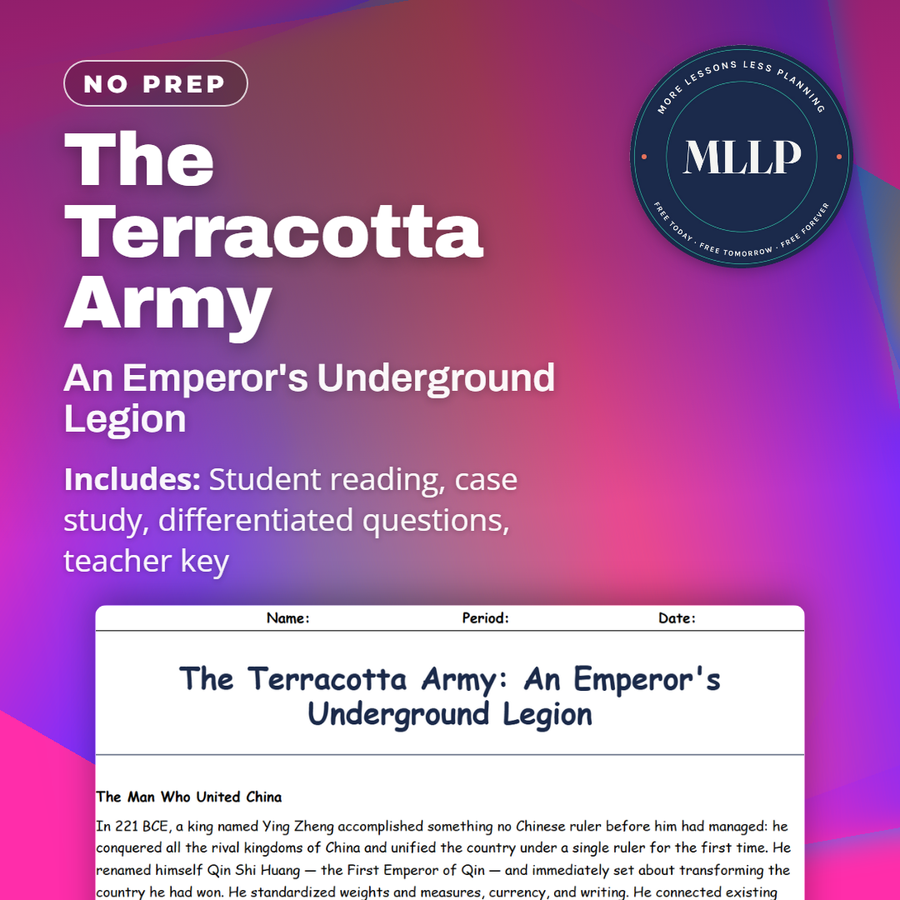
The Terracotta Army: An Emperor's Underground Legion
Quality reviewed September 2026
Facts verified September 21, 2026
- Subject
- Social Studies
- Grades
- Grades 9-12
- Length
- 9-page student worksheet
- Time
- About one 50-minute class period
- Great for
- Sub plans and independent work
- Includes
- Reading passage, comprehension questions + full answer key
- Format
- Print-and-go PDF
What students do
- A farmer's shovel struck fired clay in 1974 and led to one of history's biggest digs
- A modular system let sculptors give an estimated 8,000 warriors 8,000 different faces
- Fill in the blanks about the bronze weapons still sharp after 2,200 years underground
- Explain why Qin Shi Huang's actual burial mound remains sealed to this day
What it covers
- The four pits of clay soldiers uncovered near Lintong since 1974
- How a modular system gave thousands of warriors individual faces and weapons
- Why Qin Shi Huang's main burial mound remains sealed
Start reading this worksheet
The Man Who United China
In 221 BCE, a king named Ying Zheng accomplished something no Chinese ruler before him had managed: he conquered all the rival kingdoms of China and unified the country under a single ruler for the first time. He renamed himself Qin Shi Huang, the First Emperor of Qin, and immediately set about transforming the country he had won. He standardized weights and measures, currency, and writing. He connected existing walls into one long barrier in the north. He built roads across his empire. And he began work on a tomb that would take 700,000 laborers nearly 40 years to construct. Qin Shi Huang was famously obsessed with immortality. He sent ships to search for the Islands of the Immortals in the eastern sea. He consumed mercury pills prescribed by court alchemists, believing they would extend his life. They almost certainly shortened it. But he also prepared for death on a scale that staggers the imagination. His tomb complex near Xi'an was designed to replicate the empire he ruled in miniature, complete with rivers of mercury, ceiling maps of constellations, crossbow traps to kill intruders, and an army of clay soldiers ready to protect him in the afterlife.
A Discovery Beneath a Farmer's Field
For over 2,000 years, the Terracotta Army waited underground, unknown to the modern world. Then, in March 1974, farmers digging a well near the village of Lintong struck fragments of fired clay. Further investigation revealed something extraordinary: pit after pit filled with life-size ceramic soldiers arranged in battle formation, as if frozen at the moment they were about to march. What archaeologists eventually uncovered was astonishing in scale. Pit 1 alone, the largest of four pits discovered, contained approximately 6,000 infantry soldiers arranged in columns eleven rows deep. Pit 2 held cavalry units, war chariots, and archers. Pit 3 appeared to be the command headquarters, with officers and a chariot that may have represented the general's post. A fourth pit was discovered but found empty: construction apparently stopped when the emperor died suddenly at age 49 while traveling through his empire.
The Warriors Up Close: No Two Are Alike
The most remarkable feature of the Terracotta Army is its individuality. Ancient sculptors created each warrior's face using a modular system: standardized body parts (torso, limbs, head) were mass-produced, then individual features like hairstyles, facial expressions, and beard styles were added by hand before firing. The result is that among the estimated 8,000 warriors, no two faces are identical. Differences also reflect the real diversity of Qin Shi Huang's army. Soldiers from different regions of China had different physical features, and the sculptors appear to have captured these distinctions. Infantry soldiers wear armor; cavalry soldiers are dressed for riding; archers kneel in firing positions. Surviving traces of paint show that the warriors were originally brilliantly colored (red tunics, black armor, green accents) before exposure to air caused the pigments to flake away within minutes of excavation.
Like what you read? The full reading, the case study, and every question set are in the free download below, along with the answer key.
Why this matters
Qin Shi Huang built an entire army meant to be seen by no living person, ever, which is a strange use of art and labor worth sitting with, since most human creativity is made to be looked at and his was not. The reading also notes that 700,000 laborers worked on his tomb complex for nearly 40 years, and Chen Bao's thumbprint pressed into the base of a warrior is one of the only traces most of those workers left behind, a reminder that the people who build a civilization's monuments rarely get remembered by name. Students can weigh in on whether the still-sealed main tomb should finally be opened, using the same tradeoff between curiosity and preservation that comes up anywhere old and fragile evidence meets modern tools.
From one teacher to another
A farmer's shovel struck fired clay near Lintong in March 1974, and what followed was the excavation of an underground army built to protect China's first emperor in the afterlife. Students read about the roughly 8,000 warriors spread across four pits, each face individually finished by hand even though the bodies were mass-produced from standardized parts, and about the bronze weapons buried with them, some still sharp enough to cut paper more than 2,200 years later. The reading also covers Qin Shi Huang's actual burial mound, still sealed today partly because the technology to excavate it safely does not yet exist, and the elevated mercury levels that sensors have detected beneath it. A case study follows a young sculptor named Chen Bao pressing his thumbprint into the clay before it went into the kiln.
What you get
Download
Where should I send the next one?
Everything here is free and it stays that way. Leave your email and I'll send you the new lessons as they go up. You can unsubscribe from any one of them.
Related resources
Ancient China: An Overview of Dynasties, Power, and the Archaeological Record
Ancient Chinese Inventions: What Archaeology Proves
Han Dynasty Tombs: Buried Treasure and Beliefs About the Afterlife

Oracle Bones: Fortune-Telling That Became History
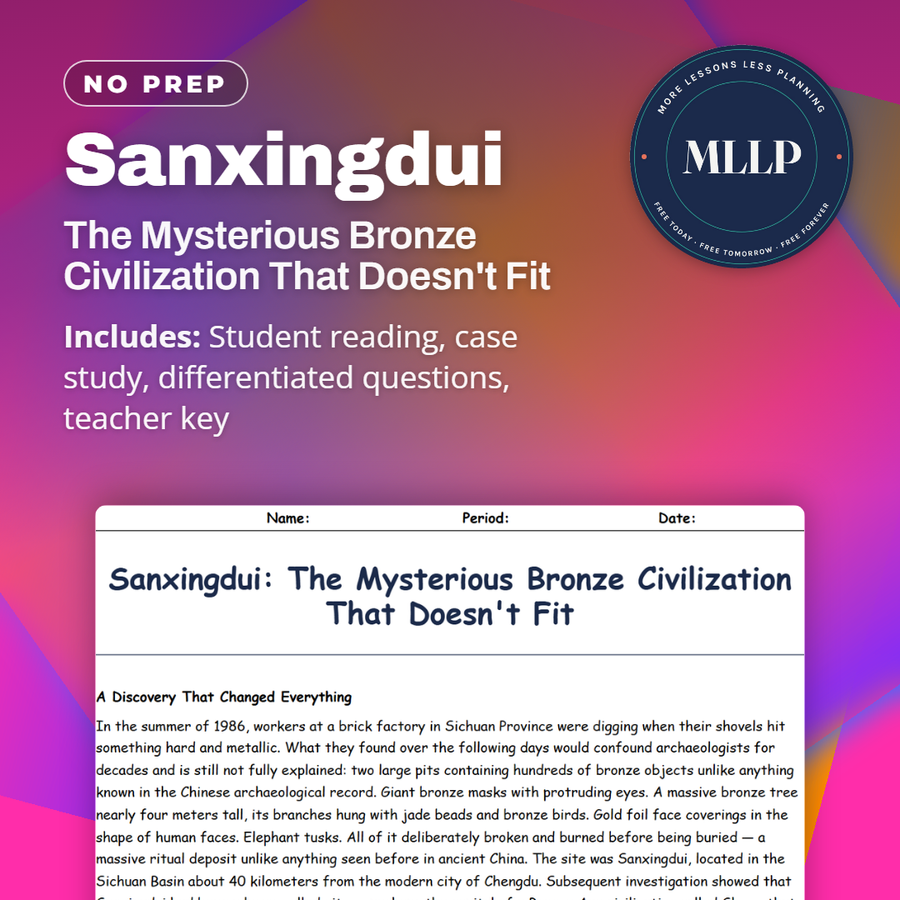
Sanxingdui: The Mysterious Bronze Civilization That Doesn't Fit
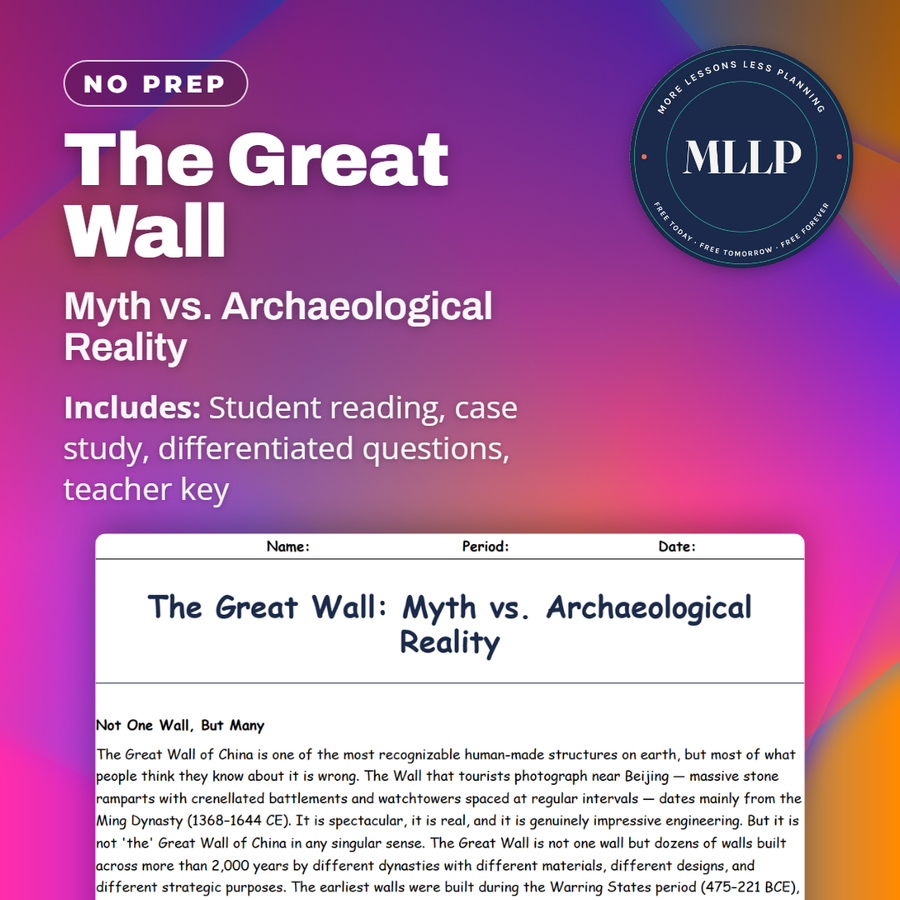
The Great Wall: Myth vs. Archaeological Reality
Every lesson on this site is free to download and use. If one of them saved you a prep period, you can chip in a few bucks toward my three kids' daycare fund. That's genuinely where tips go.