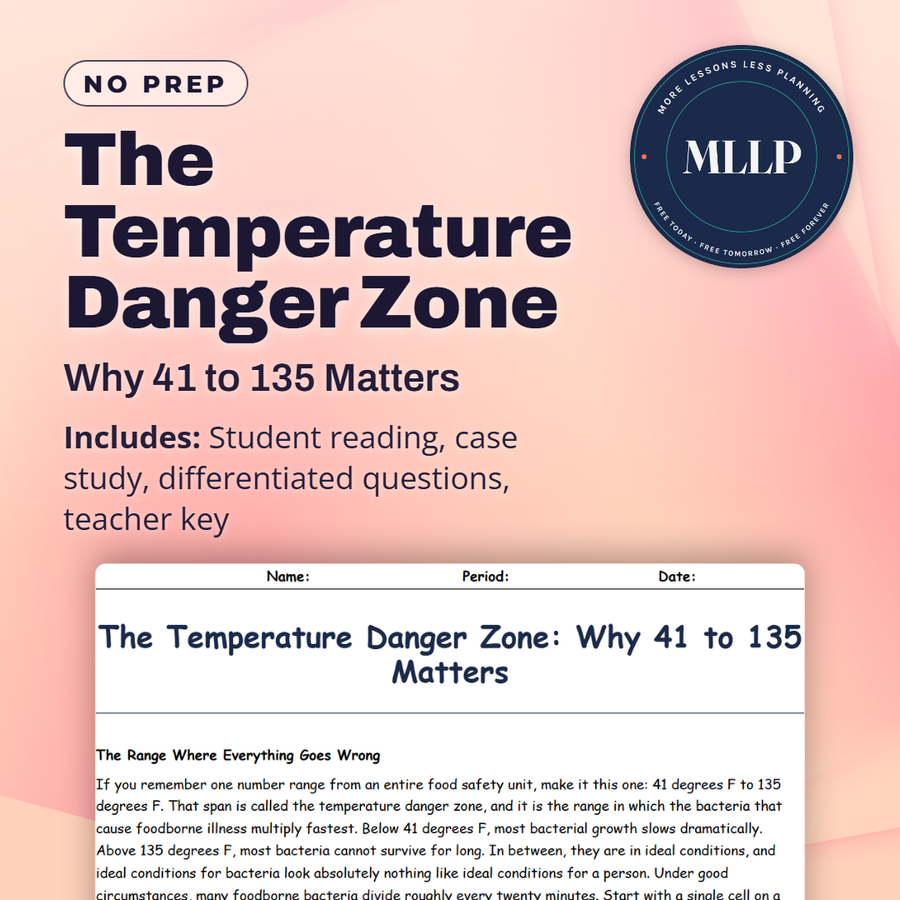
The Temperature Danger Zone: Why 41 to 135 Matters
Quality reviewed September 2026
Facts verified September 23, 2026
- Subject
- Career & Life Skills
- Grades
- Grades 9-12
- Length
- 9-page student worksheet
- Time
- About one 50-minute class period
- Great for
- Sub plans and independent work
- Includes
- Reading passage, comprehension questions + full answer key
- Format
- Print-and-go PDF
What students do
- The exponential math behind bacterial growth gets worked out step by step, from one cell to thousands
- Answer why ground beef needs a higher cooking temperature than a whole steak
- Identify the four approved thawing methods and the one method that is never allowed
- Marcus's twelve-gallon pot of chili gets checked against the two-stage cooling standard it missed
What it covers
- The exact minimum internal temperatures for poultry, ground meat, and whole cuts
- The two-stage cooling standard for a large batch of food
- The four approved thawing methods and the one that is banned
Start reading this worksheet
The Range Where Everything Goes Wrong
If you remember one number range from an entire food safety unit, make it this one: 41 degrees F to 135 degrees F. That span is called the temperature danger zone, and it is the range in which the bacteria that cause foodborne illness multiply fastest. Below 41 degrees F, most bacterial growth slows dramatically. Above 135 degrees F, most bacteria cannot survive for long. In between, they are in ideal conditions, and ideal conditions for bacteria look absolutely nothing like ideal conditions for a person. Under good circumstances, many foodborne bacteria divide roughly every twenty minutes. Start with a single cell on a piece of chicken left on the counter. Twenty minutes later there are two, then four, then eight. After four hours at room temperature that one cell has become more than four thousand. After six hours it is in the hundreds of thousands. Nothing about the chicken looks different. There is no smell, no slime, no visible change at all, because the numbers required to make somebody sick are still microscopic. This exponential math is the single most important idea in food safety, and it explains why every rule that follows is written in terms of both temperature and time. You are not fighting an invasion. You are managing a population that doubles on a schedule. Food safety codes call the foods where this math matters most potentially hazardous foods, or TCS foods, meaning they require time and temperature control for safety. The list is predictable once you know what bacteria want: moisture and protein. Meat, poultry, seafood, eggs, dairy, cooked rice and pasta, cut melon, cut leafy greens, cut tomatoes, tofu, and garlic stored in oil all qualify.
Time Is Half the Rule
Because bacterial growth is a function of both how warm the food is and how long it stays that way, food safety rules always pair the two. The standard most kitchens follow is the four-hour rule: potentially hazardous food may spend a cumulative total of four hours in the danger zone across its entire life, after which it must be thrown out. The word cumulative is doing serious work in that sentence. The clock does not reset when the food goes back into the cooler. If a pan of cooked chicken sits out for ninety minutes during prep, goes back to the walk-in, and comes out again for two hours of service, it has used three and a half hours of its four. Some codes allow six hours if the food starts at 41 degrees F and never exceeds 70, which is why you will see both numbers in different textbooks. Two other rules follow from the same math. The two-hour rule for consumers says perishable food should not sit at room temperature longer than two hours, cut to one hour if it is above 90 degrees F, which is why summer cookouts and car trips home from the grocery store deserve more caution than people give them. And the four-hour clock is why a professional kitchen labels a prepped container with a time, not just a date. Students often ask what happens if nobody was tracking. The answer is the same every time and it is not satisfying: if you cannot account for how long food has been in the danger zone, you have to assume the worst and discard it. An unknown temperature history is treated exactly like a known bad one.
Thermometers Do Not Guess
You cannot judge the temperature of food by looking at it, and color is a famously unreliable indicator. Ground beef can turn brown well before it reaches a safe temperature, and it can stay pink at a temperature that is perfectly safe. The only honest answer comes from a thermometer, inserted into the thickest part of the food and kept away from bone, fat, and the pan itself, since all three read differently than the meat around them. The minimum internal temperatures worth memorizing are short. Poultry, stuffing, and any reheated leftovers go to 165 degrees F. Ground meat goes to 155 degrees F, higher than whole cuts because grinding mixes surface bacteria all the way through. Whole cuts of beef, pork, and fish go to 145 degrees F, and eggs cooked for immediate service go to 145 as well. A thermometer only tells the truth if it is calibrated, and calibrating one takes about a minute. Fill a glass with ice, add water, stir, wait thirty seconds, and the probe should read 32 degrees F. If it does not, adjust the nut under the dial or use the reset function on a digital model. Sanitize the probe between foods, because a thermometer that goes from raw chicken into finished rice has just become a cross-contamination tool. Thermometer type matters as well. A bimetallic stem thermometer must be inserted at least two inches to read accurately, which makes it useless for a thin burger patty or a fillet. Thermocouples and thin-probe digital thermometers read from the tip, which is why they are standard in professional kitchens.
Like what you read? The full reading, the case study, and every question set are in the free download below, along with the answer key.
Why this matters
Leftovers put straight into the fridge still warm, or left on the counter to cool before dinner, are an experiment nearly every household has already run without knowing the number behind it. The reading's math, one bacterial cell becoming thousands within four hours with no visible change, is what turns a vague warning into something a student can actually calculate. Marcus's chili is the case study that makes cooling click, since a twelve-gallon pot looked fine from the outside while its center sat in the danger zone all night, and the fix was as simple as using a shallower pan. Once a student can name the actual temperatures instead of just guessing that food should be hot or cold, they can catch a mistake in their own kitchen instead of a stranger's.
From one teacher to another
One number range is worth remembering out of this entire unit, forty-one degrees F to one hundred thirty-five degrees F, the temperature danger zone where foodborne bacteria multiply fastest. The reading builds the case with real math: a single bacterial cell dividing every twenty minutes becomes more than four thousand after four hours, with no visible change to the food at all. Students work through the internal temperatures that matter, one hundred sixty-five for poultry, one hundred fifty-five for ground meat, one hundred forty-five for whole cuts, and the two-stage cooling standard that gets a large batch from one hundred thirty-five down to forty-one degrees on a schedule rather than by guessing. The case study follows Marcus, whose twelve-gallon pot of chili looked cold on the outside while its center sat at fifty-eight degrees the next morning.
What you get
Download
Where should I send the next one?
Everything here is free and it stays that way. Leave your email and I'll send you the new lessons as they go up. You can unsubscribe from any one of them.
Related resources
Cleaning vs. Sanitizing: They Are Not the Same Thing
Cross-Contamination and How to Stop It
Date Labels, Spoilage, and When to Throw It Out
Food Handler Hygiene: Gloves, Hair, and When to Stay Home
Foodborne Illness: The Pathogens That Make People Sick
HACCP: How Professionals Keep Food Safe
Every lesson on this site is free to download and use. If one of them saved you a prep period, you can chip in a few bucks toward my three kids' daycare fund. That's genuinely where tips go.