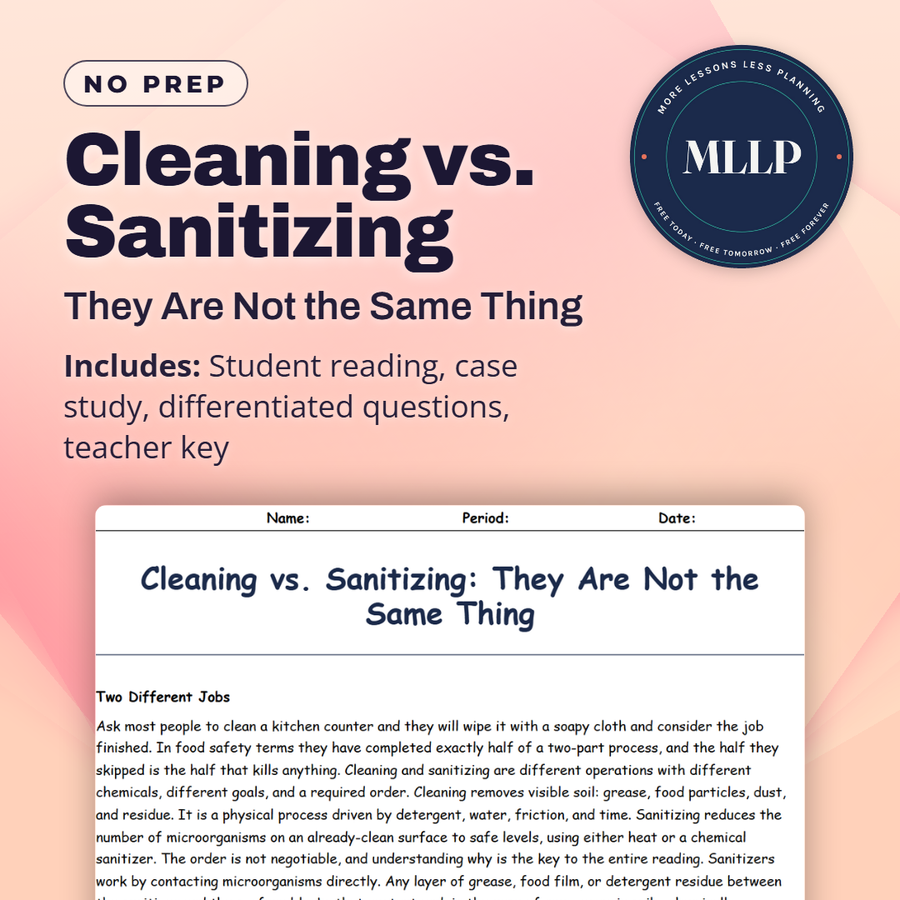
Cleaning vs. Sanitizing: They Are Not the Same Thing
Quality reviewed September 2026
Facts verified September 23, 2026
- Subject
- Career & Life Skills
- Grades
- Grades 9-12
- Length
- 8-page student worksheet
- Time
- About one 50-minute class period
- Great for
- Sub plans and independent work
- Includes
- Reading passage, comprehension questions + full answer key
- Format
- Print-and-go PDF
What students do
- The four factors that make cleaning work, from detergent choice to contact time, get weighed against each other
- Match five cleaning and sanitizing terms to their definitions
- Chlorine, iodine, and quat concentrations get checked against the parts-per-million numbers on the label
- Explain why towel drying is not allowed right after the sanitize step
What it covers
- Why sanitizing has to happen after cleaning, never before
- The correct five-step sequence at a three-compartment sink
- Concentration numbers for chlorine, iodine, and quat sanitizers
Start reading this worksheet
Two Different Jobs
Ask most people to clean a kitchen counter and they will wipe it with a soapy cloth and consider the job finished. In food safety terms they have completed exactly half of a two-part process, and the half they skipped is the half that kills anything. Cleaning and sanitizing are different operations with different chemicals, different goals, and a required order. Cleaning removes visible soil: grease, food particles, dust, and residue. It is a physical process driven by detergent, water, friction, and time. Sanitizing reduces the number of microorganisms on an already-clean surface to safe levels, using either heat or a chemical sanitizer. The order is not negotiable, and understanding why is the key to the entire reading. Sanitizers work by contacting microorganisms directly. Any layer of grease, food film, or detergent residue between the sanitizer and the surface blocks that contact and, in the case of many organic soils, chemically neutralizes the sanitizer outright. Spraying sanitizer onto a dirty counter is close to useless. It is worth noting one more distinction. Sanitizing reduces pathogens to safe levels; it does not eliminate all microorganisms. That stronger claim belongs to sterilizing, which requires equipment and conditions that no kitchen has and no kitchen needs. There is a practical test for whether somebody understands the difference. Ask what happens if you sanitize first and clean second. The answer is that you have wasted the sanitizer and finished with a surface that has detergent residue and no antimicrobial protection at all, which is worse than doing nothing.
The Chemistry of Getting Things Clean
Four factors determine whether cleaning actually works, and adjusting one usually means adjusting another. The first is the cleaning agent itself. Detergents handle everyday grease and food soil. Degreasers, which are strongly alkaline, cut baked-on fat in ovens and hoods. Delimers, which are acidic, remove the mineral scale that builds up in dish machines, steam tables, and coffee equipment in hard-water areas. Abrasive cleaners handle stubborn deposits but scratch soft surfaces, and a scratched surface is a worse surface because scratches shelter bacteria. The second factor is temperature. Warmer water dissolves soil more effectively, which is why dish machines run hot. The third is agitation, meaning the scrubbing, spraying, or brushing that physically breaks soil loose. The fourth is contact time, the length of time the agent stays on the surface doing its work. Weakness in one factor can sometimes be compensated for by strength in another, which is why a long soak substitutes for hard scrubbing. Two rules override the chemistry. Never mix cleaning chemicals, because combining bleach with an acidic or ammonia-based product releases toxic gas that has killed workers in real incidents. And always store chemicals in labeled containers, below and away from food, never in a container that once held food or drink. That last rule has a body count behind it. Sanitizer or degreaser poured into an unlabeled water bottle or a used soda cup has been swallowed by workers and by children in real incidents, and it is the most common chemical hazard health inspectors write up in small kitchens.
Sanitizers and the Numbers That Matter
Sanitizing happens two ways: heat or chemicals. Heat sanitizing means immersing an item in water at 171 degrees F or above for at least thirty seconds, or running it through a high-temperature dish machine whose final rinse reaches 180 degrees F, or 165 degrees F at the dish rack in a stationary machine. Chemical sanitizing is far more common for surfaces and uses one of three approved compounds, each with its own concentration and contact time. Chlorine, usually plain unscented bleach, works at 50 to 100 parts per million with a contact time of about seven seconds, is inexpensive and fast, but corrodes metal and loses strength quickly in light and heat. Iodine works at 12.5 to 25 parts per million with about thirty seconds of contact, is gentle on skin, but stains surfaces and fails in water above 120 degrees F. Quaternary ammonium compounds, called quats, work at roughly 200 parts per million with thirty seconds of contact, are stable and non-corrosive, but are affected by water hardness and cost more. Concentration is verified with test strips, which are the entire point of the system. A sanitizer solution that is too weak does not kill; one that is too strong is a chemical contaminant on food surfaces and can be a health hazard on its own. Four conditions change how any sanitizer performs and all four are worth checking when something is not working: concentration, contact time, water temperature, and water hardness. A solution mixed correctly in very hard water or applied for two seconds instead of thirty is a solution that failed, even though the label was followed.
Like what you read? The full reading, the case study, and every question set are in the free download below, along with the answer key.
Why this matters
A lot of my students will bus tables or wash dishes before they ever sit in a chemistry class, and this is the reading that keeps them out of trouble on day one. The gap between clean and sanitized is exactly the gap a new hire gets tested on during training, and the reading gives real numbers instead of vague advice, what ppm a chlorine solution needs, how long a quat has to sit, what a test strip actually confirms. Hannah's case study, mixing sanitizer by eye for three weeks before a test strip caught it, is the kind of mistake a first-week employee makes without anyone noticing until an inspector walks in.
From one teacher to another
Most kitchen crews treat a wipe with soapy water as the whole job, but the reading walks through why that is only step one. Cleaning removes grease and food soil with detergent, water, and scrubbing, while sanitizing is a separate step that lowers microorganisms on a surface that is already clean. Skip the order and the sanitizer either gets blocked by soil or gets wasted on a film of detergent residue. The reading walks students through the three approved chemical sanitizers, chlorine, iodine, and quats, each with its own concentration and contact time, and through the five-step sequence at a three-compartment sink. A case study follows a closer who mixed a quat bucket by eye for three weeks before a test strip caught it running at a quarter strength.
What you get
Download
Where should I send the next one?
Everything here is free and it stays that way. Leave your email and I'll send you the new lessons as they go up. You can unsubscribe from any one of them.
Related resources
Cross-Contamination and How to Stop It
Date Labels, Spoilage, and When to Throw It Out
Food Handler Hygiene: Gloves, Hair, and When to Stay Home
Foodborne Illness: The Pathogens That Make People Sick
HACCP: How Professionals Keep Food Safe
Kitchen Fires and Emergency Response
Every lesson on this site is free to download and use. If one of them saved you a prep period, you can chip in a few bucks toward my three kids' daycare fund. That's genuinely where tips go.