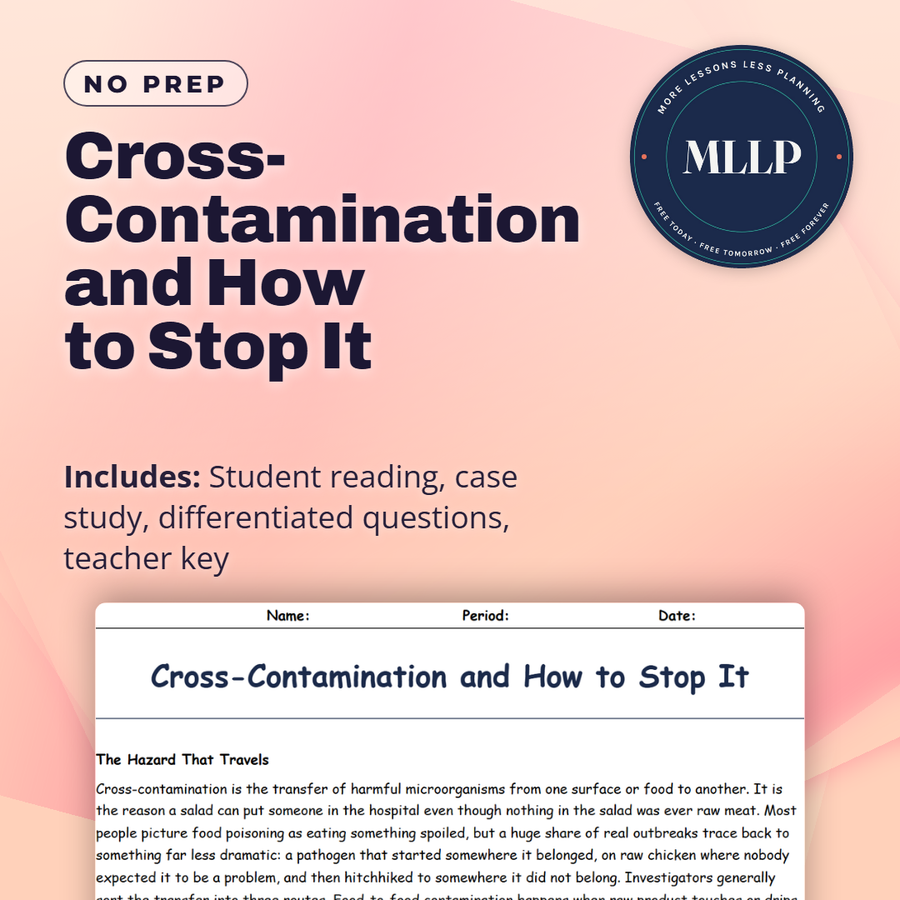
Cross-Contamination and How to Stop It
Quality reviewed September 2026
Facts verified September 23, 2026
- Subject
- Career & Life Skills
- Grades
- Grades 9-12
- Length
- 8-page student worksheet
- Time
- About one 50-minute class period
- Great for
- Sub plans and independent work
- Includes
- Reading passage, comprehension questions + full answer key
- Format
- Print-and-go PDF
What students do
- The three routes food travels when it gets contaminated, food to food, equipment to food, and people to food, get pulled apart with real examples
- Explain how a school lab with only two cutting boards can still prevent cross-contamination
- Identify which of the three contamination routes fits a mistake at a backyard grill
- Explain why cooking Priya's chicken to a safe temperature was still not enough to make the meal safe
What it covers
- The three routes cross-contamination travels through a kitchen
- Why raw poultry sits on the bottom shelf of a cooler
- The ready-to-eat rule and when gloves have to be changed
Start reading this worksheet
The Hazard That Travels
Cross-contamination is the transfer of harmful microorganisms from one surface or food to another. It is the reason a salad can put someone in the hospital even though nothing in the salad was ever raw meat. Most people picture food poisoning as eating something spoiled, but a huge share of real outbreaks trace back to something far less dramatic: a pathogen that started somewhere it belonged, on raw chicken where nobody expected it to be a problem, and then hitchhiked to somewhere it did not belong. Investigators generally sort the transfer into three routes. Food-to-food contamination happens when raw product touches or drips onto ready-to-eat product, which is why raw chicken thawing on a top shelf over a bowl of cut fruit is a textbook violation. Equipment-to-food contamination happens when a cutting board, knife, tong, or thermometer carries residue from one item to the next. People-to-food contamination happens through hands, aprons, sleeves, phones, and hair. The common thread is that every one of these transfers is invisible. Nobody sees the moment it happens, nobody smells it afterward, and the contaminated food looks exactly like the safe food sitting next to it. Because you cannot detect it, you cannot correct it after the fact. Cross-contamination is prevented by layout and habit, or it is not prevented at all. Outbreak investigations bear this out. When health departments trace a restaurant outbreak, the finding is rarely that somebody served raw chicken. It is almost always that raw chicken and something ready-to-eat shared a board, a knife, a pair of tongs, a shelf, or a pair of hands somewhere in the twenty minutes nobody was watching.
Separate Boards and the Color Code
The most visible defense in any professional kitchen is physical separation, and the most common form it takes is a color-coded cutting board system. The colors are not universal by law, but a widely used scheme runs like this: red for raw meat, yellow for raw poultry, blue for raw seafood, green for produce, tan or brown for cooked and ready-to-eat foods, and white for dairy or general use. The point of the system is that it removes judgment from a busy moment. A cook who is three tickets behind does not have to reason about whether the board they just used is safe for lettuce. They look at the color. Where separate boards are not available, the fallback is sequencing: prepare all ready-to-eat foods first, then raw items, washing and sanitizing between each stage. The same logic governs utensils, so tongs that touched raw burgers never touch the cooked ones coming off the grill, and a plate that carried raw chicken to the grill does not carry the finished chicken back. Knives and thermometers deserve particular attention because both get used constantly and both get overlooked. A thermometer probe that goes from raw chicken into a pan of rice has just done exactly what the color-coded boards were designed to prevent. Boards themselves need retiring on a schedule. Deep knife scars in a plastic board hold food particles below the level any brush can reach, and no amount of sanitizer fixes a groove. A heavily scored board gets resurfaced or replaced rather than scrubbed harder.
Storage Order in the Cooler
Refrigerator organization is not about tidiness. It is a ranking system built entirely around one question: if something drips, what does it land on? The standard top-to-bottom order places ready-to-eat foods on the highest shelf, then whole seafood, then whole cuts of beef and pork, then ground meat and ground fish, then whole and ground poultry on the very bottom. That order follows minimum internal cooking temperatures, from lowest to highest. Poultry sits at the bottom because it requires the highest cooking temperature, 165 degrees F, which means it is the item most likely to be carrying something that other foods will not be cooked hot enough to destroy. If raw chicken juice drips onto a bag of salad greens, nothing downstream will fix it, because that salad is never going to be cooked at all. A few other storage habits go with the shelf order. Store raw items in containers with lids or in solid pans rather than on open plates. Keep food at least six inches off the floor and away from walls so air circulates and so mop water and pests stay out of it. Never store chemicals above or beside food, and never reuse a container that held raw product without washing it first. The same ranking logic applies outside the cooler. On a prep table, ready-to-eat items belong upstream of raw protein rather than downstream, and in a shopping cart or grocery bag raw meat goes in its own plastic bag at the bottom, not resting against the produce.
Like what you read? The full reading, the case study, and every question set are in the free download below, along with the answer key.
Why this matters
This one lands close to home because most of my students already handle raw meat at home without a manager standing over them, whether that is grilling for a family cookout or putting away groceries after a store run. The reading's shelf order in the cooler and its three routes of contamination give students a way to explain, in specific terms, why raw chicken juice on lettuce is a real problem and not a parent being fussy. Priya's story, where fully cooked chicken went back onto the platter that carried it out raw, shows that cooking food correctly is not the whole job if the surfaces around it never got swapped out.
From one teacher to another
Nothing about cross-contamination announces itself, which is exactly what makes it dangerous. The reading sorts the hazard into three routes, food-to-food, equipment-to-food, and people-to-food, then walks through the defenses professional kitchens build against each one: color-coded cutting boards, a strict top-to-bottom shelf order in the cooler, and a ready-to-eat rule that bans bare hand contact with food that will not be cooked again. Gloves get a hard look too, since a glove that touches a phone or a trash can is carrying contamination exactly like an unwashed hand. The case study follows Priya at a family cookout, who used the same platter and tongs to carry raw chicken out and cooked chicken back in.
What you get
Download
Where should I send the next one?
Everything here is free and it stays that way. Leave your email and I'll send you the new lessons as they go up. You can unsubscribe from any one of them.
Related resources
Cleaning vs. Sanitizing: They Are Not the Same Thing
Date Labels, Spoilage, and When to Throw It Out
Food Handler Hygiene: Gloves, Hair, and When to Stay Home
Foodborne Illness: The Pathogens That Make People Sick
HACCP: How Professionals Keep Food Safe
Kitchen Fires and Emergency Response
Every lesson on this site is free to download and use. If one of them saved you a prep period, you can chip in a few bucks toward my three kids' daycare fund. That's genuinely where tips go.