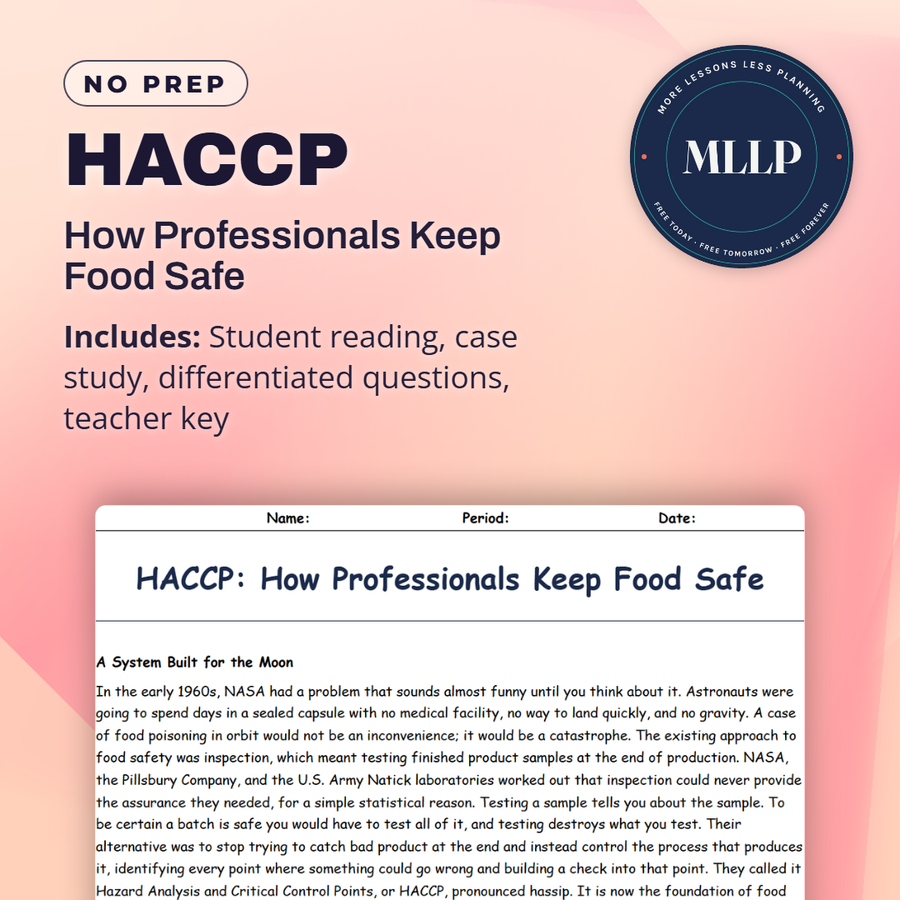
HACCP: How Professionals Keep Food Safe
Quality reviewed September 2026
Facts verified September 23, 2026
- Subject
- Career & Life Skills
- Grades
- Grades 9-12
- Length
- 9-page student worksheet
- Time
- About one 50-minute class period
- Great for
- Sub plans and independent work
- Includes
- Reading passage, comprehension questions + full answer key
- Format
- Print-and-go PDF
What students do
- The seven HACCP principles get put in the order they actually have to run
- Explain why testing a finished sample cannot guarantee a whole batch is safe
- The student monitor and recorded temperature assigned to each CCP get tied back to the two HACCP principles they represent
- The celery-washing argument in Ms. Okafor's class gets settled with the reading's own test
What it covers
- The seven HACCP principles in the order they are applied
- How to tell a control point from a critical control point
- Why HACCP began as a food safety system for astronauts
Start reading this worksheet
A System Built for the Moon
In the early 1960s, NASA had a problem that sounds almost funny until you think about it. Astronauts were going to spend days in a sealed capsule with no medical facility, no way to land quickly, and no gravity. A case of food poisoning in orbit would not be an inconvenience; it would be a catastrophe. The existing approach to food safety was inspection, which meant testing finished product samples at the end of production. NASA, the Pillsbury Company, and the U.S. Army Natick laboratories worked out that inspection could never provide the assurance they needed, for a simple statistical reason. Testing a sample tells you about the sample. To be certain a batch is safe you would have to test all of it, and testing destroys what you test. Their alternative was to stop trying to catch bad product at the end and instead control the process that produces it, identifying every point where something could go wrong and building a check into that point. They called it Hazard Analysis and Critical Control Points, or HACCP, pronounced hassip. It is now the foundation of food safety regulation worldwide, required by the FDA for seafood and juice, by the USDA for meat and poultry, and adopted voluntarily by restaurants, school districts, and food manufacturers everywhere. The first HACCP-controlled foods actually flew on Apollo missions, and the same reasoning later moved into canning, where a single under-processed batch could distribute botulism across an entire distribution region before anyone connected the cases. Astronauts were the reason it was invented, but the grocery store is why it stayed.
Prevention Instead of Inspection
The philosophical shift at the heart of HACCP is worth stating plainly because it applies far beyond food. Inspection asks whether the finished thing is acceptable. Process control asks whether the steps that produce it were performed correctly. Inspection is reactive and expensive: by the time you find a problem, you have already produced a batch, and you may have shipped it. Process control is proactive: if the temperature was verified at the cooking step, the cooling step, and the holding step, then the product is safe by construction and there is nothing left to catch. HACCP also introduces the idea of a hazard, which is anything that could cause illness or injury, sorted into three categories that show up on every food safety exam. Biological hazards are the pathogens covered earlier in this unit: bacteria, viruses, parasites, and fungi. They cause the overwhelming majority of foodborne illness. Chemical hazards include cleaning products, sanitizers at the wrong concentration, pesticide residue, and toxic metals leaching from damaged equipment. Physical hazards are foreign objects: glass, metal shavings, bone fragments, plastic, jewelry, bandages, and hair. A HACCP plan starts by listing every hazard that could realistically enter a specific product at a specific step, which is why the plan for a salad bar looks nothing like the plan for a smokehouse. HACCP also assumes a foundation is already in place. Prerequisite programs, meaning the sanitation schedule, pest control, supplier approval, equipment maintenance, and personal hygiene policies covered earlier in this unit, have to be running before a HACCP plan means anything. HACCP is the roof, not the foundation.
The Seven Principles
HACCP is built on seven principles applied in order, and they are meant to be worked through as a sequence rather than memorized as a list. Principle one is conduct a hazard analysis: map the flow of food through the operation and identify the biological, chemical, and physical hazards at each step. Principle two is determine the critical control points, or CCPs, which are the specific steps where control is essential and where a failure cannot be corrected later. Cooking chicken is a CCP because it is the last chance to destroy Salmonella. Principle three is establish critical limits, the measurable boundaries that separate safe from unsafe, such as cooking chicken to 165 degrees F. Critical limits must be numbers, not adjectives; thoroughly cooked is not a critical limit. Principle four is establish monitoring procedures that state who checks what, how, and how often. Principle five is establish corrective actions, deciding in advance what happens when a limit is missed, such as continuing to cook and rechecking, or discarding the batch. Principle six is establish verification procedures that confirm the system itself is working, including calibrating thermometers and reviewing records. Principle seven is establish record keeping and documentation, because in food safety a control that was not written down did not happen. The order genuinely matters. You cannot pick critical control points before you know the hazards, you cannot set a critical limit for a step you have not identified, and you cannot write a corrective action without a limit to miss. Skipping ahead produces a plan that looks complete and controls nothing.
Like what you read? The full reading, the case study, and every question set are in the free download below, along with the answer key.
Why this matters
This is the reading I point to when a student asks why any of this needs a name and a chart instead of common sense. HACCP is the actual credential behind a ServSafe manager certification, so understanding the seven principles is not academic, it is the difference between a resume line and a blank space for a student heading into restaurant or grocery work. The celery argument in Ms. Okafor's class is worth assigning on its own, because it forces students to apply the critical control point test to a dish instead of memorizing a definition. Once a student can explain why washing lettuce for a salad is critical but washing it for soup is not, they understand the whole framework.
From one teacher to another
NASA needed a food safety system that worked in a sealed capsule with no hospital nearby, and the system it built with Pillsbury in the 1960s is still the backbone of food safety regulation today. The reading walks through the shift from inspection, testing a finished sample, to process control, checking every step along the way, and introduces the seven HACCP principles in the order they have to be applied: hazard analysis, critical control points, critical limits, monitoring, corrective actions, verification, and record keeping. The hardest distinction in the whole reading is between a control point and a critical control point, a step where nothing downstream can fix a failure. Ms. Okafor's foods class works through that exact question with a chicken salad, arguing for twenty minutes about whether washing celery actually counts.
What you get
Download
Where should I send the next one?
Everything here is free and it stays that way. Leave your email and I'll send you the new lessons as they go up. You can unsubscribe from any one of them.
Related resources
Cleaning vs. Sanitizing: They Are Not the Same Thing
Cross-Contamination and How to Stop It
Date Labels, Spoilage, and When to Throw It Out
Food Handler Hygiene: Gloves, Hair, and When to Stay Home
Foodborne Illness: The Pathogens That Make People Sick
Kitchen Fires and Emergency Response
Every lesson on this site is free to download and use. If one of them saved you a prep period, you can chip in a few bucks toward my three kids' daycare fund. That's genuinely where tips go.