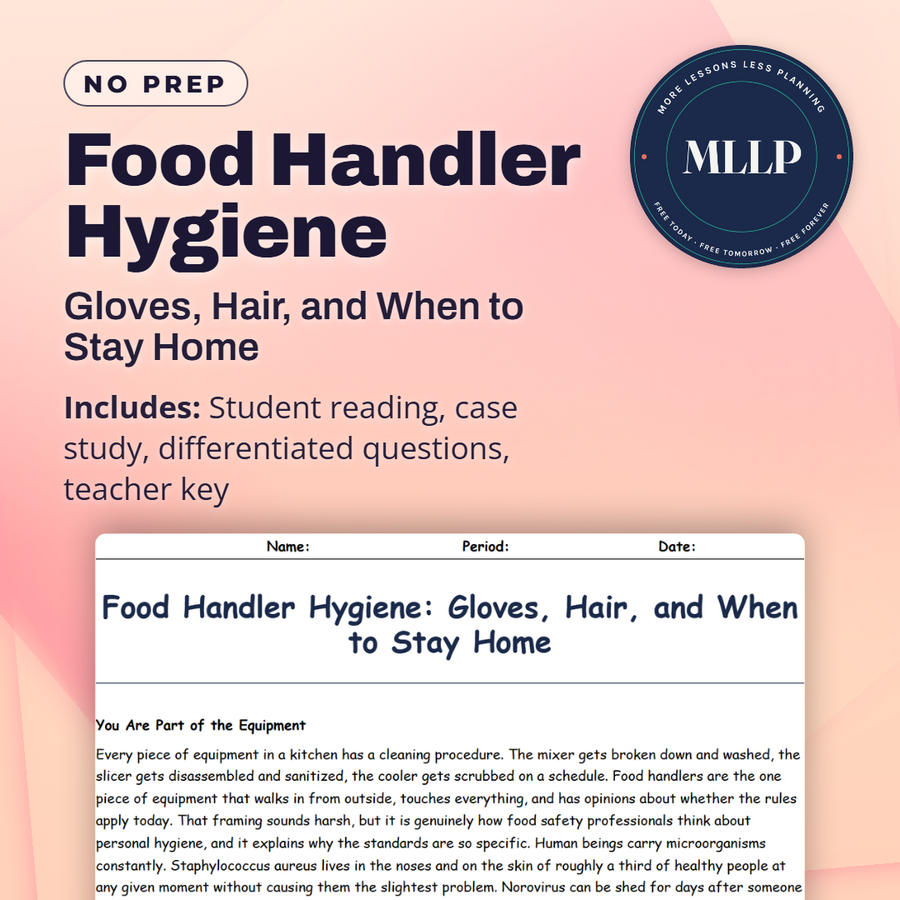
Food Handler Hygiene: Gloves, Hair, and When to Stay Home
Quality reviewed September 2026
Facts verified September 23, 2026
- Subject
- Career & Life Skills
- Grades
- Grades 9-12
- Length
- 9-page student worksheet
- Time
- About one 50-minute class period
- Great for
- Sub plans and independent work
- Includes
- Reading passage, comprehension questions + full answer key
- Format
- Print-and-go PDF
What students do
- The five steps of a proper handwash get laid out in the order a kitchen actually expects
- Fill in the blank on the exact scrub time and return-to-work hours the reading names
- Compare restriction and exclusion using Jordan's cut finger as the test case
- Jordan's cloth-tape bandage gets checked against what the reading requires instead
What it covers
- The five-step handwash and why friction is the part that works
- Jewelry, nail, and hair restraint rules for anyone handling food
- The difference between restriction and exclusion for a sick worker
Start reading this worksheet
You Are Part of the Equipment
Every piece of equipment in a kitchen has a cleaning procedure. The mixer gets broken down and washed, the slicer gets disassembled and sanitized, the cooler gets scrubbed on a schedule. Food handlers are the one piece of equipment that walks in from outside, touches everything, and has opinions about whether the rules apply today. That framing sounds harsh, but it is genuinely how food safety professionals think about personal hygiene, and it explains why the standards are so specific. Human beings carry microorganisms constantly. Staphylococcus aureus lives in the noses and on the skin of roughly a third of healthy people at any given moment without causing them the slightest problem. Norovirus can be shed for days after someone feels completely recovered. Hands pick up material from doorknobs, phones, money, aprons, hair, and faces at a rate nobody consciously tracks. None of this means food workers are dirty. It means people are biological, and a kitchen is a place where biology has consequences. The rules that follow, about handwashing, gloves, hair restraints, jewelry, uniforms, and illness reporting, are not about appearances. Every one of them closes a specific documented transmission path that has caused real outbreaks, and each is written the way it is because a shortcut version failed somewhere. There is a second reason the standards are so specific. Personal hygiene is the one area where a rule stated as a principle invites negotiation, and negotiation happens fastest when a kitchen is busy. A rule with a number in it does not bend under pressure the way a rule with an adjective does.
Handwashing Is a Procedure, Not a Rinse
Handwashing is the single highest-impact action in food safety, and almost everyone does an abbreviated version of it. The full procedure has five steps and takes about twenty seconds of actual scrubbing. Wet your hands with water as hot as you can comfortably stand. Apply soap. Scrub vigorously for ten to fifteen seconds, and scrub the parts people skip: between the fingers, the backs of the hands, the thumbs, under and around the fingernails, and the wrists and forearms. Rinse under running water with your fingers pointed down so the water carries residue off the fingertips rather than back up your arm. Dry with a single-use paper towel or a hand dryer, and use that paper towel to turn off the faucet and open the restroom door. The friction is what does the work. Soap loosens material and running water carries it away, but the physical scrubbing is the part that actually removes Norovirus, which alcohol-based hand sanitizer does not reliably kill. Sanitizer is a supplement applied to already-clean hands, never a replacement. The list of moments requiring a wash is long and non-negotiable: before starting work, before handling ready-to-eat food, before putting on gloves, after using the restroom, after touching raw meat, after eating or drinking, after touching your face or hair, after handling trash or chemicals, after using a phone, and after any break. Where you wash matters as much as how. Handwashing happens at a designated hand sink, never at a prep sink or a dish sink, because those sinks hold food residue and wash water. A hand sink is stocked with soap, single-use towels, a waste container, and a posted sign, and it is used for nothing else.
Hair, Jewelry, Nails, and Uniforms
The rest of personal hygiene policy exists to keep things from falling into food and to remove places where bacteria can hide. Hair restraints are required for anyone working with open food, which means a hat, hair net, visor, or beard restraint that actually holds the hair rather than decorating the head. Loose hair is both a physical contaminant and a reason people touch their heads, which contaminates hands. Jewelry rules are stricter than most students expect: a plain band ring is generally permitted, and everything else, including watches, bracelets, rings with stones, and most hand or wrist jewelry, is not. The reason is twofold. Textured jewelry harbors bacteria in crevices that handwashing cannot reach, and any loose item can fall into food and become a physical hazard. Fingernails must be short, clean, and filed smooth. Nail polish and artificial nails are prohibited in most jurisdictions unless gloves are worn, because polish chips and artificial nails detach and both harbor bacteria underneath. Uniforms should be clean at the start of every shift and aprons should come off before entering a restroom or taking out garbage, then be replaced with a clean one. Eating, drinking, chewing gum, and using tobacco are confined to designated areas away from food, and personal drinks are permitted only in covered containers with a straw, stored below and away from food and prep surfaces. Two habits round out the list. Tasting food requires a clean spoon used once and then set aside for washing, never a finger and never the stirring spoon returned to the pot. And sneezing or coughing means turning fully away from food, covering with the inside of the elbow, and washing your hands afterward.
Like what you read? The full reading, the case study, and every question set are in the free download below, along with the answer key.
Why this matters
Plenty of my students already have a part-time job in food service, and this is the reading where the rules stop being abstract. A five-step handwash sounds simple until students see the actual list of moments that require one, before gloves, after a phone, after touching hair, and realize how often a real shift skips most of them. Jordan's case study lands because his instinct, a strip of tape and getting back to the sandwich station, is exactly what a rushed worker mid-shift would do, and the reading explains precisely why that instinct was wrong. Staying home when you are sick gets the same treatment, the reading names the economic pressure that makes workers show up anyway instead of pretending the rule is easy to follow.
From one teacher to another
Food handlers are treated in this reading as a piece of kitchen equipment that walks in from outside, and the comparison is meant to explain why the rules are so specific. Students work through the full five-step handwashing procedure, learn why friction removes Norovirus when hand sanitizer cannot, and go through the rules on hair restraints, jewelry, nails, and uniforms that keep loose items out of open food. The hardest section covers illness reporting: which symptoms require a manager to be told, the difference between restriction and exclusion, and the twenty-four-hour rule for returning after vomiting or diarrhea stops. The case study follows Jordan, who taped over a cut finger and kept working a dinner rush instead of using a waterproof bandage and a glove.
What you get
Download
Where should I send the next one?
Everything here is free and it stays that way. Leave your email and I'll send you the new lessons as they go up. You can unsubscribe from any one of them.
Related resources
Cleaning vs. Sanitizing: They Are Not the Same Thing
Cross-Contamination and How to Stop It
Date Labels, Spoilage, and When to Throw It Out
Foodborne Illness: The Pathogens That Make People Sick
HACCP: How Professionals Keep Food Safe
Kitchen Fires and Emergency Response
Every lesson on this site is free to download and use. If one of them saved you a prep period, you can chip in a few bucks toward my three kids' daycare fund. That's genuinely where tips go.