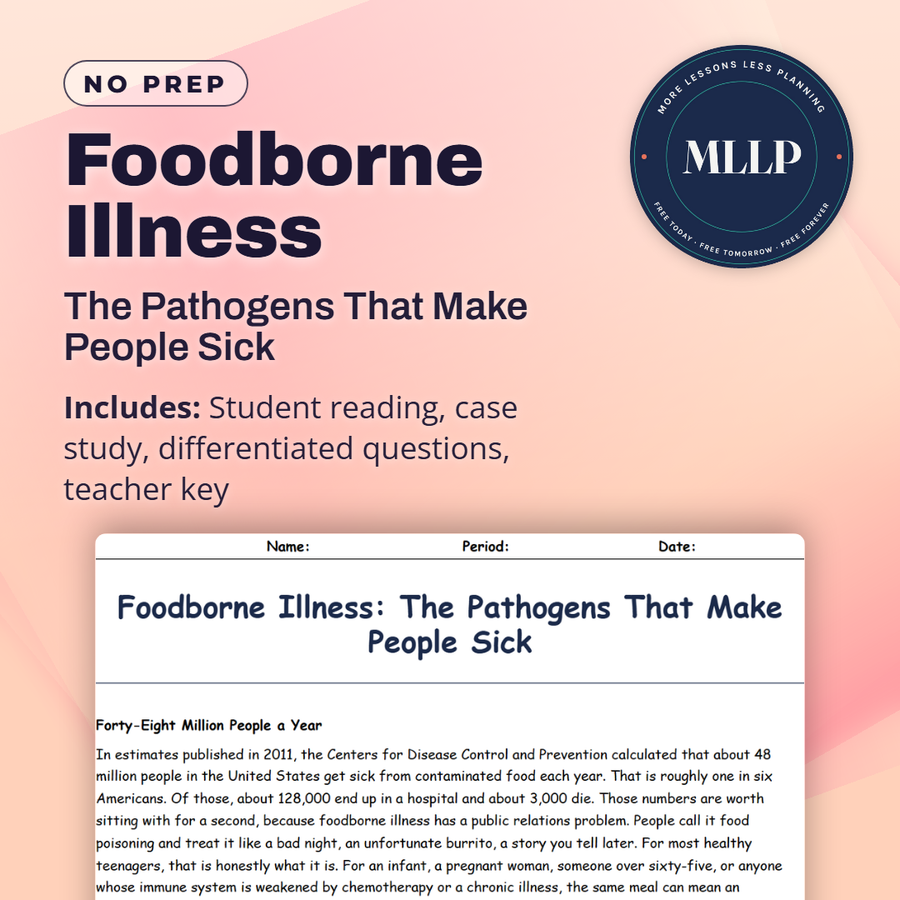
Foodborne Illness: The Pathogens That Make People Sick
Quality reviewed September 2026
Facts verified September 23, 2026
- Subject
- Career & Life Skills
- Grades
- Grades 9-12
- Length
- 9-page student worksheet
- Time
- About one 50-minute class period
- Great for
- Sub plans and independent work
- Includes
- Reading passage, comprehension questions + full answer key
- Format
- Print-and-go PDF
What students do
- Alexis gets excluded from her shift even though she felt fine and planned to wear gloves, and the reading explains why
- Identify which population groups the acronym YOPI covers and why each one is at higher risk
- Answer why staph food poisoning is not fixed by reheating the food
- Alexis's decision to stay home gets weighed against the guest list at the reception she skipped
What it covers
- The specific pathogens behind Salmonella, E. coli, Listeria, and Norovirus outbreaks
- What the Big Six pathogens have in common and why they require exclusion
- The YOPI groups and why the same meal affects them differently
Start reading this worksheet
Forty-Eight Million People a Year
In estimates published in 2011, the Centers for Disease Control and Prevention calculated that about 48 million people in the United States get sick from contaminated food each year. That is roughly one in six Americans. Of those, about 128,000 end up in a hospital and about 3,000 die. Those numbers are worth sitting with for a second, because foodborne illness has a public relations problem. People call it food poisoning and treat it like a bad night, an unfortunate burrito, a story you tell later. For most healthy teenagers, that is honestly what it is. For an infant, a pregnant woman, someone over sixty-five, or anyone whose immune system is weakened by chemotherapy or a chronic illness, the same meal can mean an ambulance. Food poisoning is also almost entirely preventable, which is what separates it from most other public health problems. It is not caused by bad luck or by food that looks or smells wrong. Contaminated food usually looks completely normal, smells completely normal, and tastes completely normal. Your senses were not built to detect a few million bacteria. That is exactly why the food safety system relies on procedures rather than on judgment. You do not decide whether chicken is safe by looking at it. You cook it to a measured internal temperature, and you keep it away from the salad. The rest of this reading is about who the actual culprits are, because you cannot defend against an enemy you cannot name. It helps to know that the four organisms responsible for most severe cases each have a signature: a favorite food, a typical incubation period, and a characteristic set of symptoms. Investigators use those signatures to trace an outbreak backward from a hospital to a specific meal, and sometimes to a specific batch of a specific ingredient.
Bacteria: The Names You Should Know
Bacteria cause the majority of serious foodborne illness, and a handful of species do most of the damage. Salmonella is the classic. It lives in the intestines of poultry and other animals and turns up in raw chicken, eggs, and occasionally produce contaminated by irrigation water. It causes fever, cramps, and diarrhea, usually starting somewhere between six hours and six days after exposure. Escherichia coli O157:H7, usually written E. coli, is far rarer but far more dangerous. It comes primarily from ground beef and from leafy greens grown near cattle operations, and it can produce a toxin that shuts down the kidneys, especially in young children. Listeria monocytogenes is unusual because it grows at refrigerator temperatures, which defeats the main defense most people rely on. It shows up in deli meats, hot dogs, soft cheeses made from unpasteurized milk, and smoked seafood, and it is the reason pregnant patients get handed a list of foods to avoid. Clostridium botulinum produces the toxin behind botulism, thrives without oxygen in improperly home-canned foods, and attacks the nervous system. Staphylococcus aureus lives on human skin and in noses, gets into food through bare hands, and produces a toxin that cooking will not destroy. That last detail matters more than it sounds: with staph, reheating the food does not fix it. Clostridium perfringens deserves a mention too, because it specializes in exactly the food a school or church kitchen produces. It thrives in large batches of meat, gravy, and stew that cool too slowly, which has earned it the nickname the cafeteria germ. Every one of these organisms is defeated by the same short list of controls covered in this unit.
Viruses, Parasites, and the Rest of the Lineup
Bacteria get the headlines, but the single most common cause of foodborne illness in the United States is a virus. Norovirus has accounted for something like half of all reported outbreaks. You may know it as the cruise ship bug or the stomach flu, though it is not related to influenza at all. Norovirus spreads through the fecal-oral route, which is a clinical way of saying that microscopic particles travel from a bathroom to a food surface on unwashed hands. It takes an astonishingly small dose to infect someone, it survives on surfaces for days, and ordinary hand sanitizer does not reliably kill it. Soap, friction, and running water do. This is the single strongest argument for the handwashing rules in the next reading. Hepatitis A is another virus transmitted the same way, though it attacks the liver and can be prevented with a vaccine. Parasites are less common in the United States but still real. Trichinella is associated with undercooked pork and wild game, Giardia with contaminated water, and Anisakis with raw fish that was not frozen properly first. Finally, not everything that makes people sick is alive at all. Chemical contamination from cleaning products stored above food, and physical contamination from glass, metal shavings, or a piece of jewelry, both count as foodborne hazards and both show up in real incident reports. Allergens belong on the list as well. For a person with a peanut or shellfish allergy, a trace amount transferred by a shared utensil is a medical emergency that has nothing to do with bacteria, which is why allergen control is treated as a food safety responsibility rather than a customer preference.
Like what you read? The full reading, the case study, and every question set are in the free download below, along with the answer key.
Why this matters
Almost every teenager I teach has a grandparent, a baby cousin, or a pregnant aunt somewhere in their extended family, which makes the YOPI section land harder than a list of bacteria names ever could on its own. The reading's point is not that food safety matters in the abstract, it is that the same plate of food that gives a healthy seventeen-year-old one rough night can put someone they love in the hospital. Alexis's case study makes that concrete: she felt fine the morning after getting sick, but Norovirus keeps shedding for days, and the guest list at that reception included exactly the people the reading warns about. Naming the actual pathogens, rather than saying food poisoning in general, is what lets students explain a real risk instead of repeating a vague warning.
From one teacher to another
Forty-eight million Americans get sick from contaminated food every year, based on the CDC's 2011 estimates that open the reading, and most of those cases never make the news because the food looked, smelled, and tasted completely normal. Students meet the specific pathogens behind that number: Salmonella in poultry and eggs, E. coli in ground beef and leafy greens, Listeria growing quietly inside a refrigerator, and Norovirus spreading through unwashed hands faster than any of the others. The reading singles out the Big Six, the pathogens contagious enough that a diagnosed worker has to be excluded from the kitchen entirely, and explains the YOPI groups, young, old, pregnant, and immunocompromised, who face the worst outcomes from the same meal a healthy teenager barely notices. The case study follows Alexis, a seventeen-year-old caterer who wanted to work a shift the morning after a night of vomiting.
What you get
Download
Where should I send the next one?
Everything here is free and it stays that way. Leave your email and I'll send you the new lessons as they go up. You can unsubscribe from any one of them.
Related resources
Cleaning vs. Sanitizing: They Are Not the Same Thing
Cross-Contamination and How to Stop It
Date Labels, Spoilage, and When to Throw It Out
Food Handler Hygiene: Gloves, Hair, and When to Stay Home
HACCP: How Professionals Keep Food Safe
Kitchen Fires and Emergency Response
Every lesson on this site is free to download and use. If one of them saved you a prep period, you can chip in a few bucks toward my three kids' daycare fund. That's genuinely where tips go.