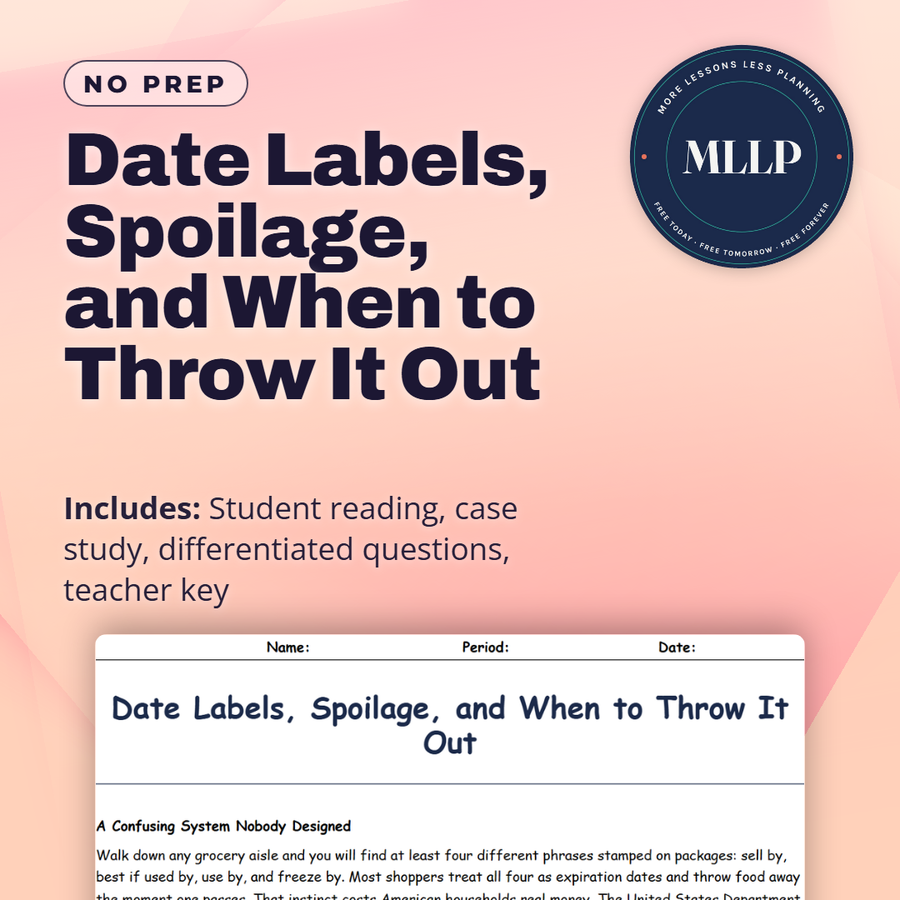
Date Labels, Spoilage, and When to Throw It Out
Quality reviewed September 2026
Facts verified September 23, 2026
- Subject
- Career & Life Skills
- Grades
- Grades 9-12
- Length
- 8-page student worksheet
- Time
- About one 50-minute class period
- Great for
- Sub plans and independent work
- Includes
- Reading passage, comprehension questions + full answer key
- Format
- Print-and-go PDF
What students do
- The difference between a sell-by date and a use-by date gets untangled phrase by phrase
- A moldy block of cheddar gets checked against the one-inch cut rule for hard foods
- Explain why the smell test could not tell Nia whether her chicken was safe
- Nia's thirteen hours on the counter get checked against the reading's four-hour danger zone limit
What it covers
- What sell by, best if used by, and use by actually mean
- Why pathogens rarely change how food looks or smells
- The mold rule for hard cheese versus soft foods like bread
Start reading this worksheet
A Confusing System Nobody Designed
Walk down any grocery aisle and you will find at least four different phrases stamped on packages: sell by, best if used by, use by, and freeze by. Most shoppers treat all four as expiration dates and throw food away the moment one passes. That instinct costs American households real money. The United States Department of Agriculture has estimated that between thirty and forty percent of the food supply in this country is wasted, and misreading date labels is one of the documented contributors. Here is the part that surprises almost everyone: with a single exception, date labels on food packaging in the United States are not federally regulated and are not safety deadlines at all. They are quality estimates set by the manufacturer, indicating when the product will be at its peak flavor, color, and texture. The one exception is infant formula, which carries a federally regulated use-by date because its nutrient content degrades measurably over time. Everything else, from a carton of milk to a bag of chips to a can of beans, is labeled at the manufacturer's discretion. States add their own patchwork rules, which is why the same brand can be labeled differently in different places. Understanding what each phrase actually means turns a guessing game into a decision you can defend. Industry groups have pushed to standardize the whole mess down to two phrases, best if used by for quality and use by for the small number of products where safety genuinely degrades. Adoption has been voluntary and uneven, so for now the burden of interpretation still sits with the shopper.
What Each Phrase Actually Means
Sell by is a stock rotation instruction written for the store, not for you. It tells the retailer the last day the item should be displayed, and it deliberately leaves a window of home storage life after that date. Milk with a sell-by date is typically good for about a week beyond it if it has been continuously refrigerated. Best if used by, sometimes written best before, is the manufacturer's estimate of peak quality. Past that date the food is generally still safe but may lose flavor, crispness, or color. Crackers go stale, canned tomatoes darken, spices fade. Use by is the manufacturer's last recommended date for peak quality, and it is the phrase closest to what people imagine an expiration date to be, but outside of infant formula it is still a quality date rather than a safety one. Freeze by tells you when to move the product to the freezer to preserve quality, and it says nothing about the safety of the food on the shelf. Two related labels appear on packages as well. A packed-on date, often coded, tells when the item was packaged. A closed or coded date is a manufacturer's internal tracking code used for recalls, which is why keeping packaging until a product is consumed is genuinely useful. Eggs carry a third code worth knowing. USDA-graded cartons are stamped with a three-digit Julian date giving the day of the year the eggs were packed, so 032 means February 1. Properly refrigerated eggs stay good three to five weeks past that pack date, which is usually well beyond the printed sell-by.
Spoilage Organisms Are Not Pathogens
The most important idea in this entire reading is that the microorganisms that make food look and smell bad are usually not the microorganisms that make people sick. Spoilage organisms, which include most molds, yeasts, and certain bacteria, break down food and produce the visible and smellable signs everybody recognizes: sour milk, slimy chicken, fuzzy bread, off odors, and discoloration. They are doing you a favor. They announce themselves. Pathogens, the organisms that cause foodborne illness, generally do not change the appearance, smell, or taste of food at all. This produces a counterintuitive conclusion that runs both directions. Food can look and smell disgusting and be technically harmless, and food can look and smell perfectly fine and be capable of hospitalizing someone. It is why the sniff test is unreliable as a safety check, though it remains a perfectly good quality check. It is also why time and temperature records outrank sensory judgment every time. A container of chicken salad that sat on a counter for six hours is unsafe regardless of how it smells, and a jar of pickles with a slightly cloudy brine may be entirely fine. When food safety professionals say when in doubt, throw it out, they are not talking about smell. They are talking about not knowing the food's temperature history. Tasting is worse than smelling as a safety test, and it is the one shortcut that carries real consequences. Some pathogens require only a handful of cells to cause illness, and botulinum toxin is dangerous in amounts far too small to taste. A sample is not a test.
Like what you read? The full reading, the case study, and every question set are in the free download below, along with the answer key.
Why this matters
Every one of my students has stood in front of a fridge deciding whether to trust a date stamped on a carton, and most of them throw out food that was still fine. The reading names the number worth remembering, thirty to forty percent of the food supply in this country goes to waste according to USDA estimates, and ties a real share of that to reading a quality date as a safety deadline. Nia's case study makes the harder point too, a chicken that smelled completely normal after thirteen hours on the counter was not safe, because pathogens do not announce themselves the way spoiled food does. Knowing which question to ask first, how long was this out rather than what does the date say, is a skill that saves both money and a bad night.
From one teacher to another
Grocery store dates confuse almost everyone, and the reading opens by explaining why: outside of infant formula, none of the phrases stamped on packaging, sell by, best if used by, use by, or freeze by, are federally regulated safety deadlines. They are quality estimates set by the manufacturer. The reading then separates spoilage organisms, which announce themselves through smell and slime, from pathogens, which usually change nothing about how food looks or tastes. That distinction is why a smell test is a quality check and never a safety check. Students read through the mold rules for hard versus soft foods and finish with a four-question process for deciding what to keep, starting with temperature history rather than the printed date. The case study follows Nia, who trusted her nose on a rotisserie chicken left out overnight.
What you get
Download
Where should I send the next one?
Everything here is free and it stays that way. Leave your email and I'll send you the new lessons as they go up. You can unsubscribe from any one of them.
Related resources
Cleaning vs. Sanitizing: They Are Not the Same Thing
Cross-Contamination and How to Stop It
Food Handler Hygiene: Gloves, Hair, and When to Stay Home
Foodborne Illness: The Pathogens That Make People Sick
HACCP: How Professionals Keep Food Safe
Kitchen Fires and Emergency Response
Every lesson on this site is free to download and use. If one of them saved you a prep period, you can chip in a few bucks toward my three kids' daycare fund. That's genuinely where tips go.