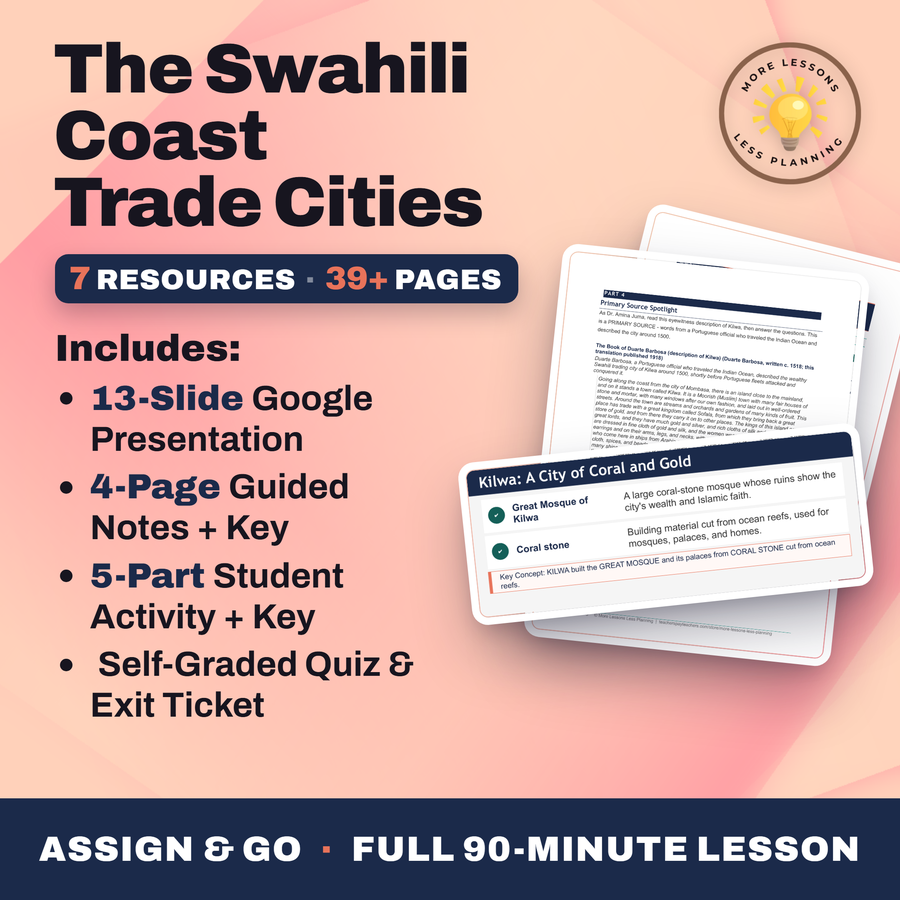
The Swahili Coast Trade Cities
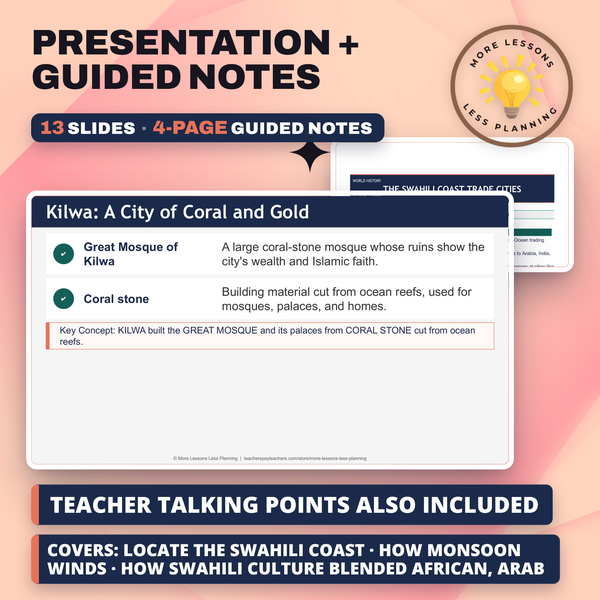
- Slide deck
- Guided notes
- Guided notes teacher key
- Activity + answer key
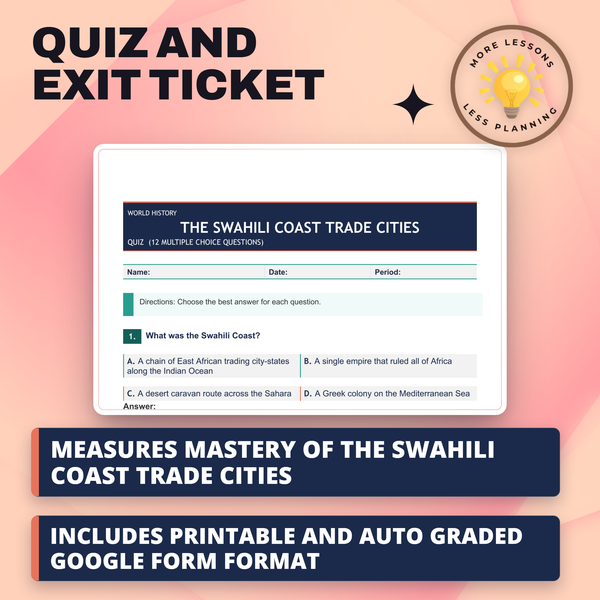
- Quiz + answer key
- Exit ticket + answer key
- Teacher guide
- Teacher presentation notes
Where should I send the next one?
Everything here is free and it stays that way. Leave your email and I'll send you the new lessons as they go up. You can unsubscribe from any one of them.
Every file in this toolkit
Related resources
Great Zimbabwe Stone City
Mansa Musa's Pilgrimage to Mecca
Songhai and Timbuktu Scholarship
The Great Schism of 1054
The Islamic Golden Age
The Rise of Islam and the Caliphates
What students do
- Locate the Swahili Coast city-states and argue why the coastline made them wealthy trading centers
- Explain how monsoon winds carried ships between East Africa, Arabia, India, and China on a yearly cycle
- Decode how Kilwa's coral-stone mosques and the Swahili language blend African, Arab, and Indian Ocean roots
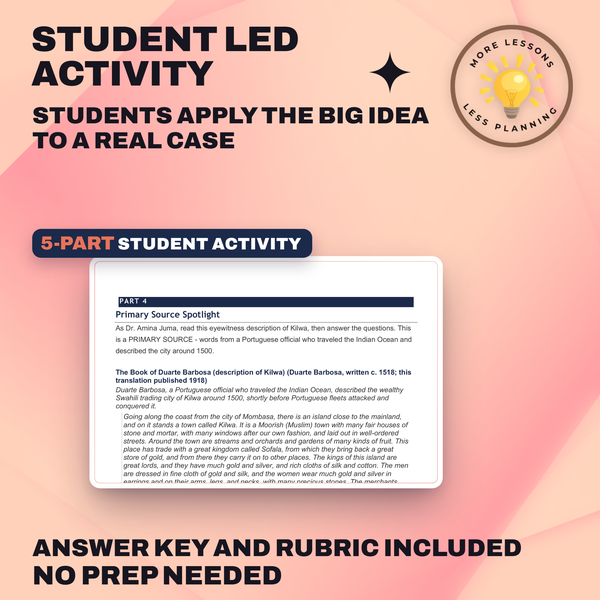
- Analyze Duarte Barbosa's eyewitness description of Kilwa alongside the archaeological record
What it covers
- Kilwa's rise on the southern gold trade and the port of Sofala that fed it
- The Great Mosque of Kilwa's coral-stone ruins as evidence of the city's wealth and faith
- How merchants traded African gold and ivory for foreign cloth and porcelain
- How historians combine a written account with archaeology to reconstruct a coastal culture
Learning targets
- Locate the Swahili Coast and explain why its cities became wealthy Indian Ocean trading centers.
- Explain how monsoon winds and Indian Ocean trade connected East Africa to Arabia, India, and China.
- Describe how Swahili culture blended African, Arab, and Indian Ocean influences at cities like Kilwa.
- Analyze how historians combine a written primary source with archaeology to reconstruct the Swahili Coast.
From one teacher to another
I like this one because it gives students a culture that's genuinely blended, not borrowed, and the coral-stone ruins at Kilwa make that argument better than I ever could in a lecture. Barbosa's account puts an actual eyewitness in the room, so instead of taking my word for Kilwa's wealth, students weigh his description against what archaeologists actually dug up. It's a good lesson for showing how trade and geography, not conquest, built one of the richest stretches of coastline in the medieval world.
Every lesson on this site is free to download and use. If one of them saved you a prep period, you can chip in a few bucks toward my three kids' daycare fund. That's genuinely where tips go.