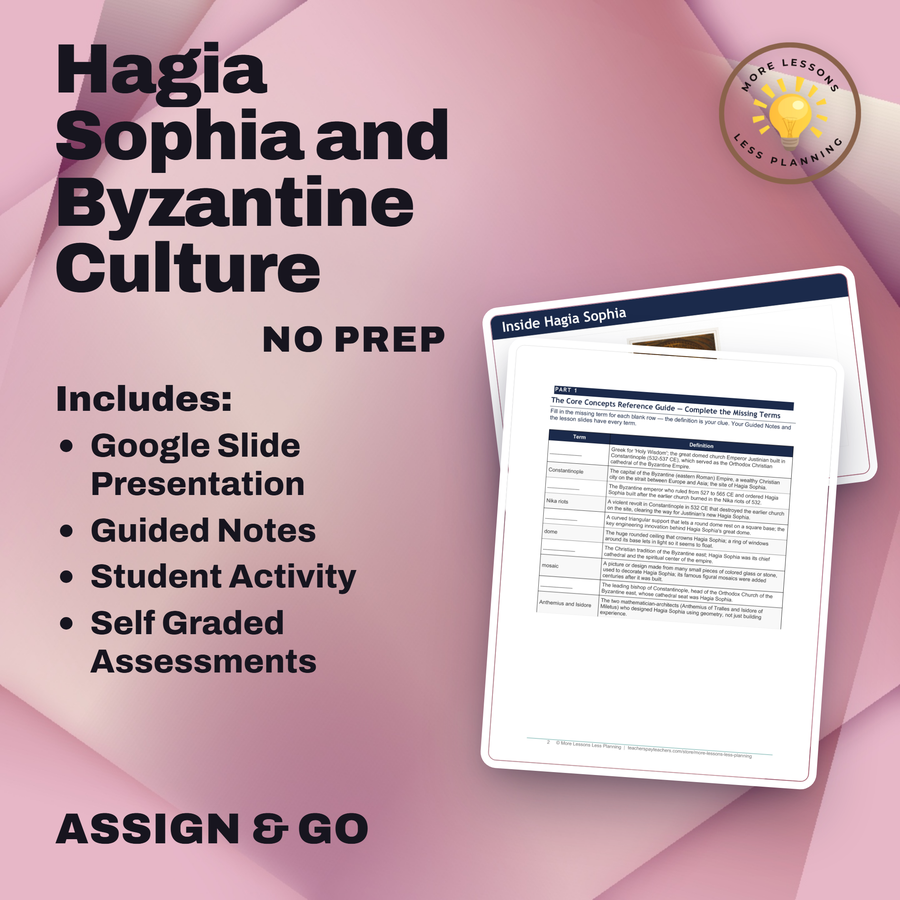
Hagia Sophia and Byzantine Culture
Quality reviewed September 2026
- Subject
- World History
- Grades
- Grades 9-12
- Time
- About two 50-minute class periods
- Includes
- 11 ready-to-teach files
- Format
- Word (.docx) · PowerPoint (.pptx)
- Slide deck
- Guided notes
- Guided notes teacher key
- Activity + answer key
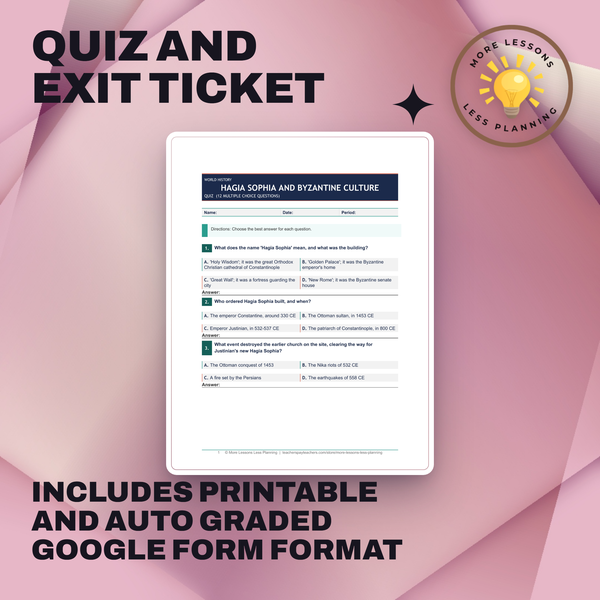
- Quiz + answer key
- Exit ticket + answer key
- Teacher guide
- Teacher presentation notes
What students do
- Explain how the pendentives and ring of windows made Hagia Sophia's dome seem to float
- Trace why Justinian ordered the church built in 532-537 CE after the Nika riots destroyed the earlier one
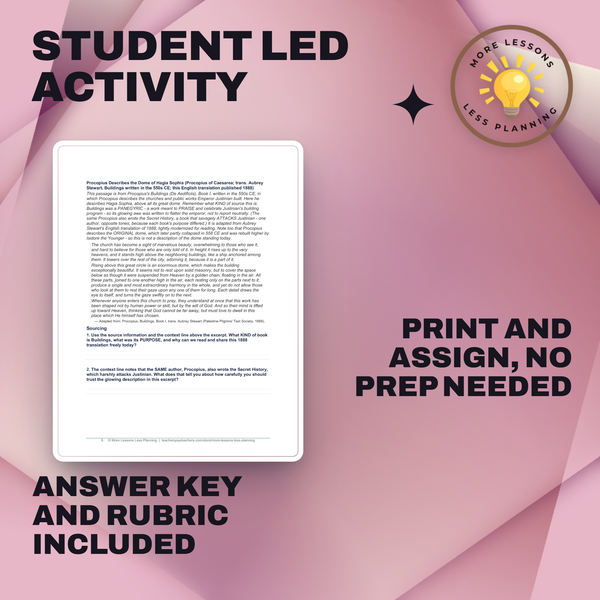
- Read Procopius's account of Hagia Sophia and explain why commissioned praise isn't the same as neutral reporting
- Describe Hagia Sophia's role as the Orthodox cathedral and religious heart of Constantinople
What it covers
- The dome, the pendentives, and the ring of windows behind Hagia Sophia's "floating dome" effect
- The Nika riots of 532 CE and why Justinian rebuilt on the site at all
- Anthemius of Tralles and Isidore of Miletus, the mathematician-architects who designed the church
- Procopius's Buildings and why the same historian who praised Justinian here also wrote a scathing Secret History about him
Learning targets
- Explain what Hagia Sophia was ('Holy Wisdom'), who had it built and when, and what it meant as the Orthodox cathedral at the heart of Constantinople.
- Describe the engineering that made Hagia Sophia possible - the dome, the pendentives, and the ring of windows that creates the 'floating dome' effect - and explain that the original dome collapsed and was rebuilt.
- Explain how Hagia Sophia reflected Byzantine wealth, engineering skill, and Orthodox Christian identity.
- Read an excerpt from Procopius's Buildings as a primary source, and read it critically as commissioned praise rather than neutral reporting.
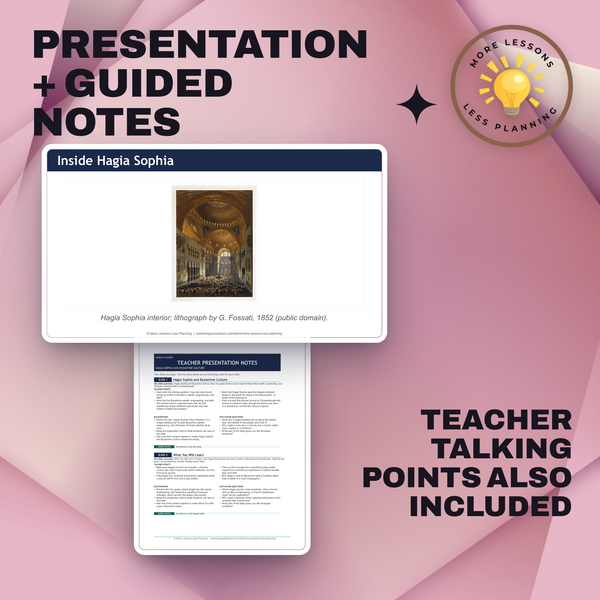
Peek inside
'Holy Wisdom'
Hagia Sophia is Greek for 'Holy Wisdom.'
It was the great domed cathedral of the Byzantine Empire.
It was the chief church of Orthodox Christianity in the east.
The heart of Constantinople
'Holy Wisdom'
is Greek for 'Holy Wisdom.' It was the great domed cathedral that Emperor Justinian built in Constantinople, and it served as the Orthodox Christian cathedral of the Byzantine Empire.
The church stood in , the capital of the Byzantine Empire — a wealthy Christian city on the strait between Europe and Asia, and the site of Hagia Sophia.
1. The Byzantine Empire's greatest church, Greek for 'Holy Wisdom,' stood at the very heart of Constantinople. This great domed cathedral was called .
Why this matters
A dome this heavy has no business looking like it floats. Pendentives carry the weight into the walls while a ring of windows at the base breaks up the shadow, so the dome reads as weightless. Anthemius of Tralles and Isidore of Miletus worked out that geometry after the Nika riots leveled the church before it.
Rebuilding on the same ground after a riot is its own kind of statement, and the scale reinforces it: this was never just an impressive building, it was the religious center of an empire, built to argue for Byzantine power alongside Byzantine faith.
From one teacher to another
The hook I use every year is that Procopius, the historian whose glowing account of Hagia Sophia students read in this lesson, also secretly wrote a Secret History that tears Justinian apart, so before they trust a single line of his praise, we talk about who paid for it and why. That sets up the engineering piece honestly: the pendentives and the ring of windows really did let Byzantine builders make a stone dome look weightless, and Anthemius and Isidore worked that out with geometry, not guesswork. By the end, students can explain why Justinian rebuilt after the Nika riots and why a cathedral this size sat at the actual center of Byzantine religious and political life, not just the visual center of Constantinople.
Every file in this toolkit
Download
Where should I send the next one?
Everything here is free and it stays that way. Leave your email and I'll send you the new lessons as they go up. You can unsubscribe from any one of them.
Related resources
Ghana and the Gold-Salt Trade
Great Zimbabwe Stone City
Justinian and Byzantine Law
Mansa Musa's Pilgrimage to Mecca
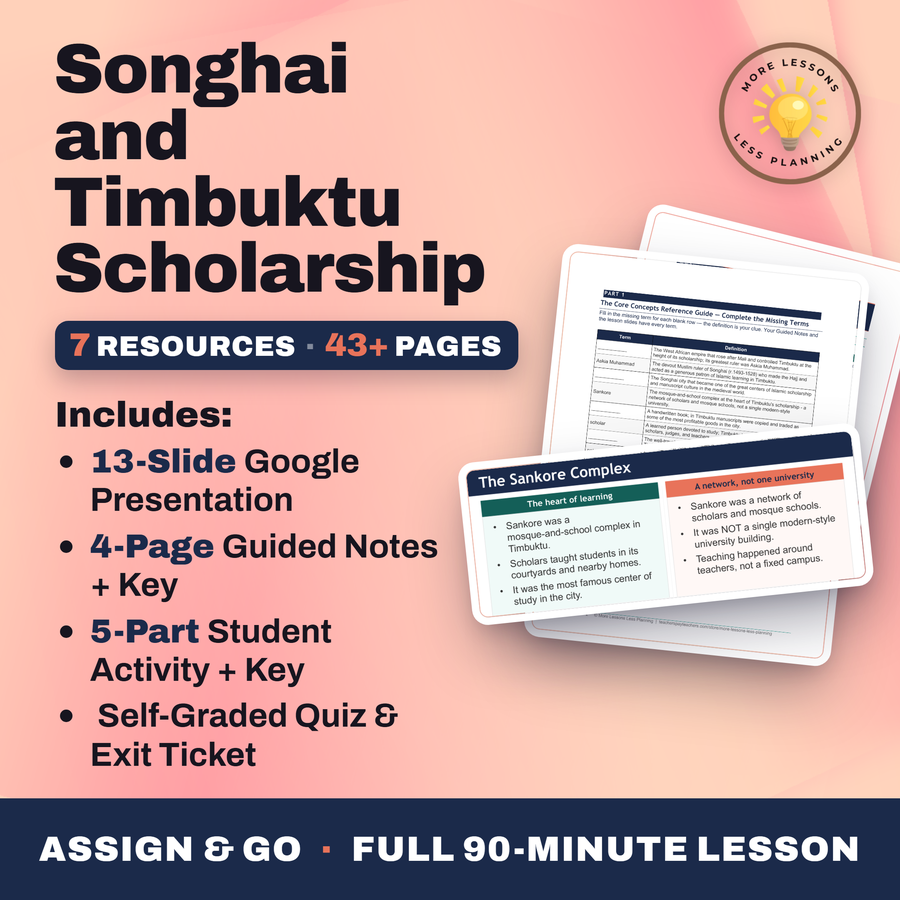
Songhai and Timbuktu Scholarship
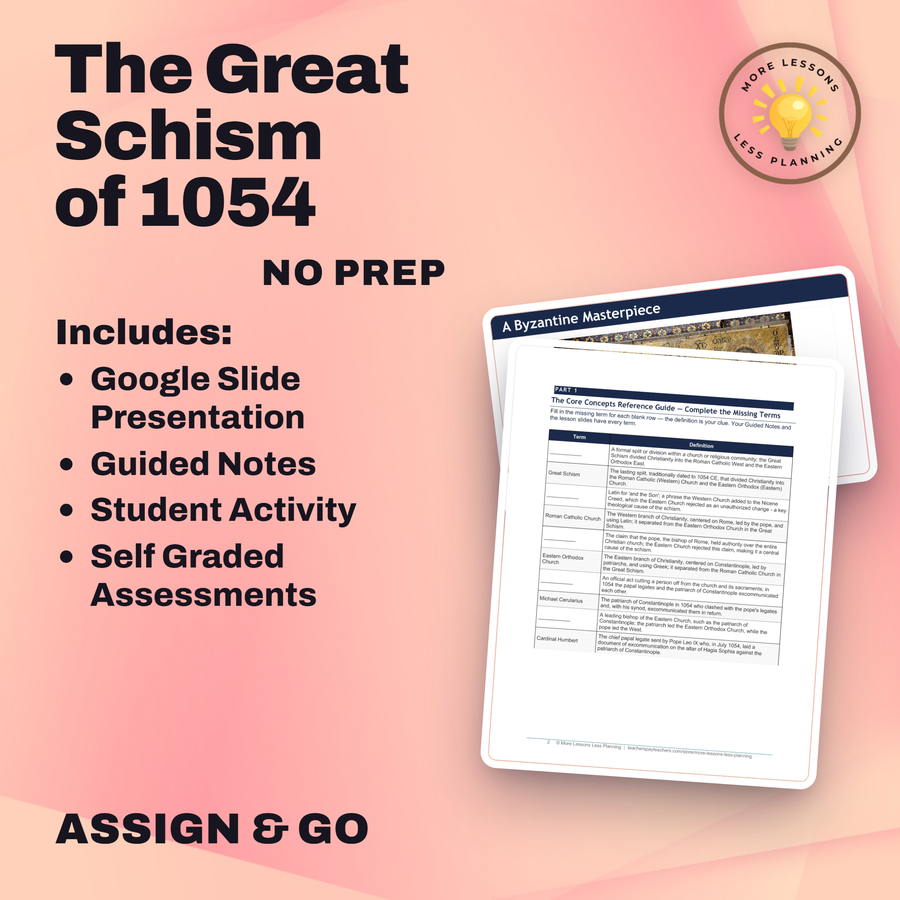
The Great Schism of 1054
Every lesson on this site is free to download and use. If one of them saved you a prep period, you can chip in a few bucks toward my three kids' daycare fund. That's genuinely where tips go.