
Ghana and the Gold-Salt Trade
Quality reviewed September 2026
- Subject
- World History
- Grades
- Grades 9-12
- Time
- About two 50-minute class periods
- Includes
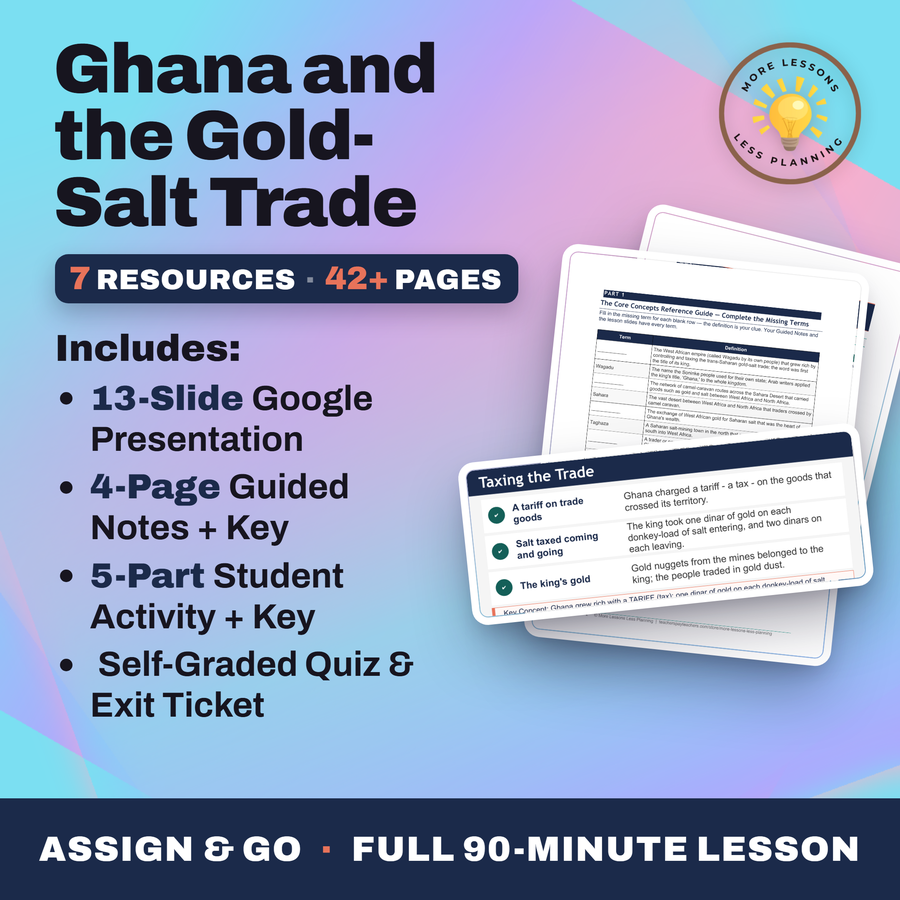
- 11 ready-to-teach files
- Format
- Word (.docx) · PowerPoint (.pptx)
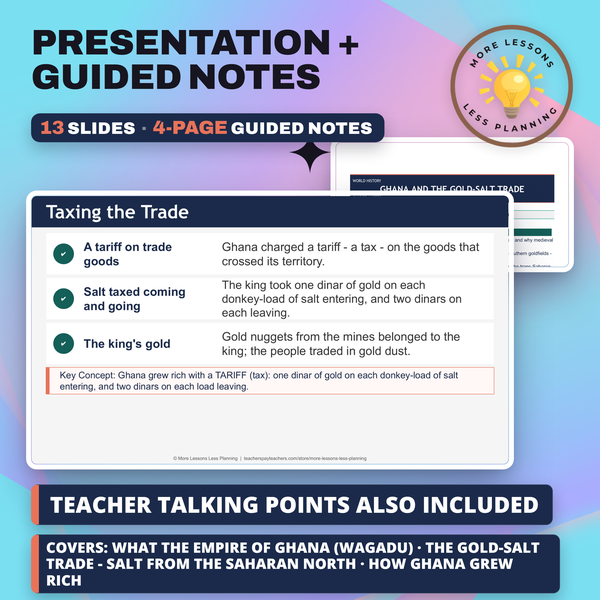
- Slide deck
- Guided notes
- Guided notes teacher key
- Activity + answer key
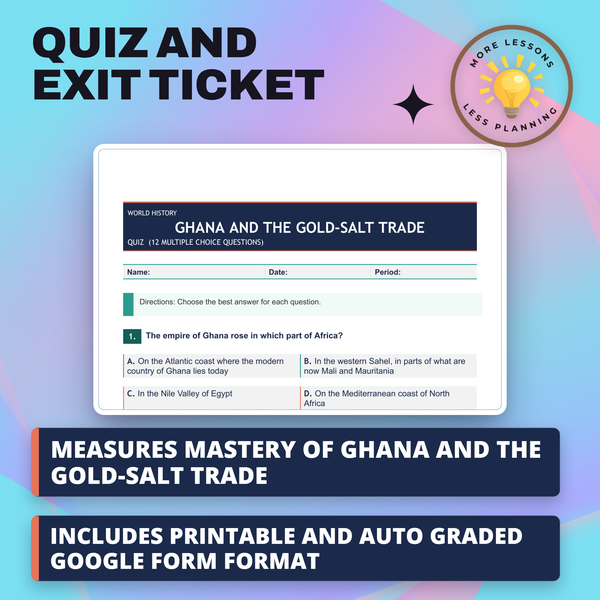
- Quiz + answer key
- Exit ticket + answer key
- Teacher guide
- Teacher presentation notes
What students do
- Explain why medieval Ghana, called Wagadu by its own people, is not the modern nation of the same name
- Trace the gold-salt trade and explain how Ghana grew rich as a middleman rather than a gold miner
- Read al-Bakri's eleventh-century account of the royal court and evaluate it as a secondhand source
- Write a report correcting two common misconceptions about Ghana, using specific lesson evidence
What it covers
- Why the empire of Ghana, called Wagadu by the Soninke, sat in the western Sahel, not on the modern nation's coast
- The gold-salt trade, with salt moving south from Saharan mines and gold moving north from southern goldfields
- The tariff the king charged on the trade, one dinar of gold per donkey-load of salt entering, two leaving
- Al-Bakri's account of Koumbi Saleh's twin towns, written from travelers' reports rather than a visit
Learning targets
- Explain what the empire of Ghana (Wagadu) was, where and when it rose, and why medieval Ghana is not the modern nation of the same name.
- Describe the gold-salt trade - salt from the Saharan north, gold from the southern goldfields - and why each was so valuable.
- Explain how Ghana grew rich as the middleman that controlled and taxed the trans-Saharan trade rather than mining gold itself.
- Analyze a primary source - al-Bakri's eleventh-century description of Ghana's royal court and the taxation of gold and salt (via Dubois, 1896) - and judge it as a secondhand account.
Peek inside
West Africa's first great empire
The empire of Ghana rose in the western Sahel of Africa.
Its own Soninke people called their state Wagadu.
'Ghana' was first the title of its king, then the kingdom.
Not the modern country
West Africa's First Great Empire
The West African empire that grew rich by controlling and taxing the trans-Saharan gold-salt trade - called WAGADU by its own Soninke people - is the empire of .
Wagadu was the name the Soninke used for their state; 'Ghana' was first the king's TITLE. Medieval Ghana sat in the western Sahel, NOT the modern nation, which took the old name in .
1. The West African empire that grew rich by controlling and taxing the trade across the desert - called Wagadu by its own Soninke people - was .
Why this matters
Koumbi Saleh wasn't one city but two, and al-Bakri's account of its layout is one of the few details that survive about how the empire organized itself, not just what it traded. It sat in the western Sahel, nowhere near the coastline of the country that later borrowed its name.
Sitting on the route between Saharan salt and southern goldfields meant the empire never had to mine an ounce of gold to profit from every ounce passing through. Students who equate wealth with owning the resource have to rethink that here, because Ghana's wealth came from position, not production.
From one teacher to another
The correction I make on day one is that the country called Ghana today borrowed its name from an empire that sat somewhere else entirely and ended centuries earlier, so students spend the whole lesson learning about medieval Wagadu instead. The economics is the part that surprises them: Ghana never mined much of its own gold, it grew rich as the middleman sitting between Saharan salt in the north and goldfields in the south, taxing every donkey-load of salt that crossed its land at one dinar of gold coming in and two going out. They read al-Bakri's eleventh-century description of the king's gold-draped court, and I make them notice he never actually visited Ghana himself, he compiled it from merchants' reports, so it's a rich source but a secondhand one. It ends with them correcting two specific wrong claims about Ghana in writing, which is a better test of whether the middleman idea stuck than just answering multiple choice.
Every file in this toolkit
Download
Where should I send the next one?
Everything here is free and it stays that way. Leave your email and I'll send you the new lessons as they go up. You can unsubscribe from any one of them.
Related resources
Great Zimbabwe Stone City
Hagia Sophia and Byzantine Culture
Justinian and Byzantine Law
Mansa Musa's Pilgrimage to Mecca
Songhai and Timbuktu Scholarship
The Great Schism of 1054
Every lesson on this site is free to download and use. If one of them saved you a prep period, you can chip in a few bucks toward my three kids' daycare fund. That's genuinely where tips go.