

Justinian and Byzantine Law
Quality reviewed September 2026
- Subject
- World History
- Grades
- Grades 9-12
- Time
- About two 50-minute class periods
- Includes
- 11 ready-to-teach files
- Format
- Word (.docx) · PowerPoint (.pptx)
- Slide deck
- Guided notes
- Guided notes teacher key
- Activity + answer key
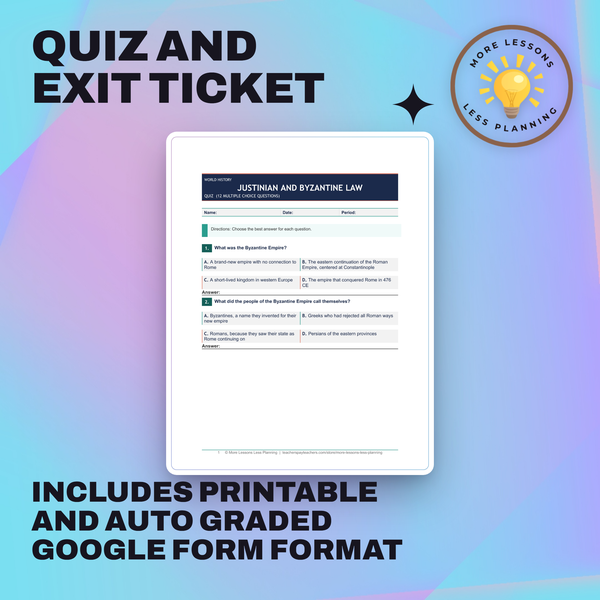
- Quiz + answer key
- Exit ticket + answer key
- Teacher guide
- Teacher presentation notes
What students do
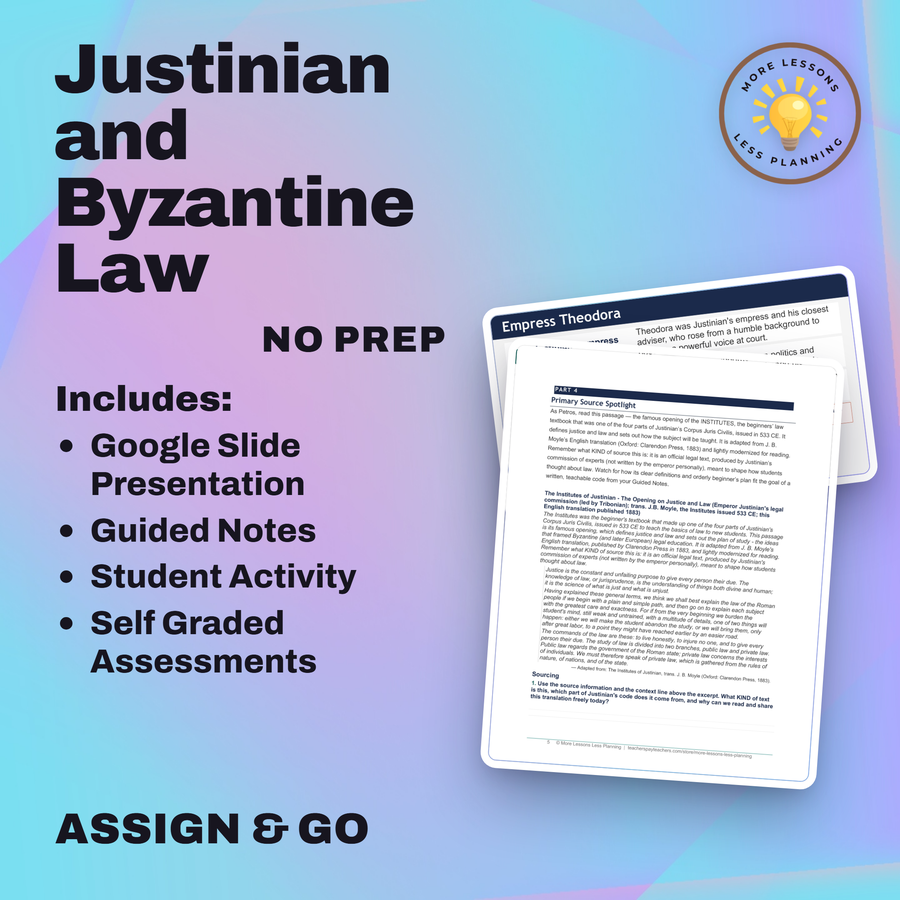
- Explain how the Byzantine Empire carried Rome's government and identity east to Constantinople
- Trace how Tribonian's commission, not Justinian himself, codified centuries of Roman law
- Read an excerpt from the Institutes of Justinian, the beginners' law textbook, as a primary source
- Identify the four parts of the Corpus Juris Civilis and explain why one written code beat scattered laws
What it covers
- Why Byzantines still called themselves Romans, not a new people with a new name
- The Code, the Digest, the Institutes, and the Novels, the four parts of the code
- Justinian's real role as the one who ordered and authorized the work, not the author
- How the code became the root of continental Europe's civil law tradition
Learning targets
- Explain what the Byzantine Empire was and how it continued the Roman Empire in the east, centered at Constantinople.
- Describe how Emperor Justinian and the jurist Tribonian's commission collected and codified centuries of Roman law.
- Identify the four parts of the Corpus Juris Civilis and explain why a single written, unified code mattered.
- Read an excerpt from the Institutes of Justinian as a primary source and connect its ideals to Justinian's legal code.
Peek inside
Rome's eastern half survives
When the western Roman Empire fell in 476 CE, the eastern half lived on.
Historians call this eastern Roman state the Byzantine Empire.
'Byzantine' is a later label; its own people still called themselves Romans.
Centered at Constantinople
1. After the western Roman Empire fell in 476 CE, the eastern half ruled from Constantinople lived on for centuries. Historians call this eastern Roman state the .
Why this matters
Constantinople outlived Rome by nearly a thousand years, and its people never stopped calling themselves Romans, a harder fact to sit with than any battle date. Justinian's push to gather Roman law into one code, the Corpus Juris Civilis, was part of that same claim: acting like Rome, not a successor copying it.
I want students tracing where continental Europe's civil law tradition actually comes from, past the trivia of naming the Code, the Digest, the Institutes, and the Novels, until they find this codification sitting at the root of it. A sixth-century law project still shapes how courts are structured today, long after the empire that wrote it disappeared.
From one teacher to another
Ask a class who wrote Justinian's law code and half of them will say Justinian, full stop. I put the actual opening of his Institutes in front of them instead, the same textbook Roman law students used in 533 CE, so they can see for themselves that a commission led by the jurist Tribonian did the work while the emperor authorized it. Once they've sorted out who did what, tracing the code's four parts and its lasting mark on continental European law makes a lot more sense. It's a compact, primary-source-driven period that clears up a stubborn mix-up about how ancient governments actually got things done.
Every file in this toolkit
Download
Where should I send the next one?
Everything here is free and it stays that way. Leave your email and I'll send you the new lessons as they go up. You can unsubscribe from any one of them.
Related resources

Ghana and the Gold-Salt Trade

Great Zimbabwe Stone City
Hagia Sophia and Byzantine Culture

Mansa Musa's Pilgrimage to Mecca

Songhai and Timbuktu Scholarship

The Great Schism of 1054
Every lesson on this site is free to download and use. If one of them saved you a prep period, you can chip in a few bucks toward my three kids' daycare fund. That's genuinely where tips go.