
Songhai and Timbuktu Scholarship
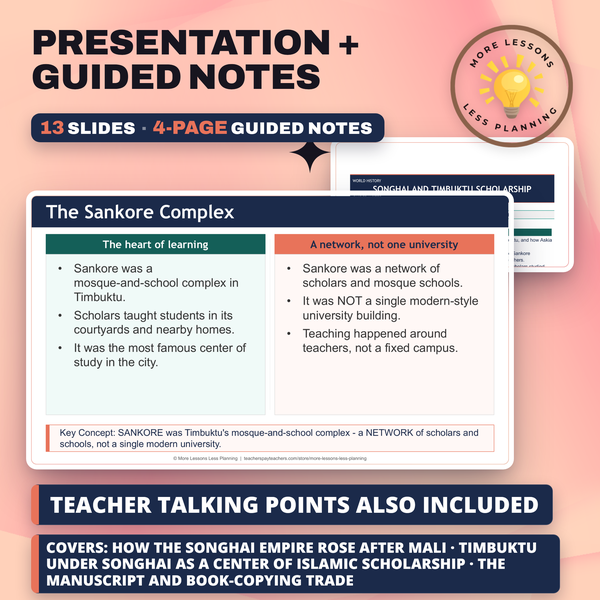
- Slide deck
- Guided notes
- Guided notes teacher key
- Activity + answer key
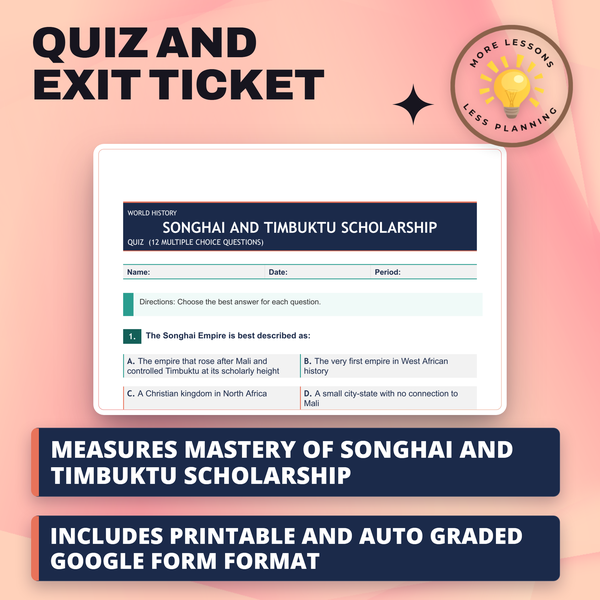
- Quiz + answer key
- Exit ticket + answer key
- Teacher guide
- Teacher presentation notes
Where should I send the next one?
Everything here is free and it stays that way. Leave your email and I'll send you the new lessons as they go up. You can unsubscribe from any one of them.
Every file in this toolkit
Related resources
Great Zimbabwe Stone City
Mansa Musa's Pilgrimage to Mecca
The Great Schism of 1054
The Islamic Golden Age
The Rise of Islam and the Caliphates
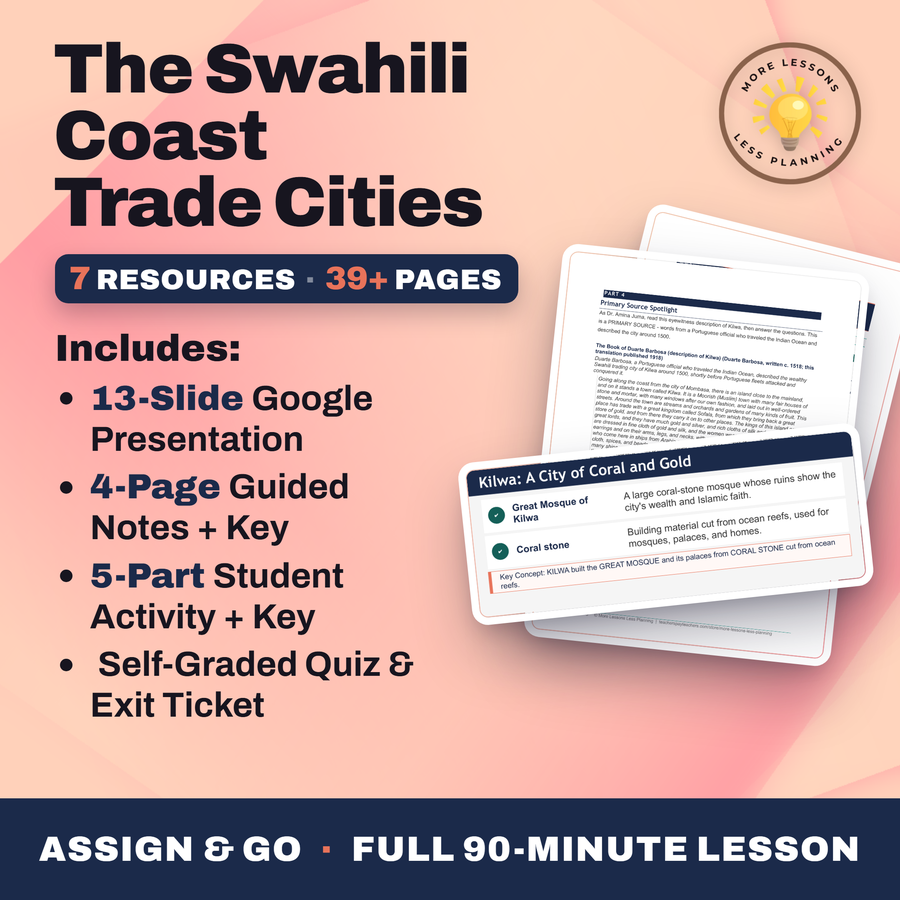
The Swahili Coast Trade Cities
What students do
- Trace how Askia Muhammad's patronage turned Timbuktu into a center of Islamic scholarship
- Map Timbuktu's manuscript trade and explain why books outsold nearly every other good in the market
- Analyze Leo Africanus's description of Timbuktu's scholars as the account of an outside observer
- Explain how a Moroccan gunpowder army ended the golden age at the Battle of Tondibi
What it covers
- The Sankore complex as a network of scholars and mosque schools, rather than a single university
- Timbuktu's community of judges, teachers, and scholars maintained at the ruler's expense
- What Leo Africanus's account can and cannot tell us as an outsider's report written from memory
- The 1591 collapse of Songhai and what it meant for Timbuktu's scholarship
Learning targets
- Explain how the Songhai Empire rose after Mali and took control of Timbuktu, and how Askia Muhammad acted as a patron of Islamic learning.
- Describe Timbuktu under Songhai as a center of Islamic scholarship - the Sankore mosque-and-school complex and its community of scholars, judges, and teachers.
- Explain the manuscript and book-copying trade of Timbuktu and what its scholars studied (Islamic law, theology, astronomy, mathematics).
- Analyze a primary source - Leo Africanus's description of Timbuktu's scholars and book trade (via Pory, 1600 / 1896) - judging him as an outside observer, and explain why the golden age ended at the 1591 Battle of Tondibi.
From one teacher to another
I built this one to fix a mix-up I kept catching in my own students' notes, crediting Timbuktu's golden age to Mali when it actually belongs to Songhai. The primary source is the real payoff here: Leo Africanus's account of a city where handwritten books sold for more than almost any other good, read as the report of a visitor recalling a trip from memory years later in Rome. By the end, students can explain the difference between a network of scholars and a modern university, and they're clear on why a source's distance from the event changes how you read it.
Every lesson on this site is free to download and use. If one of them saved you a prep period, you can chip in a few bucks toward my three kids' daycare fund. That's genuinely where tips go.