
Great Zimbabwe Stone City
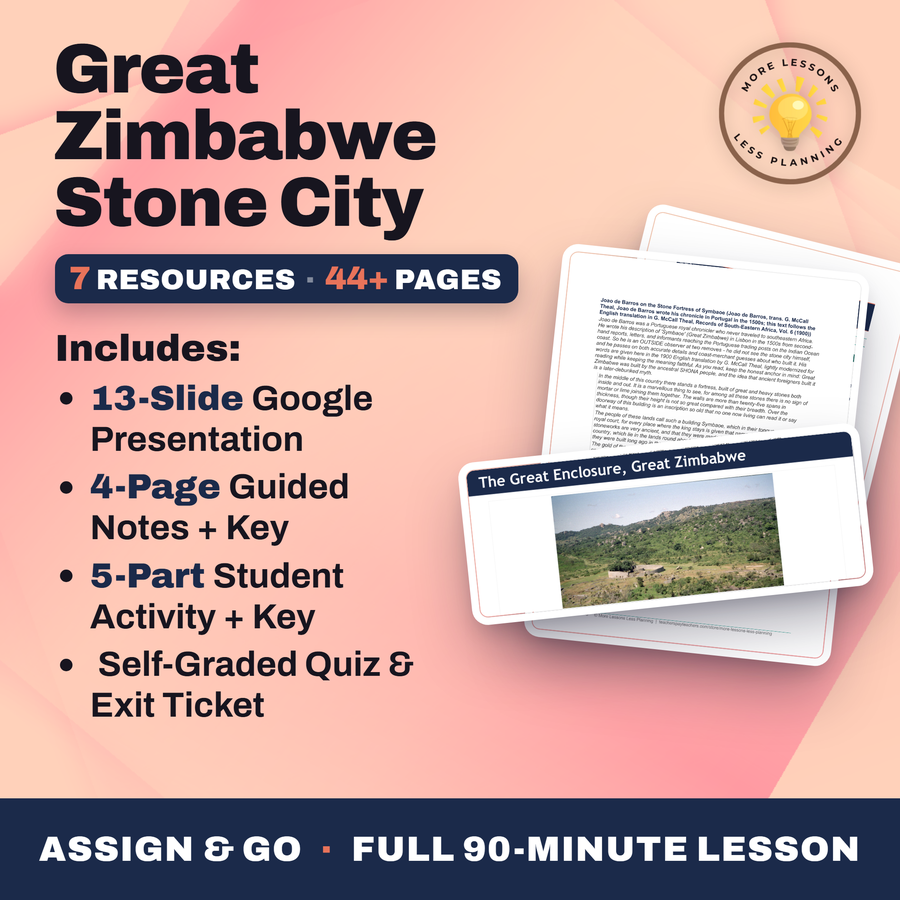
- Slide deck
- Guided notes
- Guided notes teacher key
- Activity + answer key
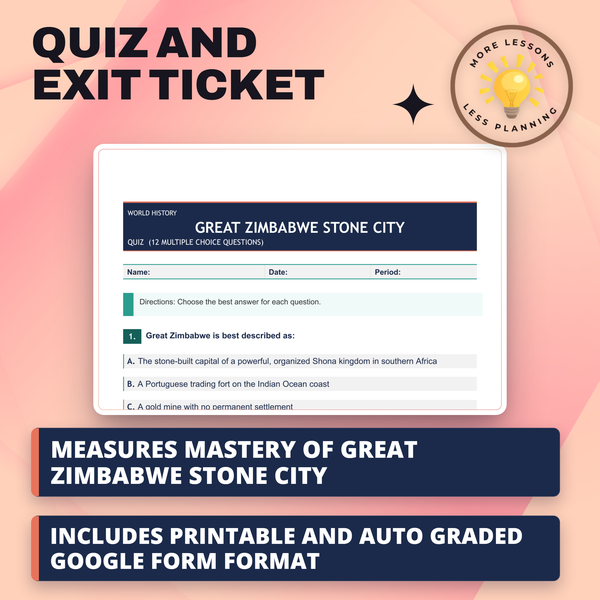
- Quiz + answer key
- Exit ticket + answer key
- Teacher guide
- Teacher presentation notes
Where should I send the next one?
Everything here is free and it stays that way. Leave your email and I'll send you the new lessons as they go up. You can unsubscribe from any one of them.
Every file in this toolkit
Related resources
Mansa Musa's Pilgrimage to Mecca

Songhai and Timbuktu Scholarship
The Great Schism of 1054
The Islamic Golden Age
The Rise of Islam and the Caliphates
The Swahili Coast Trade Cities
What students do
- Explain how dry-stone construction held the Great Enclosure's walls together with no mortar at all
- Map the gold trade route from the interior mines to the Indian Ocean coast
- Decode why Chinese porcelain and Persian ceramics turned up buried in an inland African capital
- Evaluate Joao de Barros's secondhand account against the archaeological evidence that debunked it
What it covers
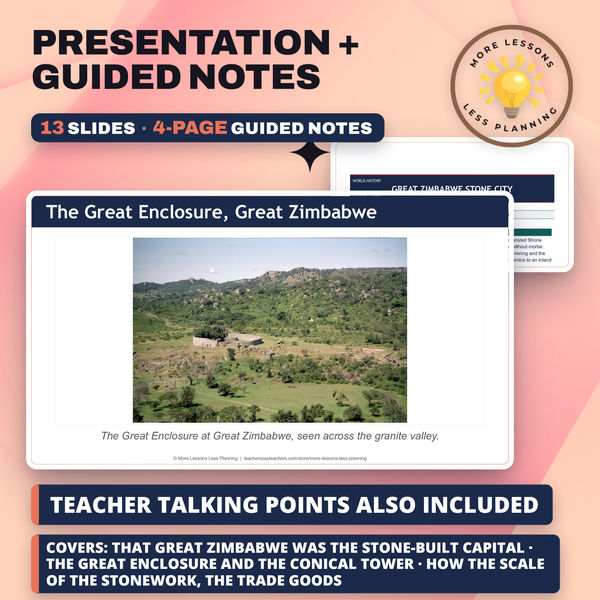
- The Great Enclosure and the conical tower, and what their scale tells us about labor and authority
- Cattle herds as a measure of a ruler's wealth alongside gold and trade goods
- The colonial-era foreign-origin myth, and how radiocarbon dating and local Iron-Age finds answered it
- Why de Barros counts as an outside observer even though his account is centuries old
Learning targets
- Explain that Great Zimbabwe was the stone-built capital of a powerful, organized Shona kingdom (c.1100-1450 CE), built by the ancestral Shona people in dry stone without mortar.
- Describe the Great Enclosure and the conical tower, and explain how gold mining and the Indian Ocean trade brought glass beads, Chinese porcelain, and Persian ceramics to an inland African capital.
- Explain how the scale of the stonework, the trade goods, and cattle wealth together reveal an organized, powerful kingdom.
- Analyze a primary source - Joao de Barros's description of 'Symbaoe' (via Theal, 1900) - as an outside observer's account, and explain why the colonial foreign-origin theory is a myth debunked by archaeology.
From one teacher to another
I sequence this one so the evidence comes before the myth: students work through the stonework, the cattle bones, and the imported porcelain first, then meet the old colonial claim that outsiders built the city, so they debunk it themselves instead of taking my word for it. De Barros adds a useful wrinkle since he never set foot in southern Africa and wrote from secondhand reports, and that's what turns the lesson into a real conversation about what a source can and can't tell you.
Every lesson on this site is free to download and use. If one of them saved you a prep period, you can chip in a few bucks toward my three kids' daycare fund. That's genuinely where tips go.