The St. Bartholomew's Day Massacre
- Slide deck
- Guided notes
- Guided notes teacher key
- Activity + answer key
- Quiz + answer key
- Exit ticket + answer key
- Teacher guide
- Teacher presentation notes
Where should I send the next one?
Everything here is free and it stays that way. Leave your email and I'll send you the new lessons as they go up. You can unsubscribe from any one of them.
Every file in this toolkit
Related resources
Machiavelli's The Prince
Medici Florence and the Renaissance
Reformation Spreads
The European Witch Hunts
Aggression and Appeasement
Alliances and the Causes of WWI
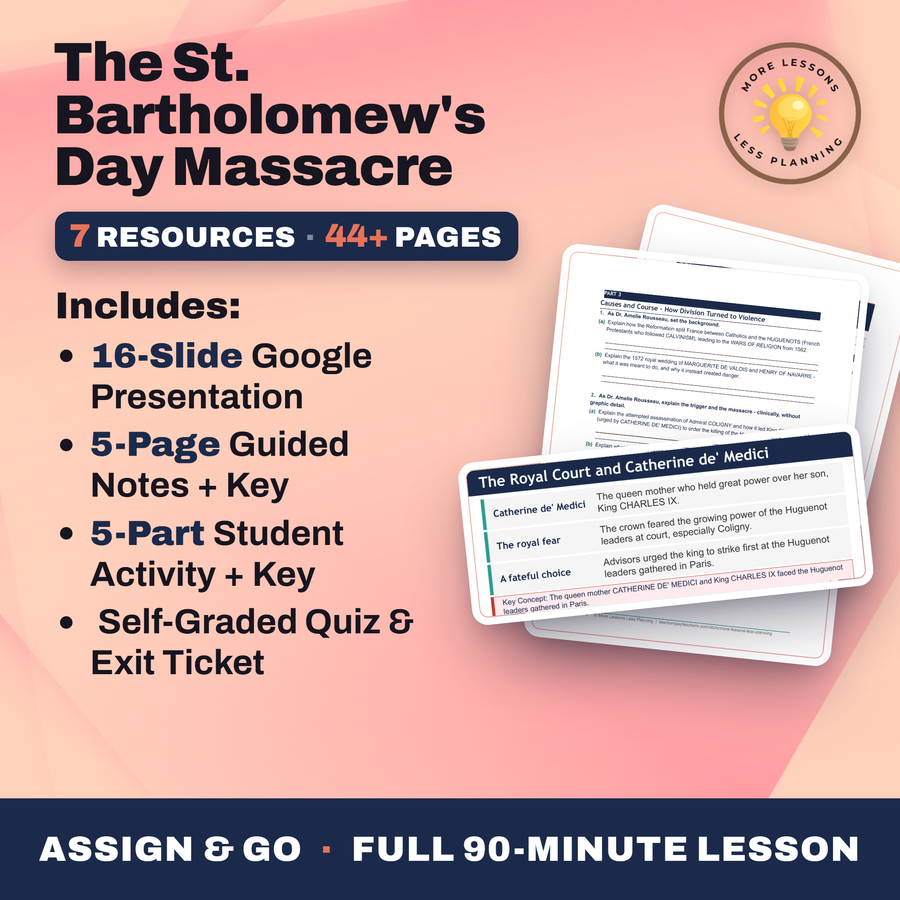
What students do
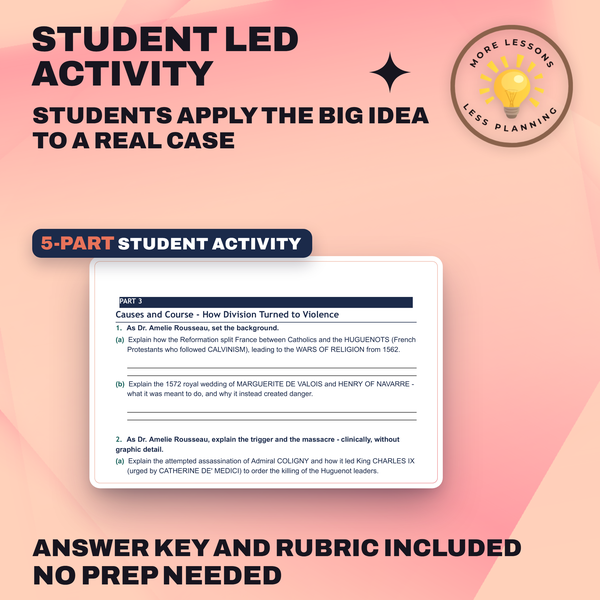
- Explain how decades of Wars of Religion set Catholics and Huguenots against each other in 1560s France
- Trace the chain of events from the 1572 royal wedding through the attack on Admiral Coligny to the killing order Charles IX gave
- Analyze an excerpt of Marguerite de Valois's eyewitness memoir of the night inside the Louvre
- Evaluate the massacre's consequences, including the renewed Wars of Religion and Henry of Navarre's survival
What it covers
- Who the Huguenots were and how Calvinism divided France's Catholic majority from a Protestant minority
- The royal wedding of Marguerite de Valois and Henry of Navarre as the event that brought Huguenot leaders to Paris
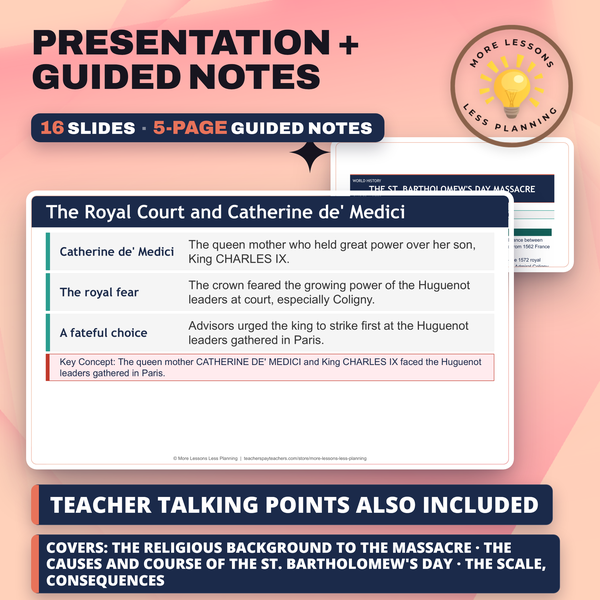
- Catherine de' Medici's role in urging the order that started the killing on August 24, 1572
- Why a firsthand memoir still needs to be read as one person's account of a contested night
Learning targets
- Explain the religious background to the massacre: the Reformation split France between Catholics and Huguenots (French Protestants who followed Calvinism), and from 1562 France was torn by a series of Wars of Religion.
- Explain the causes and course of the St. Bartholomew's Day Massacre - the 1572 royal wedding that drew Huguenot leaders to Paris, the attempted assassination of Admiral Coligny, the order by King Charles IX (urged by Catherine de' Medici) to kill the Huguenot leaders, and the killing that began on August 24, 1572 and spread across France.
- Describe the scale, consequences, and significance of the massacre - thousands killed, deeper division, the resumed Wars of Religion, Henry of Navarre's survival, and the massacre as a lasting symbol of how religious hatred can turn into mass violence.
- Analyze a primary source - an adapted excerpt of the Memoirs of Marguerite de Valois (Bohn translation, 1845) - reading it critically as a firsthand eyewitness memoir, and explain how religious division in France turned into the mass violence of 1572.
From one teacher to another
This is a hard topic and I teach it the way I'd want a colleague to hand it to me, clinically, with the causes laid out step by step rather than any dwelling on the violence itself. Marguerite de Valois's memoir works well precisely because she was in the room that night, so students get a real eyewitness account instead of a secondhand summary, and I have them weigh what one person's memory can and cannot confirm. I keep the tone neutral toward both Catholics and Huguenots throughout, since this is a lesson about how religious division curdled into mass violence, not a verdict on either faith.
Every lesson on this site is free to download and use. If one of them saved you a prep period, you can chip in a few bucks toward my three kids' daycare fund. That's genuinely where tips go.