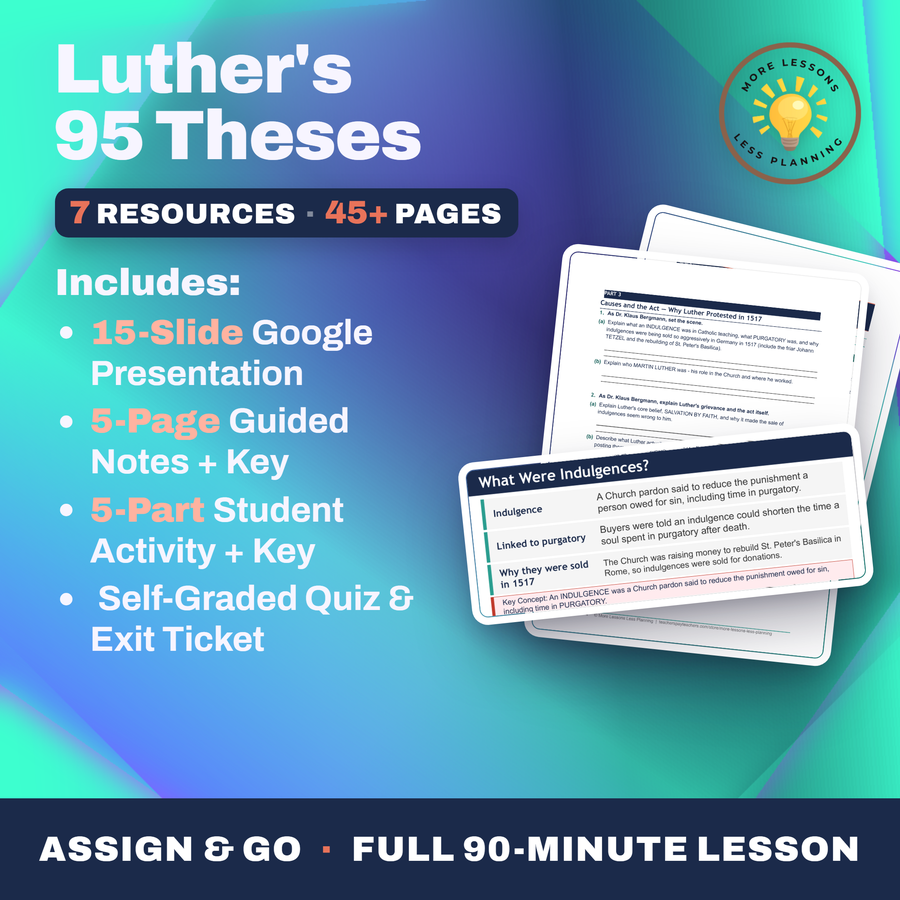
Luther's 95 Theses
Quality reviewed September 2026
- Grades
- Grades 9-12
- Time
- About two 50-minute class periods
- Includes
- 11 ready-to-teach files
- Format
- Word (.docx) · PowerPoint (.pptx)
- Slide deck
- Guided notes
- Guided notes teacher key
- Activity + answer key
- Quiz + answer key
- Exit ticket + answer key
- Teacher guide
- Teacher presentation notes
What students do
- Explain why the sale of indulgences by preachers like Johann Tetzel provoked Luther's protest at Wittenberg in 1517
- Read selected theses from Luther's own text and identify what he says forgiveness actually depends on
- Explain how the printing press turned a local university dispute into a movement that spread across Germany within weeks
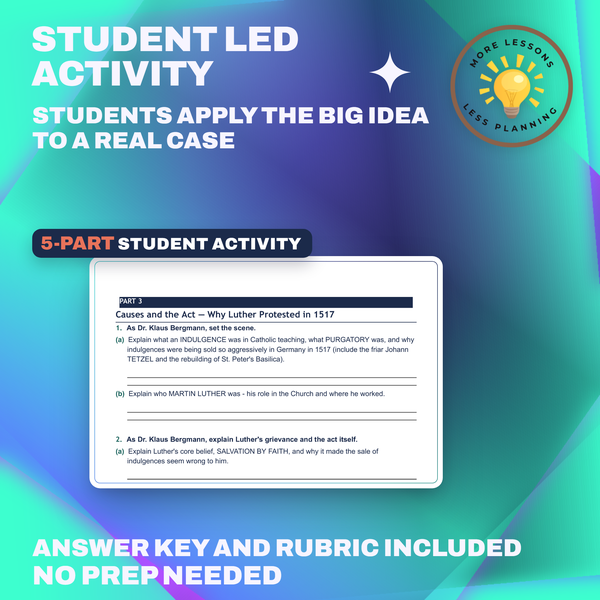
- Write an evidence-based analysis of what the theses can and cannot tell a historian about the Catholic Church's official teaching
What it covers
- The causes of Luther's protest: indulgence sales, grievances about Church corruption, and the printing press
- Selected theses from Luther's own 1517 text (the 1915 Philadelphia Edition translation), with sourcing, comprehension, and analysis questions
- How the Ninety-Five Theses spread and split western Christianity into Catholic and Protestant
- Reading a persuasive religious argument critically, as historical evidence rather than settled doctrine
Learning targets
- Explain who Martin Luther was and the situation in which he wrote the Ninety-Five Theses (1517): a German monk and professor at Wittenberg who objected to the Church's sale of indulgences, which the friar Johann Tetzel was selling nearby partly to help fund the rebuilding of St. Peter's Basilica in Rome.
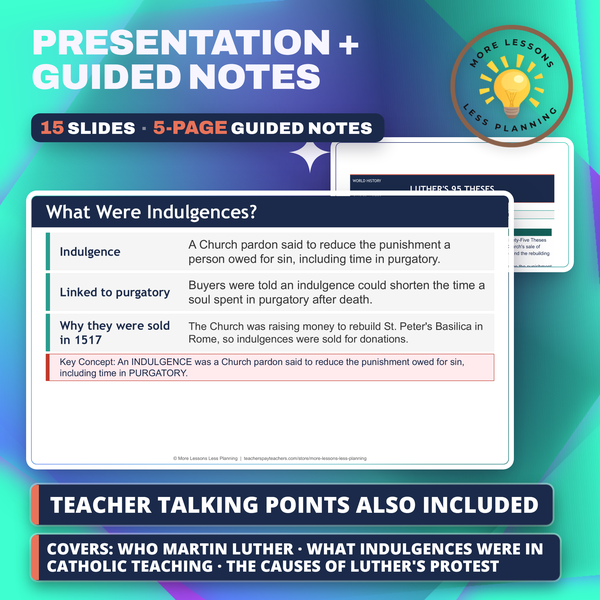
- Explain what indulgences were in Catholic teaching - pardons said to reduce the punishment for sin, including time in purgatory - and summarize Luther's main grievance, his belief in salvation by faith and God's grace rather than by payments or good works.
- Analyze the causes of Luther's protest (the sale of indulgences, grievances about Church corruption, and the printing press) and the act itself (the Ninety-Five Theses posted or sent at Wittenberg in 1517).
- Analyze a primary source - selected theses from the Ninety-Five Theses - reading it critically as a persuasive argument, and explain the consequences of Luther's protest: how the printing press spread it, how it grew into the Protestant Reformation, and how it led to a permanent break with Rome.
Peek inside
Around 1500, the Roman Catholic CHURCH dominated western Europe.
It shaped daily life, education, law, and above all salvation.
Catholic teaching said sinners might spend time in PURGATORY after death.
PURGATORY was described as a state of purification before heaven.
The Church offered ways to reduce the punishment owed for sin.
A World Shaped by the Church
Around 1500, the Roman Catholic was the most powerful institution in western Europe, shaping daily life, learning, and salvation.
Catholic teaching said many souls went after death to , a state of purification before heaven, where they suffered for a time for their sins.
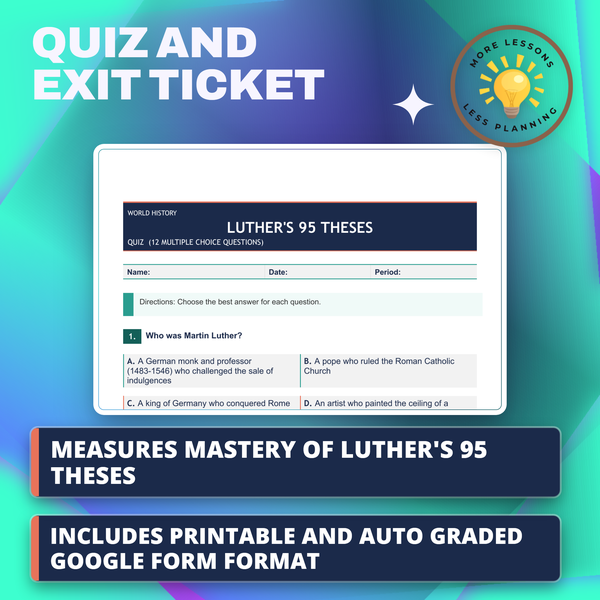
1. What is the name of the 1517 list of ninety-five arguments Luther wrote to criticize the sale of indulgences?
Why this matters
Johann Tetzel selling indulgences is the spark this whole reading is built around, a small, specific transaction rather than an abstract grievance, and it was specific enough to get a university professor angry enough to nail up an argument in Wittenberg in 1517.
The theses students read come from a specific 1915 English translation, and I flag that detail on purpose so nobody mistakes a translated legal-academic document for something Luther wrote in English himself. Treating translation as a variable, not an invisible given, is a small habit that pays off on every primary source afterward.
From one teacher to another
I treat this one strictly as history, not devotion: what Luther argued, why he argued it, and what happened next. The guided notes build the causes - the sale of indulgences, the grievances about Church corruption, the printing press waiting in the wings - before the primary source drops students into Luther's own words. These are real selected theses, including his blunt question about why the pope wouldn't just empty purgatory out of love instead of charging for it, and I make students treat them as one side of an argument, not a neutral report of Catholic teaching. The activity has them explain why short, quotable theses spread so fast once the printing press got hold of them, then write an analysis of what the source can and can't prove about the wider Church. It's academic and comparative throughout, never devotional. Guided notes, activity, quiz, and exit ticket all come with answer keys, along with a teacher guide.
Every file in this toolkit
Download
Where should I send the next one?
Everything here is free and it stays that way. Leave your email and I'll send you the new lessons as they go up. You can unsubscribe from any one of them.
Related resources
Leonardo da Vinci - The Renaissance Man
Machiavelli's The Prince
Medici Florence and the Renaissance
Michelangelo and the Sistine Chapel Ceiling
Reformation Spreads
The European Witch Hunts
Every lesson on this site is free to download and use. If one of them saved you a prep period, you can chip in a few bucks toward my three kids' daycare fund. That's genuinely where tips go.