Leonardo da Vinci - The Renaissance Man
Quality reviewed September 2026
- Grades
- Grades 9-12
- Time
- About two 50-minute class periods
- Includes
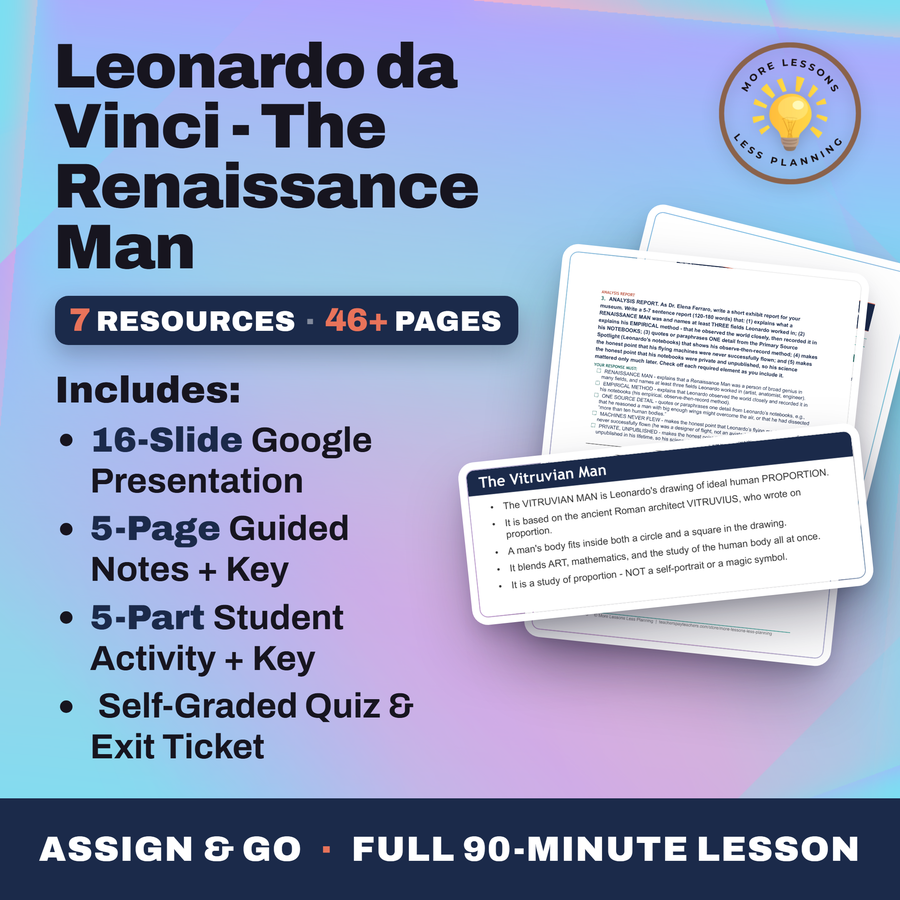
- 11 ready-to-teach files
- Format
- Word (.docx) · PowerPoint (.pptx)
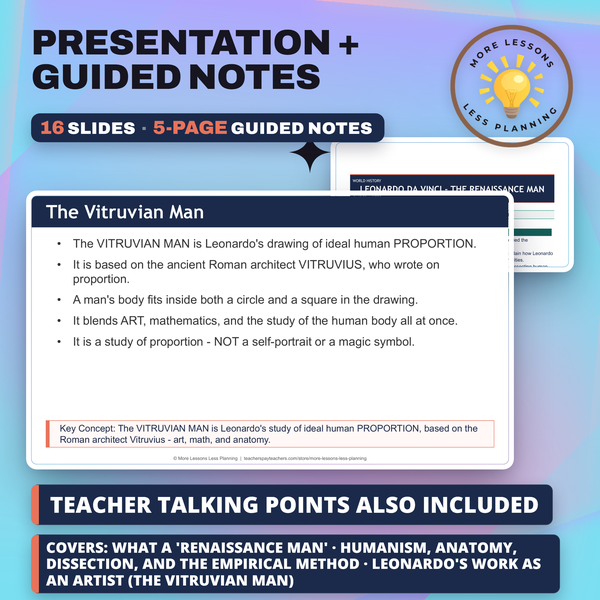
- Slide deck
- Guided notes
- Guided notes teacher key
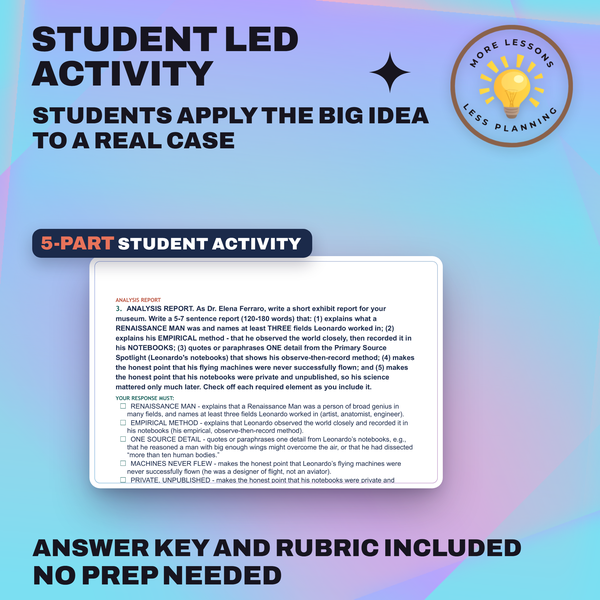
- Activity + answer key
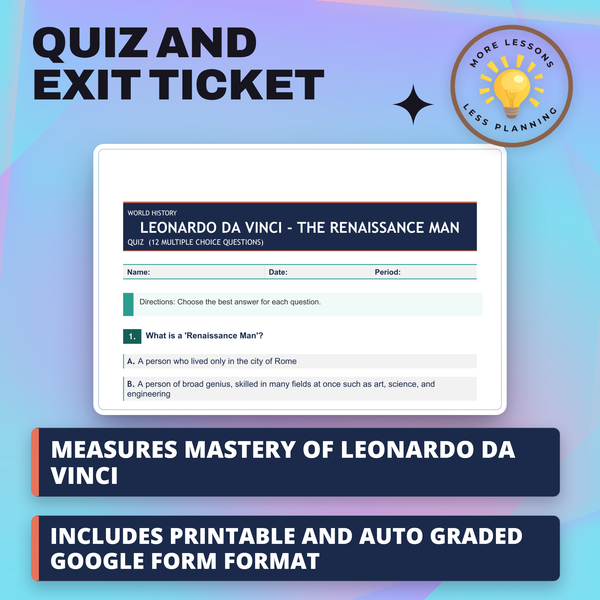
- Quiz + answer key
- Exit ticket + answer key
- Teacher guide
- Teacher presentation notes
What students do
- Explain the Renaissance Man ideal and trace Leonardo's work across art, anatomy, and engineering
- Read an excerpt from Leonardo's own notebooks and identify his empirical, observe-then-record method
- Name at least two honest limits on Leonardo's achievements, including unfinished work and unflown machines
- Write an exhibit report crediting Leonardo's genius without overstating what he actually completed
What it covers
- The Renaissance Man ideal, and how Leonardo crossed art, anatomy, and engineering through one method
- The Vitruvian Man as a study of proportion blending art, mathematics, and the body
- Leonardo's own notebook account of dissecting more than ten bodies and reasoning toward human flight
- Why his flying machines never flew and his private, unpublished notebooks changed medicine only centuries later
Learning targets
- Explain what a 'Renaissance Man' was and how Leonardo da Vinci embodied the Renaissance ideal of broad genius across art, anatomy, and engineering.
- Define humanism, anatomy, dissection, and the empirical method, and explain how Leonardo learned by observing the world and recording it rather than trusting old authorities.
- Describe Leonardo's work as an artist (the Vitruvian Man), an anatomist (dissecting human bodies), and an engineer (designing flying machines) - while recognizing honestly that he left most projects unfinished, his flying machines never flew, and his private notebooks went unpublished in his lifetime.
- Analyze a primary source - an excerpt from Leonardo's own notebooks - and explain how it shows his empirical observe-then-record method, while reading it as private working notes rather than published, finished science.
Peek inside
LEONARDO DA VINCI (1452-1519) was born near the town of Vinci in ITALY.
He trained as a painter in Florence in the workshop of the artist Verrocchio.
He worked across Italy and France for wealthy PATRONS who paid for his work.
His patrons included the Medici, the Sforza of Milan, and the French king.
He was a painter, but also studied the body, nature, water, and machines.
A Painter of Many Talents
LEONARDO DA VINCI (1452-1519) was born near the town of Vinci in , and trained as a painter in Florence.
He worked for a wealthy PATRON - a backer who paid for an artist's work - moving between the , the Sforza of Milan, and the French king.
1. What is the term for a person of broad genius, skilled in many fields at once - art, science, and engineering - the ideal Leonardo came to represent?
Why this matters
Watching an eagle's wing and cutting into a human body sound like unrelated activities, but this reading treats them as the same method: observe closely, then record exactly what is there. The Vitruvian Man gets treated as one finished picture when really it is one example of a habit Leonardo repeated across a dozen fields.
Grading the exhibit report means catching students who want to credit Leonardo with finished inventions instead of sketches and reasoning. I ask for genius and honesty in the same paragraph, since crediting the method without inflating the results is the harder, more accurate thing to write.
From one teacher to another
The myth I correct first is that Leonardo actually built and flew his inventions, because he didn't. Not one of his flying machines ever left the ground, and most of his projects sat unfinished. That honesty is what makes the lesson work, because once students accept that his greatness wasn't a pile of finished inventions, they can actually see what it was: a single method of close observation applied across painting, dissection, and machine design. They read his own notebook entry where he reasons toward human flight from watching an eagle's wings and then, in the same passage, matter-of-factly mentions dissecting more than ten human bodies to map out veins, which is about as clean an example of empirical thinking as a fifteenth-century source gets. I also make sure they know those notebooks were private and written backwards in mirror-writing, never published in his lifetime, so his anatomy didn't actually change medicine until centuries after he died, which is a good check on the impulse to treat every genius as an instant influence.
Every file in this toolkit
Download
Where should I send the next one?
Everything here is free and it stays that way. Leave your email and I'll send you the new lessons as they go up. You can unsubscribe from any one of them.
Related resources
Luther's 95 Theses
Machiavelli's The Prince
Medici Florence and the Renaissance
Michelangelo and the Sistine Chapel Ceiling
Reformation Spreads

The European Witch Hunts
Every lesson on this site is free to download and use. If one of them saved you a prep period, you can chip in a few bucks toward my three kids' daycare fund. That's genuinely where tips go.