Medici Florence and the Renaissance
- Slide deck
- Guided notes
- Guided notes teacher key
- Activity + answer key
- Quiz + answer key
- Exit ticket + answer key
- Teacher guide
- Teacher presentation notes
Where should I send the next one?
Everything here is free and it stays that way. Leave your email and I'll send you the new lessons as they go up. You can unsubscribe from any one of them.
Every file in this toolkit
Related resources
Machiavelli's The Prince
Reformation Spreads
The European Witch Hunts
The St. Bartholomew's Day Massacre
Aggression and Appeasement
Alliances and the Causes of WWI
What students do
- Explain how Medici banking wealth turned into art and learning through patronage
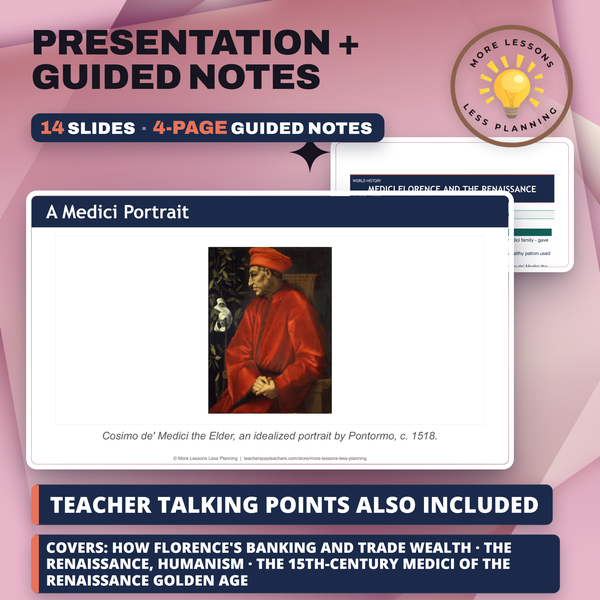
- Distinguish Cosimo the Elder and Lorenzo the Magnificent's 15th-century Florence from the later Duke Cosimo I who patronized Cellini
- List multiple causes of Florence's Renaissance beyond Medici money alone, including classical texts and guild competition
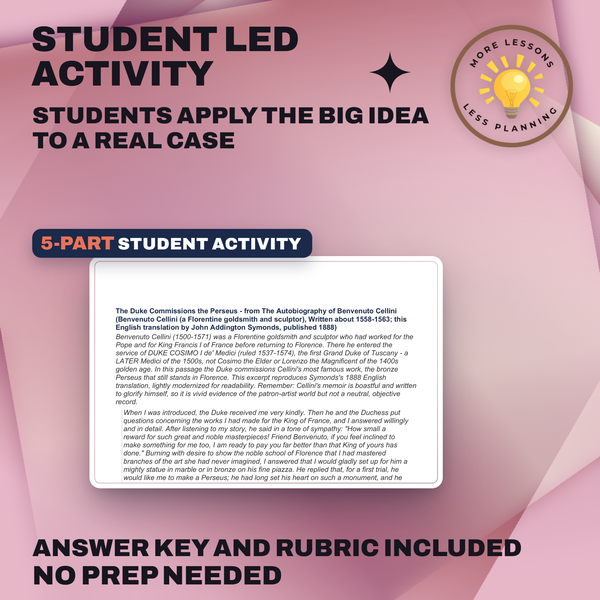
- Analyze an excerpt from Benvenuto Cellini's autobiography as vivid but boastful firsthand evidence, not a neutral record
What it covers
- Patronage, commission, and how a wealthy backer chose and paid for a specific work of art
- Humanism and the revival of classical Greek and Roman learning that shaped Renaissance art
- Why Medici patronage mixed genuine support for art with self-interested image-making and political legitimacy
- Two Medicis easily confused, and why keeping them straight changes how you read the primary source
Learning targets
- Explain how Florence's banking and trade wealth - concentrated in the Medici family - gave the city the means to fund a rebirth of art and learning.
- Define the Renaissance, humanism, and patronage, and explain how a wealthy patron used a commission to turn banking wealth into art.
- Distinguish the 15th-century Medici of the Renaissance golden age (Cosimo de' Medici the Elder and Lorenzo the Magnificent) from the later Duke Cosimo I (r. 1537-1574), the patron of the artist Benvenuto Cellini.
- Analyze a primary source - an excerpt from The Autobiography of Benvenuto Cellini - and explain that it is vivid but boastful firsthand evidence of the patron-artist world, not a neutral record, and that patronage had multiple motives and was one of several causes of the Renaissance.
From one teacher to another
The trap I built this lesson to avoid is treating Medici money as the whole story, so students also work through guild competition, classical texts, and trade wealth as causes running alongside patronage, not underneath it. Cellini's memoir is a great source precisely because it's unreliable in an instructive way, he's bragging the whole time, and getting students to read a boastful firsthand account critically is half the point. I also make sure students don't collapse Cosimo the Elder into Duke Cosimo I, since mixing up a century of Medici history is an easy mistake that quietly wrecks the source analysis.
Every lesson on this site is free to download and use. If one of them saved you a prep period, you can chip in a few bucks toward my three kids' daycare fund. That's genuinely where tips go.