Michelangelo and the Sistine Chapel Ceiling
Quality reviewed September 2026
- Grades
- Grades 9-12
- Time
- About two 50-minute class periods
- Includes
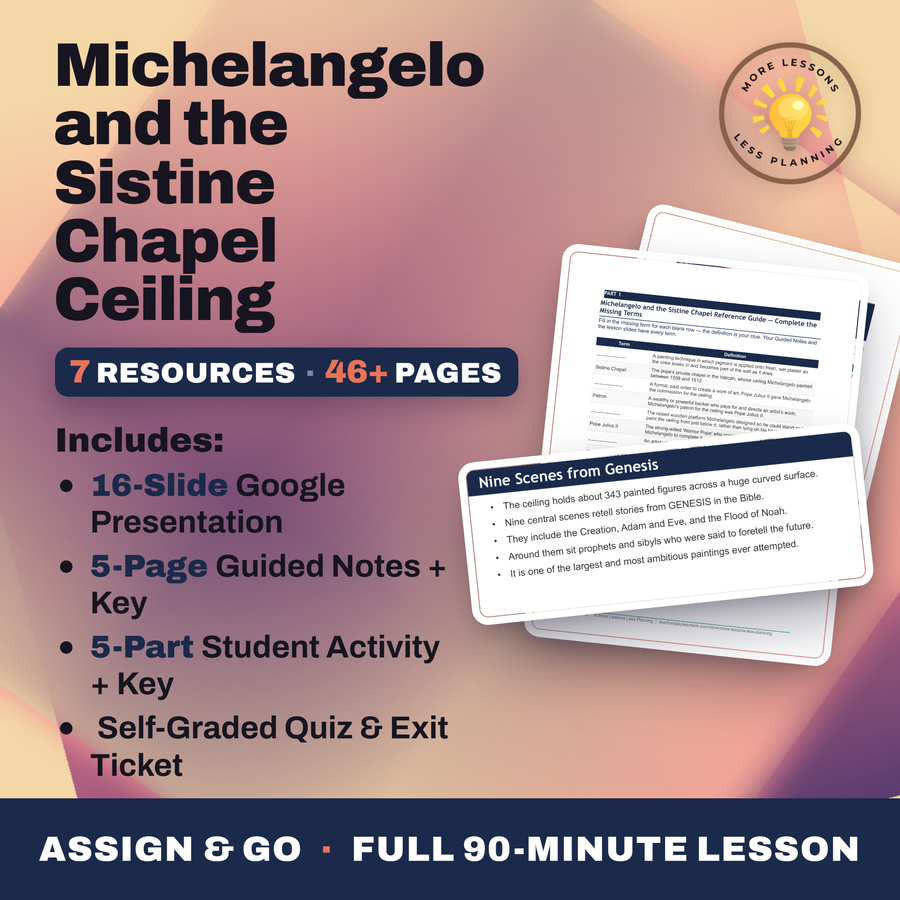
- 11 ready-to-teach files
- Format
- Word (.docx) · PowerPoint (.pptx)
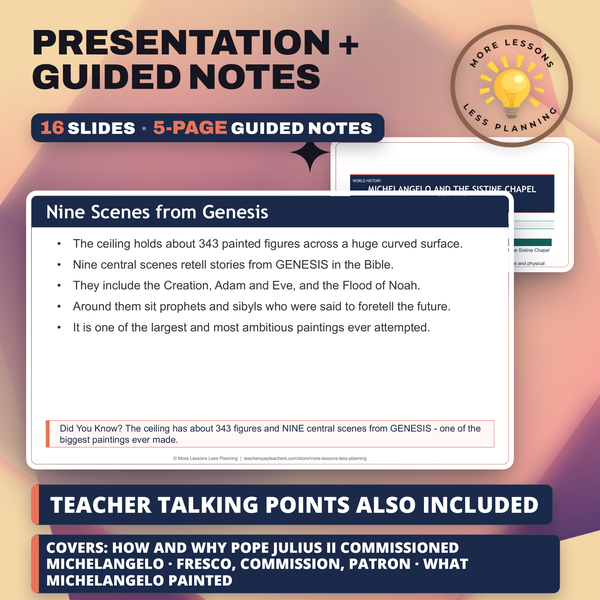
- Slide deck
- Guided notes
- Guided notes teacher key
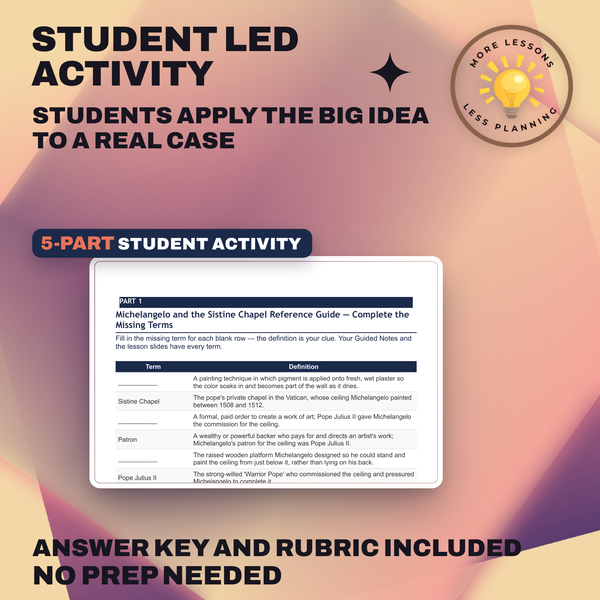
- Activity + answer key
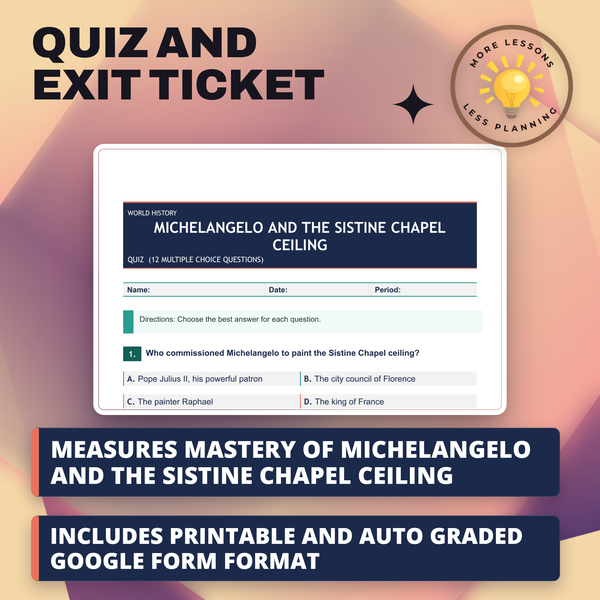
- Quiz + answer key
- Exit ticket + answer key
- Teacher guide
- Teacher presentation notes
What students do
- Explain why Pope Julius II commissioned the ceiling and how patronage pressure shaped Michelangelo's work
- Define fresco, commission, patron, and scaffold, and describe the physical labor of painting the ceiling
- Correct the popular myth that Michelangelo painted lying on his back, using what actually happened
- Read an excerpt from Vasari's Life of Michelangelo and evaluate it as an admiring biography written decades later
What it covers
- Pope Julius II's commission and how the pressures of patronage shaped Michelangelo's work
- Fresco technique and the physical demands of painting while standing on a scaffold Michelangelo designed himself
- The Genesis scenes Michelangelo painted, including the Creation of Adam, and his use of assistants
- Vasari's Life of Michelangelo as a primary source, and why it has to be read critically
Learning targets
- Explain how and why Pope Julius II commissioned Michelangelo to paint the Sistine Chapel ceiling (1508-1512), and how the pressures of patronage shaped the work.
- Define fresco, commission, patron, and scaffold, and describe the technique and physical labor Michelangelo used to paint the ceiling.
- Describe what Michelangelo painted (scenes from Genesis, including The Creation of Adam) - while recognizing honestly that he considered himself a sculptor, resented the commission, worked with assistants, and did NOT paint lying on his back as the popular myth claims.
- Analyze a primary source - an excerpt from Vasari's Life of Michelangelo - and explain what it reliably shows and where it must be read critically as an admiring biography written decades later.
Peek inside
MICHELANGELO Buonarroti (1475-1564) was a giant of the RENAISSANCE in Italy.
The RENAISSANCE was a rebirth of art and learning that revived Greece and Rome.
He considered himself a SCULPTOR - an artist who carves figures from stone.
He carved the marble statues David and the Pieta before the ceiling.
He painted the Sistine ceiling reluctantly - it was not the art he loved most.
A Renaissance Sculptor
MICHELANGELO Buonarroti (1475-1564) was a giant of the , the rebirth of art and learning in Europe that revived the study of ancient Greece and Rome.
He considered himself a - an artist who carves figures from stone or marble - far more than a painter, and had already carved the David and the Pieta.
1. What is the term for painting onto fresh, wet plaster so the color soaks in and becomes part of the wall as it dries?
Why this matters
Reluctance is the starting point here, not inspiration. Michelangelo considered himself a sculptor, not a painter, when Pope Julius II handed him the ceiling commission in 1508, and that mismatch between the artist and the job shapes everything students read afterward.
Collaboration gets flattened in most retellings, but Michelangelo led a team for plaster and labor while reserving figures like the Creation of Adam for his own hand. That division corrects a picture of one man alone on a scaffold for four years, since teamwork and singular vision were not opposites here.
From one teacher to another
Every student walks in already sure Michelangelo painted the Sistine Chapel lying on his back, so I built this one to correct that first and use the correction to teach how patronage actually worked. Students learn why Pope Julius II commissioned the ceiling in 1508, why Michelangelo, who considered himself a sculptor, took the job reluctantly, and how he actually painted it: standing on a scaffold he designed himself, leading assistants for plaster and labor while painting the figures, including the Creation of Adam, on his own. The primary source is an excerpt from Vasari's Life of Michelangelo, written decades later by an admirer, and students are asked to read it as valuable evidence that still has to be checked, not as a neutral account. Guided notes track the slides, the activity has a complete answer key, and the quiz and exit ticket both come with keys.
Every file in this toolkit
Download
Where should I send the next one?
Everything here is free and it stays that way. Leave your email and I'll send you the new lessons as they go up. You can unsubscribe from any one of them.
Related resources
Leonardo da Vinci - The Renaissance Man
Luther's 95 Theses
Machiavelli's The Prince
Medici Florence and the Renaissance
Reformation Spreads

The European Witch Hunts
Every lesson on this site is free to download and use. If one of them saved you a prep period, you can chip in a few bucks toward my three kids' daycare fund. That's genuinely where tips go.