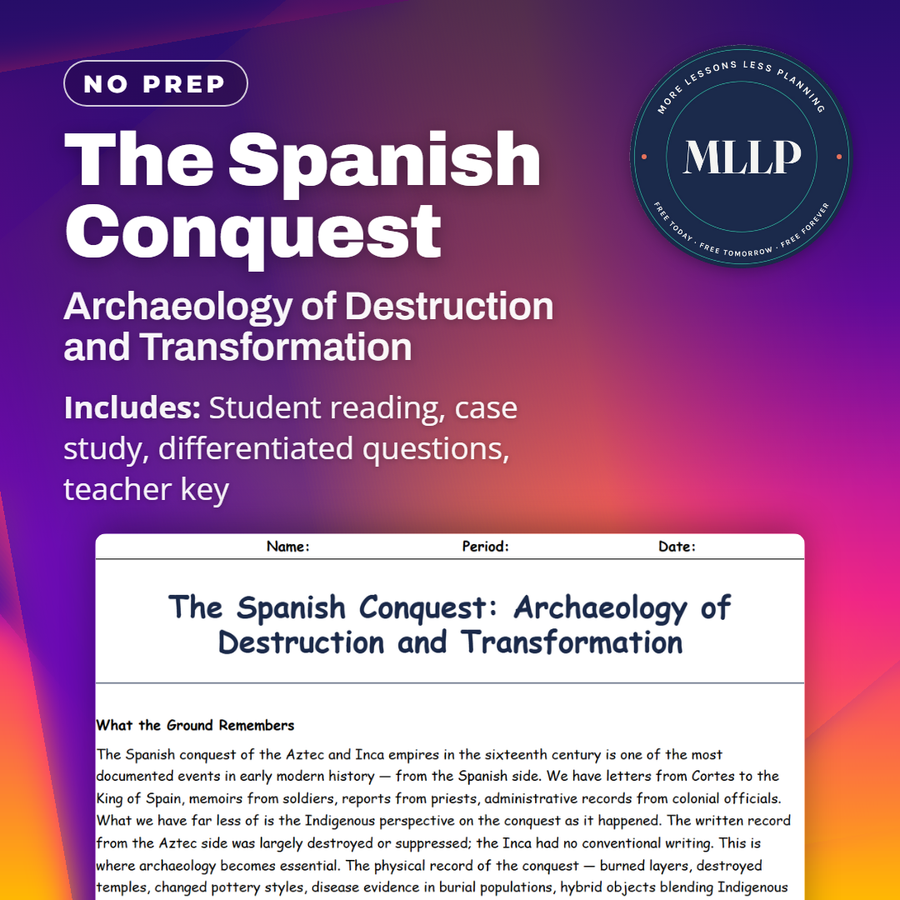
The Spanish Conquest: Archaeology of Destruction and Transformation
Quality reviewed September 2026
Facts verified September 21, 2026
- Subject
- Social Studies
- Grades
- Grades 9-12
- Length
- 9-page student worksheet
- Time
- About one 50-minute class period
- Great for
- Sub plans and independent work
- Includes
- Reading passage, comprehension questions + full answer key
- Format
- Print-and-go PDF
What students do
- Explain why disease, not Spanish weapons, caused most of the population collapse
- Cuauhtli the goldsmith hides Mexica facial style inside a commissioned Spanish crucifix
- A burned 1521 layer inside Tenochtitlan gets compared to mass graves from the same period
- Write out what makes an object like Cuauhtli's crucifix count as a hybrid artifact
What it covers
- The burned 1521 destruction layer under Tenochtitlan and the Coricancha buried under a Cusco church
- Mass graves and ancient DNA evidence tying conquest-era deaths to epidemic disease
- Hybrid objects that blend Indigenous craft with Spanish imagery after the conquest
Start reading this worksheet
What the Ground Remembers
The Spanish conquest of the Aztec and Inca empires in the sixteenth century is one of the most documented events in early modern history, from the Spanish side. We have letters from Cortes to the King of Spain, memoirs from soldiers, reports from priests, administrative records from colonial officials. What we have far less of is the Indigenous perspective on the conquest as it happened. The written record from the Aztec side was largely destroyed or suppressed; the Inca had no conventional writing. This is where archaeology becomes essential. The physical record of the conquest (burned layers, destroyed temples, changed pottery styles, disease evidence in burial populations, hybrid objects blending Indigenous and European manufacturing) tells a story that the victors' documents do not. Archaeological evidence of the conquest period is surprisingly specific. In Tenochtitlan, excavations have identified a distinct burned layer dateable to 1521 (the year of the final Spanish siege), containing smashed pottery, burned architecture, and human remains showing trauma consistent with violent death. In Cusco, the Spanish cathedral and the Church of Santo Domingo were built directly over Inca temples, using Inca stone as construction material. The Coricancha (the Inca 'Temple of the Sun,' considered the holiest site in the empire) had its gold stripped and its upper walls demolished; the Spanish church was built on its surviving Inca foundation, which visitors can still see today.
Disease: The Invisible Conqueror
Before Spanish soldiers arrived in most parts of the Americas, European diseases arrived first. Smallpox, measles, typhus, and influenza spread through Indigenous populations with no prior immunity at catastrophic rates. The epidemic of smallpox that preceded Cortes's final assault on Tenochtitlan killed enormous numbers of defenders, including the emperor Cuitlahuac, who died of smallpox in 1520. By the time Cortes entered the ruins of Tenochtitlan in 1521, a large portion of its population was already dead. Archaeological evidence of epidemic disease is found in burial populations of the period. Normal burial patterns in Aztec and Inca contexts involved individual or small group interments with careful placement and grave goods. During the conquest period, mass graves appear: large pits containing dozens or hundreds of individuals, often with minimal goods and disorganized skeletal arrangement, consistent with communities overwhelmed by mortality they had no capacity to manage through normal funerary practices. Stable isotope and ancient DNA analysis of individuals in these mass graves has in some cases confirmed the presence of disease pathogens, including Salmonella enterica, associated with an epidemic of enteric (paratyphoid) fever.
Destruction and Reuse: The Archaeology of Temples
The systematic destruction of Aztec and Inca religious architecture was not accidental. It was deliberate Spanish policy: part of the campaign to eliminate Indigenous religion and replace it with Christianity. The method was efficient and pragmatic: where possible, churches were built directly on top of existing temples, using their foundations and often their stone. This accomplished two things simultaneously: it gave the Spanish an instant supply of construction material, and it made a powerful symbolic statement about the replacement of one religion by another. The archaeological signature of this process is now well-studied. At Cholula in Mexico, a Spanish colonial church sits on top of what is still the largest pyramid by volume in the world, a structure that the Spanish may not have fully recognized as a pyramid because it had been overgrown to resemble a hill. At Cusco's central plaza (the Huacaypata), Spanish colonial buildings replaced Inca administrative structures while reusing Inca stone and even some Inca wall sections. At dozens of smaller sites across both empires, excavations reveal the characteristic pattern of Inca or Aztec construction below, colonial construction above, with a destruction or burning layer in between.
Like what you read? The full reading, the case study, and every question set are in the free download below, along with the answer key.
Why this matters
Most of what students know about the conquest comes from the winning side's letters and memoirs, so the physical record matters as an independent check on that story. A burned layer of pottery, a mass grave with no room for individual burial rites, or a crucifix carved with quietly Mexica features all say something the Spanish accounts do not, that Indigenous people were adapting and surviving even while their political and religious world was being destroyed. Cuauhtli's choice to shape a Christian face in his own tradition is a small act, easy to miss, and it is exactly the kind of detail that written conquest narratives never had a reason to record.
From one teacher to another
Cuauhtli learned goldsmithing as a boy in the Aztec lost wax tradition. By the time a Spanish merchant commissions him to make a crucifix, his master is dead and the temples he once made offerings for are rubble, which is where this reading's case study picks him up. The reading traces the physical record of conquest itself, a burned layer under Tenochtitlan dated to 1521, the Coricancha's Inca stonework still visible under a Cusco church built directly on top of it, and mass graves whose disorganized burial patterns and ancient DNA point to epidemic disease rather than battle. Students weigh why smallpox and collapsed food systems, not Spanish weapons alone, caused most of the population loss historians estimate at 50 to 90 percent within a century. It closes on Cuauhtli's crucifix itself, a Christian object carrying Mexica facial features that the Spanish merchant who commissioned it may never notice.
What you get
Download
Where should I send the next one?
Everything here is free and it stays that way. Leave your email and I'll send you the new lessons as they go up. You can unsubscribe from any one of them.
Related resources
Aztec Daily Life: Markets, Schools, and Chocolate
Aztec Human Sacrifice: Separating Fact from Propaganda
Descendant Communities Today: Living Heritage of the Americas
Inca Child Sacrifice: Capacocha and the Mountain Mummies
Machu Picchu: The Lost City That Was Never Lost
Quipu: The Inca Writing System Made of Knots
Every lesson on this site is free to download and use. If one of them saved you a prep period, you can chip in a few bucks toward my three kids' daycare fund. That's genuinely where tips go.