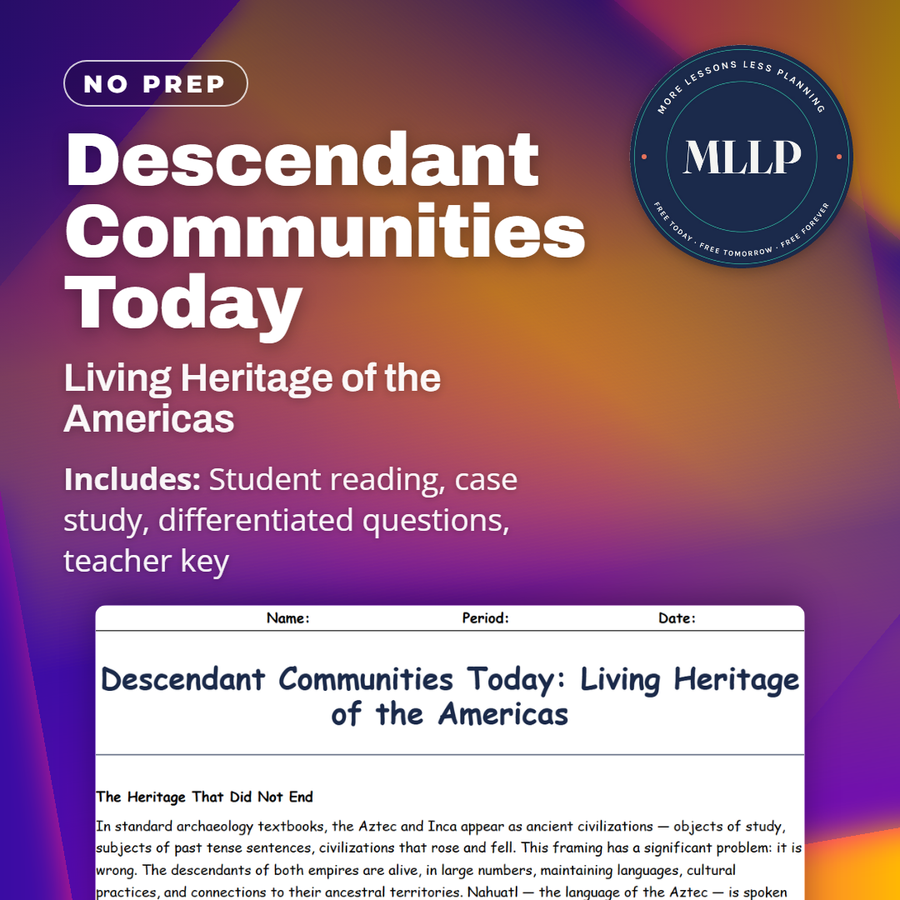
Descendant Communities Today: Living Heritage of the Americas
Quality reviewed September 2026
Facts verified September 21, 2026
- Subject
- Social Studies
- Grades
- Grades 9-12
- Length
- 9-page student worksheet
- Time
- About one 50-minute class period
- Great for
- Sub plans and independent work
- Includes
- Reading passage, comprehension questions + full answer key
- Format
- Print-and-go PDF
What students do
- Dr. Flores prepares two versions of the same discovery, one for a science journal and one for the community of Huilloc
- Answer why Machu Picchu's tourism revenue is a live dispute for local Quechua communities
- Nahuatl and Quechua speaker counts in the millions get set against textbook talk of a vanished empire
- Explain what community archaeology adds in Nahua-speaking regions that outside researchers miss
What it covers
- Living Nahuatl and Quechua speaker populations and what that means for calling these empires ancient
- Community archaeology projects in Mexico and Peru and what local knowledge adds to a dig
- Mining, tourism, and repatriation disputes over Aztec and Inca heritage today
Start reading this worksheet
The Heritage That Did Not End
In standard archaeology textbooks, the Aztec and Inca appear as ancient civilizations: objects of study, subjects of past tense sentences, civilizations that rose and fell. This framing has a significant problem: it is wrong. The descendants of both empires are alive, in large numbers, maintaining languages, cultural practices, and connections to their ancestral territories. Nahuatl, the language of the Aztec, is spoken today by approximately 1.5 million people in Mexico. Quechua, the administrative language of the Inca Empire, has between 6 and 9 million speakers across Peru, Bolivia, Ecuador, Colombia, and Argentina. These are not small remnant populations. They are significant communities whose relationship to the archaeological past is not academic but personal and political. This reality fundamentally changes how we should think about Aztec and Inca archaeology. When a site is excavated, the people most directly affected are not archaeologists in universities, but communities whose ancestors built the site and whose cultural identity is bound up in it. When artifacts are displayed in museums in New York or London or Berlin, the people with the deepest stake in those objects are not the museum's donors but the communities from which the objects came. This is not a new insight (Indigenous communities have been saying it for generations), but it has taken a long time for academic archaeology to take it seriously as a methodological and ethical principle.
What Nahua Communities Are Doing
In Mexico, Nahua communities, the modern descendants of the Aztec and related Nahuatl-speaking peoples, have been increasingly active in asserting their rights over ancestral heritage. This includes advocacy around specific repatriation cases, participation in archaeological site management, and legal challenges to excavation permits that were granted without community consultation. The Mexican government's National Institute of Anthropology and History (INAH), which controls archaeological heritage in Mexico, has a complex relationship with Indigenous communities: it often protects sites from looting and development, but it also sometimes acts as a gatekeeper that limits community access to their own heritage. Community-based archaeology projects in the Nahua-speaking regions of Mexico have begun to demonstrate an alternative model. In these projects, local community members are trained as excavators, interpreters, and site managers. Research questions are developed in consultation with community members rather than imposed by outside researchers. Findings are shared with the community in accessible formats before they are published in academic journals. The results have been positive both archaeologically (community members often have knowledge of local landscape, oral traditions, and site locations that academic researchers lack) and politically, building community investment in site protection.
What Quechua Communities Are Doing
In the Andes, Quechua communities face some of the most acute heritage conflicts in the world. The region's extraordinary concentration of Inca sites means that development projects (mining, road construction, dam building) constantly threaten archaeological material. Quechua communities living on or near these sites often have the most direct knowledge of their extent and significance, and the most direct stake in their protection. They also frequently have the least political power in the systems that grant permits and approve projects. Community-based responses have varied. In some areas, Quechua communities have formed their own heritage monitoring organizations that document threats and report to national and international authorities. In others, community members have trained as archaeologists through partnerships with Peruvian and international universities, creating a generation of researchers who study their own ancestral heritage. The concept of community archaeology in the Andes is increasingly recognized by international bodies including UNESCO, which has incorporated community consultation into its World Heritage Site management requirements for sites in Indigenous territories.
Like what you read? The full reading, the case study, and every question set are in the free download below, along with the answer key.
Why this matters
Calling a civilization purely ancient carries a hidden claim, that its people are gone and its story is finished. Nahua and Quechua communities are neither, and the mining permits, museum disputes, and tourism revenue fights described in this reading are happening in Peru and Mexico on an ordinary week right now, not in some historical footnote. Students who assume archaeology only studies the dead meet Dr. Flores, an Indigenous archaeologist writing for her own community in Quechua, and a debate over who benefits from the thousands of visitors Machu Picchu takes in every day. Dr. Flores says she is more nervous about the Quechua version of her write-up than about the peer-reviewed one, and that detail is the reading's answer to who the audience for a discovery actually is.
From one teacher to another
Nahuatl is still spoken by about a million and a half people in Mexico, and Quechua has millions more speakers across Peru, Bolivia, Ecuador, and beyond, a fact this reading opens with because most students have never heard it. Dr. Carmen Flores, a Quechua archaeologist in the case study, writes up the same discovery twice, once for a peer reviewed journal and once for the community of Huilloc in Quechua, and students weigh why she says she is more nervous about the second version. The reading covers community archaeology projects where local residents train as excavators and interpreters rather than serve only as field labor, plus the live conflicts over mining permits and Machu Picchu's tourism revenue that put descendant communities and national governments on opposite sides. It closes Unit 9 by treating the Aztec and Inca as living cultures with present day stakes, standing well past any past tense textbook chapter.
What you get
Download
Where should I send the next one?
Everything here is free and it stays that way. Leave your email and I'll send you the new lessons as they go up. You can unsubscribe from any one of them.
Related resources
Aztec Daily Life: Markets, Schools, and Chocolate
Aztec Human Sacrifice: Separating Fact from Propaganda
Inca Child Sacrifice: Capacocha and the Mountain Mummies
Machu Picchu: The Lost City That Was Never Lost
Quipu: The Inca Writing System Made of Knots
Tenochtitlan: The Aztec Capital Beneath Mexico City
Every lesson on this site is free to download and use. If one of them saved you a prep period, you can chip in a few bucks toward my three kids' daycare fund. That's genuinely where tips go.