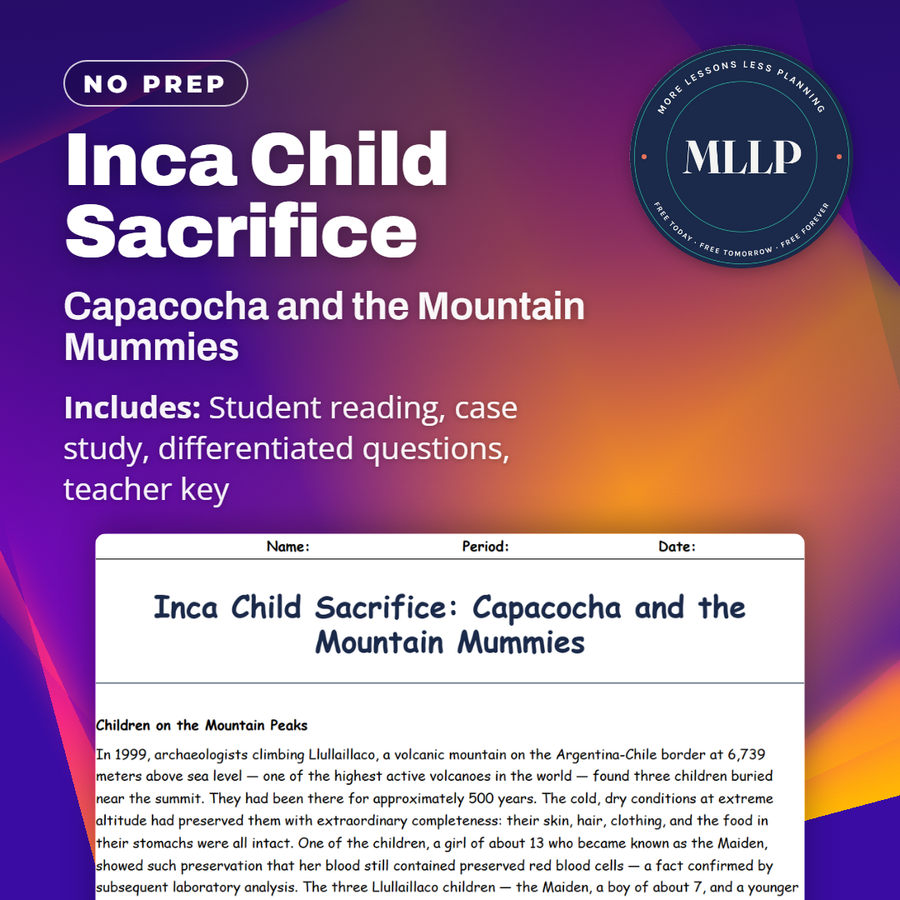
Inca Child Sacrifice: Capacocha and the Mountain Mummies
Quality reviewed September 2026
Facts verified September 21, 2026
- Subject
- Social Studies
- Grades
- Grades 9-12
- Length
- 9-page student worksheet
- Time
- About one 50-minute class period
- Great for
- Sub plans and independent work
- Includes
- Reading passage, comprehension questions + full answer key
- Format
- Print-and-go PDF
What students do
- Hair analysis traces the Llullaillaco children's final months through rising coca and chicha levels
- Trace the capacocha journey from a noble family in the provinces to a summit burial chamber
- Dr. Farfan's three justifications for displaying the children get weighed against Kolla objections
- Explain why spondylus shell counted as the Inca's highest possible ritual offering
What it covers
- The 1999 Llullaillaco discovery and what forensic hair analysis revealed about the ritual
- Capacocha as a form of tribute connecting noble families, the state, and the mountain gods
- The ongoing debate over displaying the mummified children at a museum in Salta
Start reading this worksheet
Children on the Mountain Peaks
In 1999, archaeologists climbing Llullaillaco, a volcanic mountain on the Argentina-Chile border at 6,739 meters above sea level (one of the highest active volcanoes in the world), found three children buried near the summit. They had been there for approximately 500 years. The cold, dry conditions at extreme altitude had preserved them with extraordinary completeness: their skin, hair, clothing, and the food in their stomachs were all intact. One of the children, a girl of about 13 who became known as the Maiden, showed such preservation that her blood still contained preserved red blood cells, a fact confirmed by subsequent laboratory analysis. The three Llullaillaco children (the Maiden, a boy of about 7, and a younger girl of about 6) were participants in the Inca ritual of capacocha, the sacrifice of children at important moments: the death of an emperor, the installation of a new one, natural disasters, or important military victories. Capacocha was not a common practice (it was reserved for moments of supreme state importance), but it was one of the most revealing archaeological windows into Inca religious life and the relationship between the state, the mountains, and the divine.
What the Forensic Analysis Revealed
Forensic analysis of the Llullaillaco children has produced an extraordinarily detailed picture of their final year of life. Chemical analysis of their hair, which grows at a known rate and encodes diet and stress in its structure over time, revealed a timeline of preparation for the ritual. In the months leading up to the sacrifice, the children's diet shifted dramatically: they began consuming significant quantities of coca leaves and chicha (fermented maize beer), both of which were sacred substances in Inca religion. The coca and chicha levels increased sharply in the final weeks of life, indicating sedation: the children were almost certainly unconscious or in an altered state when they died. The children's clothing and burial goods were of the highest quality in the Inca world. The Maiden wore a fine alpaca wool dress with feathered ornaments; all three were accompanied by miniature figurines in gold, silver, and spondylus shell. Spondylus, a thorny oyster shell from the Ecuadorian coast, was one of the most valuable ritual substances in the Inca world, associated with rain, fertility, and the sea. The quality of the offerings confirms that these children were treated as extraordinarily important, possibly as divine messengers or intermediaries between the human world and the mountain deities (apus).
Capacocha: The Ritual in Context
The capacocha ritual, as described in Spanish colonial sources and partially reconstructed from archaeological evidence, involved a complex process. Children chosen for capacocha were selected across the empire, typically from noble families, and were considered a form of living tribute (the highest possible gift) from the provinces to the Inca state and to the mountains. They traveled to Cusco to be presented to the Sapa Inca, then began a journey to their sacrificial site, often months long. Communities along the route provided food and ceremony. The journey to the summit of Llullaillaco from Cusco would have taken weeks of travel across the altiplano and up into extreme altitude. The fact that the children were still alive at the summit, and that they died there, confirms that the Inca had developed enough physiological understanding of altitude to manage the ascent. The children were placed in rock-cut chambers near the summit, provided with their burial goods, and left. They likely died of exposure after the sedating effects of the coca and chicha rendered them insensible. Archaeological evidence from dozens of other Andean peak sites shows that this practice occurred across the empire, not just at Llullaillaco.
Like what you read? The full reading, the case study, and every question set are in the free download below, along with the answer key.
Why this matters
This reading puts students in the middle of a real, unresolved argument instead of handing them a settled answer. The children on Llullaillaco were placed there deliberately, as a religious act with meaning to the people who did it, and both returning them and keeping them in a climate controlled case in Salta carry real costs and real justifications. Students meet a museum director who has had the same conversation with Kolla representatives three times without resolving it, which is closer to how most heritage disputes actually go than any textbook summary. It is a reminder that archaeology often ends in a genuine disagreement over whose authority governs the dead.
From one teacher to another
Three children lay near the summit of Llullaillaco for about five hundred years before climbers found them in 1999, preserved so completely by the cold and altitude that one child still had intact red blood cells. The reading walks through what hair analysis revealed about their last months, a documented shift toward coca leaves and fermented maize beer that points to deliberate sedation before they were left on the mountain. Students read the ritual of capacocha in its own religious terms, as the highest tribute a noble family could offer the state and the mountain gods, alongside a modern case study of a museum director who has to justify keeping the children on display against the wishes of nearby Kolla and Quechua communities. It is one of the harder readings in the unit, and it is meant to be.
What you get
Download
Where should I send the next one?
Everything here is free and it stays that way. Leave your email and I'll send you the new lessons as they go up. You can unsubscribe from any one of them.
Related resources
Aztec Daily Life: Markets, Schools, and Chocolate
Aztec Human Sacrifice: Separating Fact from Propaganda
Descendant Communities Today: Living Heritage of the Americas
Machu Picchu: The Lost City That Was Never Lost
Quipu: The Inca Writing System Made of Knots
Tenochtitlan: The Aztec Capital Beneath Mexico City
Every lesson on this site is free to download and use. If one of them saved you a prep period, you can chip in a few bucks toward my three kids' daycare fund. That's genuinely where tips go.