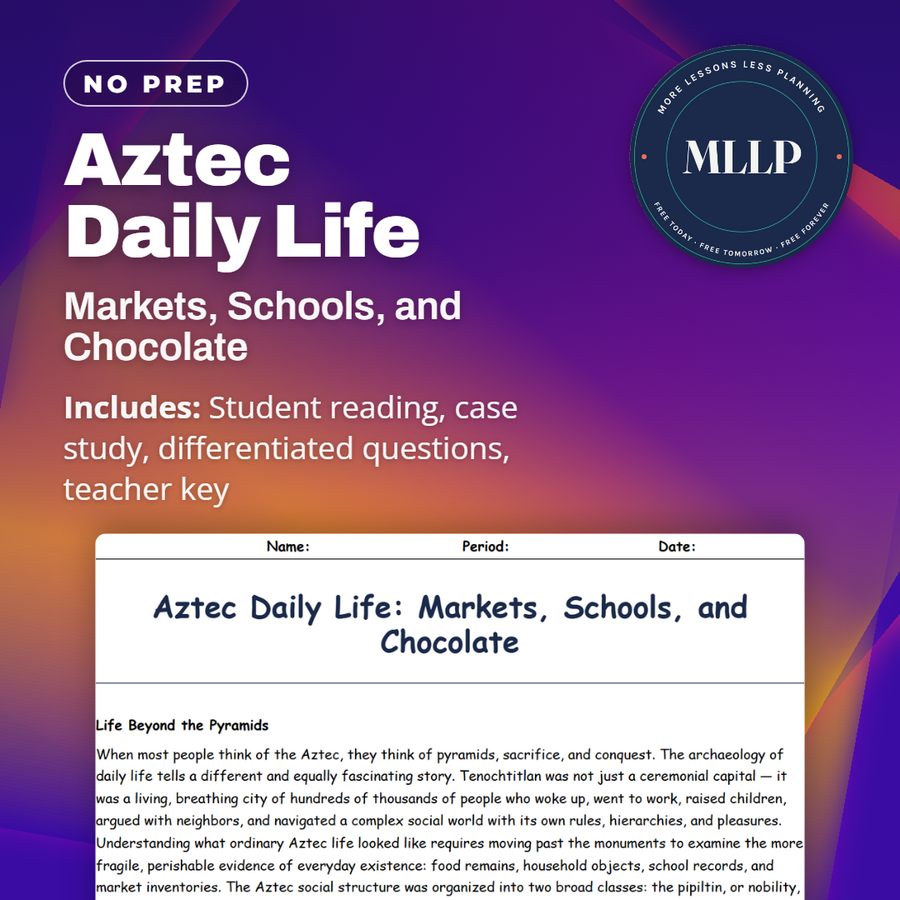
Aztec Daily Life: Markets, Schools, and Chocolate
Quality reviewed September 2026
Facts verified September 21, 2026
- Subject
- Social Studies
- Grades
- Grades 9-12
- Length
- 9-page student worksheet
- Time
- About one 50-minute class period
- Great for
- Sub plans and independent work
- Includes
- Reading passage, comprehension questions + full answer key
- Format
- Print-and-go PDF
What students do
- Xochitl's cloth gets valued against cacao beans in a real Tlatelolco price negotiation
- Sumptuary laws that reserved cotton and feathers for nobles get checked against household textile finds
- Tlatelolco's market ran by category, gold jewelry in one section, medicine and cooked food in others
- Fill in the blanks on cacao's roles as currency, drink, and status symbol
What it covers
- Aztec social classes and the mandatory calmecac and telpochcalli school system
- The Tlatelolco market and cacao's role as currency, drink, and status symbol
- Sumptuary laws and the textile evidence for Aztec dress codes and gender roles
Start reading this worksheet
Life Beyond the Pyramids
When most people think of the Aztec, they think of pyramids, sacrifice, and conquest. The archaeology of daily life tells a different and equally fascinating story. Tenochtitlan was not just a ceremonial capital: it was a living, breathing city of hundreds of thousands of people who woke up, went to work, raised children, argued with neighbors, and navigated a complex social world with its own rules, hierarchies, and pleasures. Understanding what ordinary Aztec life looked like requires moving past the monuments to examine the more fragile, perishable evidence of everyday existence: food remains, household objects, school records, and market inventories. The Aztec social structure was organized into two broad classes: the pipiltin, or nobility, and the macehualtin, the commoners who made up the vast majority of the population. Below the macehualtin were the mayeque, a class of rural laborers bound to noble estates, and the tlactin, enslaved people who could in some cases buy their freedom or be freed by their masters. Social mobility existed but was limited. What distinguished the Aztec system from many contemporary societies was its compulsory education: every child, regardless of social class or gender, was legally required to attend school.
The Calmecac and Telpochcalli: Two Kinds of School
Aztec education was divided into two parallel systems. The calmecac was attached to temples and educated the children of the nobility and those destined for the priesthood. Students there learned reading and writing (in the Nahuatl pictographic script), astronomy, religion, law, and the calendar. Training was rigorous and included physical hardship, fasting, and extended periods of ritual practice. The calmecac produced the administrators, priests, and military leaders who ran the empire. The telpochcalli, or 'house of youth,' educated commoner boys in practical skills including warfare, agriculture, and community service. Girls attended separate schools where they learned weaving, cooking, religious ritual, and household management. The education system also included a third, more informal institution: the cuicacalli, or 'house of song,' where young people of both classes learned music, dance, and oral history. These schools were not optional. Parents who failed to enroll their children could face penalties from the state. Archaeological evidence for these institutions is largely indirect: references in codices (the pictographic books the Aztec produced), Spanish descriptions written after the conquest, and occasional architectural remains. The telpochcalli in particular may have left physical traces in residential districts of Tenochtitlan that have not yet been fully identified beneath Mexico City.
The Market at Tlatelolco
If Tenochtitlan had a heart, it was the Templo Mayor. But if it had a circulatory system, it was the great market at Tlatelolco, the neighboring island city that was absorbed into the Aztec capital in 1473. Spanish accounts describe a market so large that Cortes himself claimed it was twice the size of the market in Salamanca, Spain, and Salamanca was a major city. Bernal Diaz del Castillo described sellers organized by commodity: one section for gold and silver jewelry, another for textiles, another for slaves, another for medicine, another for freshly cooked food. He counted specific stalls for pepper, tobacco, dogs for eating, eagles and other birds for sacrificial use, timber, tiles, and pottery. Archaeological evidence from Tlatelolco corroborates this diversity. Excavations have recovered obsidian tools from Teotihuacan and the Pachuca region, pottery from distant provinces, marine shells from both coasts, cacao residues, and the carbonized remains of diverse food plants. The market was not just a local exchange but an imperial clearing house through which tribute goods from across Mesoamerica moved. A dedicated judicial presence, market judges who heard disputes and imposed penalties, helped maintain order.
Like what you read? The full reading, the case study, and every question set are in the free download below, along with the answer key.
Why this matters
Most of what survives from Tenochtitlan is stone, because stone survives and cloth does not, so the archaeological record naturally favors temples and rulers over market stalls and household looms where most Aztec people actually spent their days. Xochitl's negotiation over cacao beans shows an economy where women's weaving counted as real wealth and real currency, and where a teenager was expected to know the going rate for her own family's labor. Students who assume ancient economies ran on simple barter, a few chickens traded for a few eggs, meet market judges, legal dress codes, and chemical residue analysis on centuries old pottery in this reading instead.
From one teacher to another
Xochitl is seventeen when she carries her mother's woven cloth into the market at Tlatelolco alone for the first time, and I built the case study around that walk because it shows how directly commoner women's labor connected to the wider Aztec economy. The reading covers the two track Aztec school system, the calmecac for nobles and the telpochcalli for commoners, mandatory for every child regardless of class or gender. Students also work through what the market at Tlatelolco actually sold, and how chemical testing on centuries old pottery found the same chemical marker that cacao leaves in a cup today. Sumptuary laws come up too, the actual legal rules about who could wear cotton and whose cloak could carry which feathers. It is a reading that moves past pyramids and sacrifice into the daily texture of a massive, working city.
What you get
Download
Where should I send the next one?
Everything here is free and it stays that way. Leave your email and I'll send you the new lessons as they go up. You can unsubscribe from any one of them.
Related resources
Aztec Human Sacrifice: Separating Fact from Propaganda
Descendant Communities Today: Living Heritage of the Americas
Inca Child Sacrifice: Capacocha and the Mountain Mummies
Machu Picchu: The Lost City That Was Never Lost
Quipu: The Inca Writing System Made of Knots
Tenochtitlan: The Aztec Capital Beneath Mexico City
Every lesson on this site is free to download and use. If one of them saved you a prep period, you can chip in a few bucks toward my three kids' daycare fund. That's genuinely where tips go.