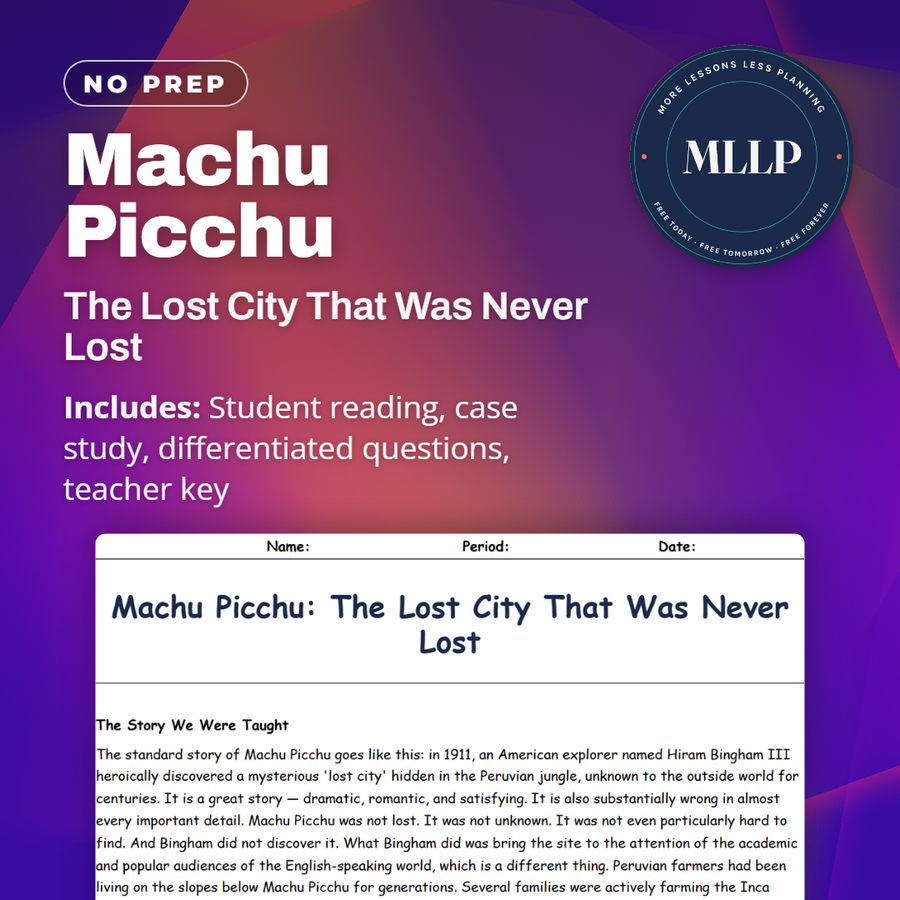
Machu Picchu: The Lost City That Was Never Lost
Quality reviewed September 2026
Facts verified September 21, 2026
- Subject
- Social Studies
- Grades
- Grades 9-12
- Length
- 9-page student worksheet
- Time
- About one 50-minute class period
- Great for
- Sub plans and independent work
- Includes
- Reading passage, comprehension questions + full answer key
- Format
- Print-and-go PDF
What students do
- Match terms like andenes and acllacuna to their role in the reading's evidence
- Pablito Richarte's grandson explains what the 1911 "discovery" left out about who already knew the site
- Explain why Machu Picchu is now identified as Pachacuti's royal estate rather than a fortress
- Ashlar stonework fitted without mortar gets compared to the 60 percent of the site built underground
What it covers
- Hiram Bingham's 1911 expedition and the Quechua families who already lived on the site
- Ashlar masonry and the hidden drainage system that keeps Machu Picchu standing
- The Yale repatriation dispute over 46,000 objects, resolved in 2010 and 2012
Start reading this worksheet
The Story We Were Taught
The standard story of Machu Picchu goes like this: in 1911, an American explorer named Hiram Bingham III heroically discovered a mysterious 'lost city' hidden in the Peruvian jungle, unknown to the outside world for centuries. It is a great story: dramatic, romantic, and satisfying. It is also substantially wrong in almost every important detail. Machu Picchu was not lost. It was not unknown. It was not even particularly hard to find. And Bingham did not discover it. What Bingham did was bring the site to the attention of the academic and popular audiences of the English-speaking world, which is a different thing. Peruvian farmers had been living on the slopes below Machu Picchu for generations. Several families were actively farming the Inca terraces when Bingham arrived. A local boy named Pablito Richarte, son of one of these farmers, guided Bingham up the mountain for a few centavos. The 'rediscovery' narrative is a product of the colonial-era assumption that a place only truly existed once a Western explorer had documented it.
Who Built Machu Picchu and Why?
Machu Picchu was constructed in the mid-fifteenth century, almost certainly during the reign of the Inca emperor Pachacuti (ruled 1438-1471), who transformed the Inca from a regional power into the largest empire in the Americas. The site sits at approximately 2,430 meters above sea level on a ridge between two mountain peaks in the Cusco region of Peru, overlooking the Urubamba River below. Its location is both strategically defensible and astronomically aligned: windows and doorways in the main structures are precisely oriented to capture the rising sun at the summer solstice and other significant calendar moments. For much of the twentieth century, Machu Picchu was described as a 'lost city' or 'mountain citadel,' with various theories about its function: a refuge for the Inca nobility, a military outpost, a religious center, a women's convent for the Chosen Women (acllacuna). Careful archaeological analysis, particularly work by archaeologist John Rowe and later by Johan Reinhard and others, has produced a more specific answer: Machu Picchu was almost certainly the royal estate of Pachacuti. The estate was a private country retreat for the emperor and his household, similar in concept to a European king's hunting lodge, though vastly grander in scale.
The Architecture: No Mortar, No Margin for Error
The most immediately striking feature of Machu Picchu to any visitor is the quality of its stone construction. The Inca used a technique called ashlar masonry: precisely cutting and fitting stones together without any mortar, relying entirely on the exact shape of each block to create a stable fit. The stones are fitted so tightly that in many places a knife blade cannot be inserted between them. This is particularly remarkable given that the Inca had no iron tools: all cutting was done with stone, bone, and bronze implements, and the stones were shaped by abrasion and patient refinement rather than by sharp-edged cutting. The engineering of Machu Picchu goes far beyond the visible structures. About 60% of the construction effort went into underground and invisible infrastructure: drainage channels, retaining walls, and a sophisticated foundation system that allows the site to survive the heavy rainfall and periodic earthquakes of the Andean environment. The agricultural terraces (andenes) that step down the mountain on multiple sides were not decorative: they prevented erosion, managed water runoff, and produced food for the site's estimated 500-1,000 permanent residents. Modern engineers studying the site have described the drainage system as more sophisticated than many contemporary systems.
Like what you read? The full reading, the case study, and every question set are in the free download below, along with the answer key.
Why this matters
The word discovery does real work in this story, and most of that work erases the people who were already there. Pablito Richarte's family kept farming those terraces for generations, and his grandson Agustin is still correcting a record his own grandfather never got the chance to correct himself. Students run into this same pattern anywhere a Western name gets attached to a place other people already knew, and the Yale case shows what it actually took, a century of diplomatic pressure, to get forty six thousand objects sent back to Peru. It raises a clear question worth sitting with, who finds something, and who always knew it was there.
From one teacher to another
Pablito Richarte knew the way up the mountain before Hiram Bingham ever asked, and the eleven year old who guided the American explorer for a few coins is the starting point for a reading that takes apart the lost city story most students already believe. Machu Picchu was never lost. Quechua families were farming its terraces when Bingham arrived in 1911, and the reading credits them by name where it can. From there students move into what the site actually was, the royal estate of the emperor Pachacuti rather than a fortress or a convent, and how its stonework and drainage were engineered well enough to survive five centuries of Andean rain and earthquakes without mortar. The reading closes with the Yale repatriation dispute, forty six thousand objects removed in 1912 and finally returned to Peru a century later, a case still cited in fights over the Elgin Marbles and the Benin Bronzes.
What you get
Download
Where should I send the next one?
Everything here is free and it stays that way. Leave your email and I'll send you the new lessons as they go up. You can unsubscribe from any one of them.
Related resources
Aztec Daily Life: Markets, Schools, and Chocolate
Aztec Human Sacrifice: Separating Fact from Propaganda
Descendant Communities Today: Living Heritage of the Americas
Inca Child Sacrifice: Capacocha and the Mountain Mummies
Quipu: The Inca Writing System Made of Knots
Tenochtitlan: The Aztec Capital Beneath Mexico City
Every lesson on this site is free to download and use. If one of them saved you a prep period, you can chip in a few bucks toward my three kids' daycare fund. That's genuinely where tips go.