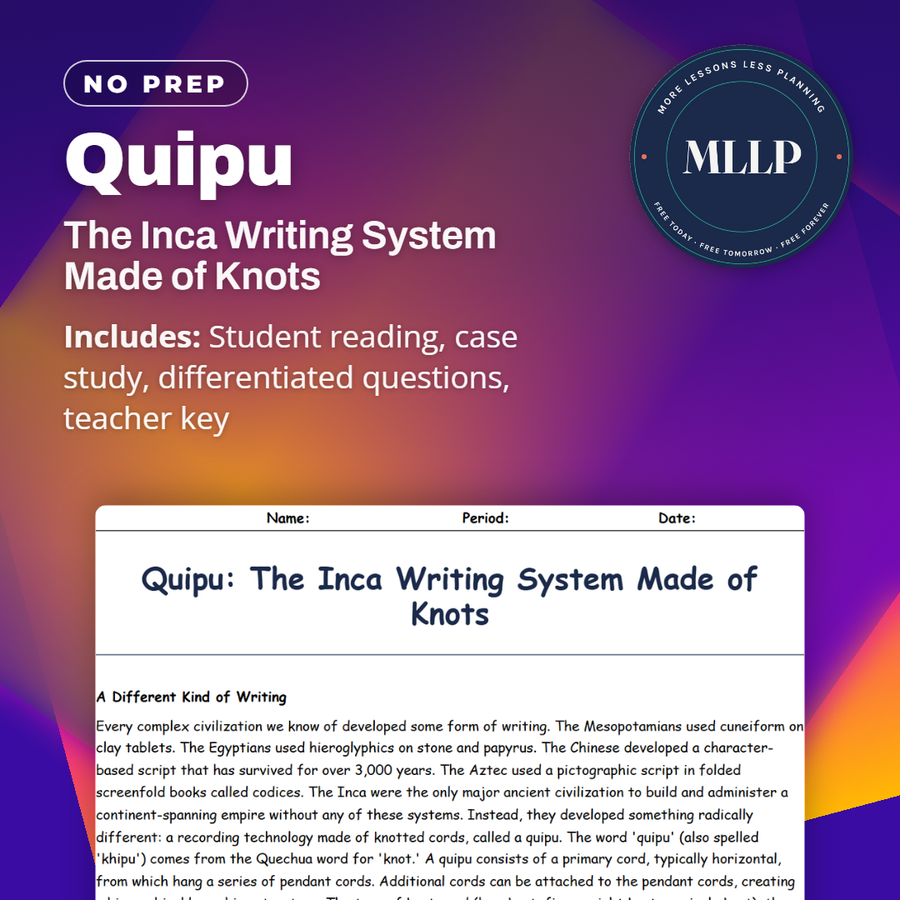
Quipu: The Inca Writing System Made of Knots
Quality reviewed September 2026
Facts verified September 21, 2026
- Subject
- Social Studies
- Grades
- Grades 9-12
- Length
- 10-page student worksheet
- Time
- About one 50-minute class period
- Great for
- Sub plans and independent work
- Includes
- Reading passage, comprehension questions + full answer key
- Format
- Print-and-go PDF
What students do
- Maria's grandmother reads knotted cords by touch, a practice Maria is only beginning to map
- Fill in the gaps on why the Spanish burned quipus after the Third Council of Lima
- The Puruchuco quipu's 23 villages get checked against its hierarchy of pendant cord totals
- Explain what decimal place-value knots can prove and what they still cannot prove
What it covers
- How Inca quipus recorded numbers using a decimal place-value knot system
- The unresolved question of whether quipus also encoded narrative and law
- Community knowledge in Peru today and the ethics of who gets to read a quipu
Start reading this worksheet
A Different Kind of Writing
Every complex civilization we know of developed some form of writing. The Mesopotamians used cuneiform on clay tablets. The Egyptians used hieroglyphics on stone and papyrus. The Chinese developed a character-based script that has survived for over 3,000 years. The Aztec used a pictographic script in folded screenfold books called codices. The Inca were the only major ancient civilization to build and administer a continent-spanning empire without any of these systems. Instead, they developed something radically different: a recording technology made of knotted cords, called a quipu. The word 'quipu' (also spelled 'khipu') comes from the Quechua word for 'knot.' A quipu consists of a primary cord, typically horizontal, from which hang a series of pendant cords. Additional cords can be attached to the pendant cords, creating a hierarchical branching structure. The type of knot used (long knot, figure-eight knot, or single knot), the position of the knot on the cord, the color of the cord, the twist direction of the fiber, the ply of the thread, and the relative spacing of knots all potentially carry information. Quipus range in size from small devices with a handful of cords to massive administrative records with hundreds of pendant strings.
What Quipus Could Do: Numbers Are Clear
One function of quipus is well established and has been decoded: they recorded numerical information using a decimal place-value system. Knots at the bottom of a pendant cord represented ones, knots above them represented tens, then hundreds, then thousands. This is a positional number system, the same basic logic as Arabic numerals, which are the foundation of modern mathematics. The Inca used this system to record tribute amounts, census data, agricultural yields, military tallies, and astronomical observations. The quipucamayoc (the keeper and reader of quipus) was a specialist bureaucratic role that required years of training. The numerical system is sophisticated. A single quipu found at the Puruchuco site near Lima contains records of 23 different villages, with local data on pendant strings that aggregate upward through the hierarchy to regional and imperial totals. This is essentially a spreadsheet encoded in cord: multiple layers of data organized in a hierarchical structure that could be read at different levels of detail depending on what the reader needed. Modern researchers studying this quipu have confirmed that the totals at each level of the hierarchy consistently match the sum of the subordinate data, proving that the numerical encoding is precise and systematic.
The Narrative Question: Did Quipus Do More Than Count?
The more contested question is whether quipus could encode non-numerical information: narrative, history, law, poetry, or administrative text. Spanish colonial sources consistently describe quipus being used to record history and oral tradition, not just numbers. One account describes quipu specialists reciting the history of each Inca emperor's reign from their cords. Another describes laws being recorded in quipu form. If true, this would mean the Inca had a full writing-equivalent system, just encoded in a radically different physical medium than any other known civilization. The evidence is tantalizing but not conclusive. Several researchers, including Gary Urton of Harvard, have developed elaborate classification systems for quipu features and identified patterns that suggest narrative encoding. Urton counted 24 binary features in quipu construction (twist direction, ply, color, knot type, etc.) that could in principle encode an enormous amount of information, more than enough for a writing system. However, actually reading what those features say, if they say anything beyond numbers, remains an unsolved problem. No Rosetta Stone for the quipu has been found.
Like what you read? The full reading, the case study, and every question set are in the free download below, along with the answer key.
Why this matters
Every other major ancient civilization we teach left behind writing that specialists can read today. The Inca left behind roughly 900 surviving quipus and no agreed method for reading most of what is on them, because the people who knew how were killed or silenced within a couple of generations of conquest. That gap matters beyond archaeology. It is a case study in how fast specialized knowledge disappears once the people who hold it are no longer allowed to teach it, and Maria's grandmother is a rare example of that knowledge surviving anyway, quietly, in a chest in one Andean village.
From one teacher to another
Maria's grandmother keeps a bundle of knotted cords in a cedar chest in a village in Peru. On feast days she runs her fingers along it and tells stories that Maria, now a graduate student, is starting to suspect are not memorized but actually read. That case study sits next to the reading's central puzzle, quipus have a numerical function that is fully decoded, a decimal place value system used for tribute, census, and yield data, but nobody has cracked whether the knots also carried narrative, law, or history the way Spanish colonial writers claimed. Students see why that second question is so hard to answer, since the Spanish burned huge numbers of quipus after 1583 and prosecuted the specialists trained to read them. The reading ends on Maria's dilemma, whether her grandmother's private knowledge belongs in an academic archive at all.
What you get
Download
Where should I send the next one?
Everything here is free and it stays that way. Leave your email and I'll send you the new lessons as they go up. You can unsubscribe from any one of them.
Related resources
Aztec Daily Life: Markets, Schools, and Chocolate
Aztec Human Sacrifice: Separating Fact from Propaganda
Descendant Communities Today: Living Heritage of the Americas
Inca Child Sacrifice: Capacocha and the Mountain Mummies
Machu Picchu: The Lost City That Was Never Lost
Tenochtitlan: The Aztec Capital Beneath Mexico City
Every lesson on this site is free to download and use. If one of them saved you a prep period, you can chip in a few bucks toward my three kids' daycare fund. That's genuinely where tips go.