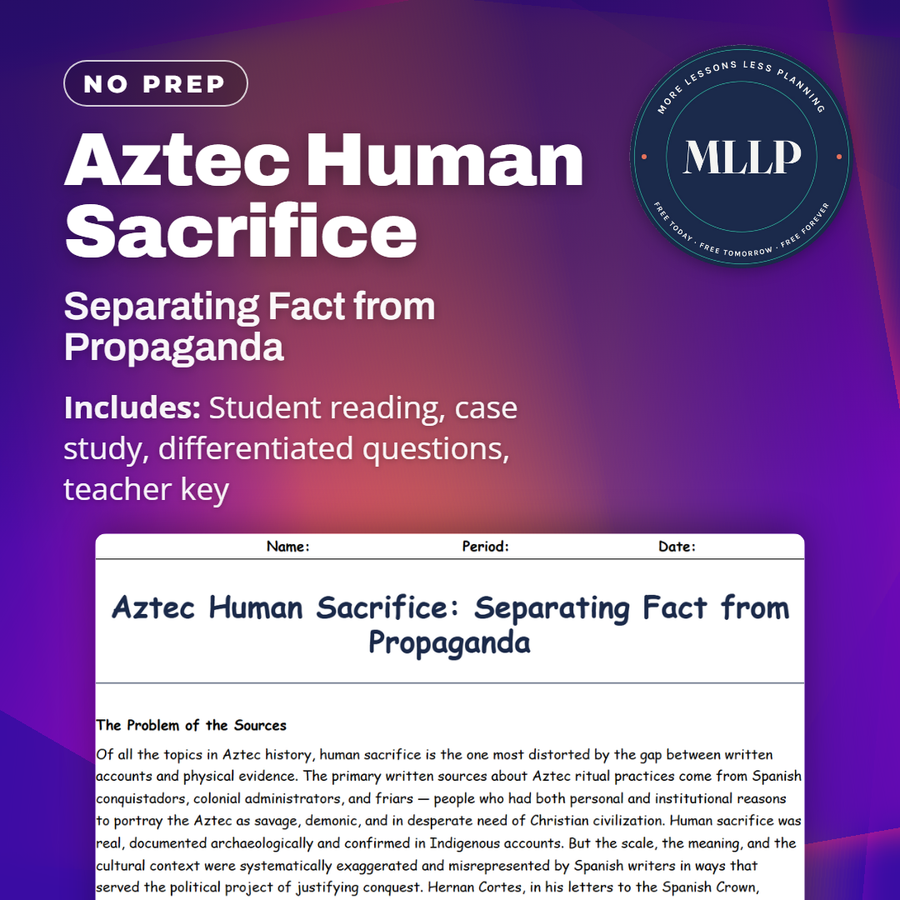
Aztec Human Sacrifice: Separating Fact from Propaganda
Quality reviewed September 2026
Facts verified September 21, 2026
- Subject
- Social Studies
- Grades
- Grades 9-12
- Length
- 9-page student worksheet
- Time
- About one 50-minute class period
- Great for
- Sub plans and independent work
- Includes
- Reading passage, comprehension questions + full answer key
- Format
- Print-and-go PDF
What students do
- Trace how isotope analysis on Templo Mayor skulls points to captive warriors far from home
- Spanish claims of 80,000 sacrificed in a single 1487 ceremony get checked against tzompantli skull counts
- Itzcoatl's last night as a captive is read against the Aztec religious logic of the fifth sun
- Match key terms like tzompantli and xochiyaoyotl to what the excavation actually found
What it covers
- Templo Mayor excavations and the 603-skull tzompantli confirmed since 2015
- Why Spanish accounts of sacrifice served a political purpose after conquest
- The religious logic of the fifth sun and the Flowery Wars that supplied captives
Start reading this worksheet
The Problem of the Sources
Of all the topics in Aztec history, human sacrifice is the one most distorted by the gap between written accounts and physical evidence. The primary written sources about Aztec ritual practices come from Spanish conquistadors, colonial administrators, and friars, people who had both personal and institutional reasons to portray the Aztec as savage, demonic, and in desperate need of Christian civilization. Human sacrifice was real, documented archaeologically and confirmed in Indigenous accounts. But the scale, the meaning, and the cultural context were systematically exaggerated and misrepresented by Spanish writers in ways that served the political project of justifying conquest. Hernan Cortes, in his letters to the Spanish Crown, described massive sacrifice rituals involving thousands of victims per ceremony. The friar Diego de Duran wrote detailed descriptions of elaborate rituals that may reflect genuine observation, clerical imagination, or some mixture of both. The problem is that we cannot always know. Archaeology, however, does not have political motives. The physical evidence from sites like the Templo Mayor gives us a dataset that we can analyze on its own terms, and what it shows is both more and less dramatic than the Spanish accounts suggest.
What the Bones Actually Show
Excavations at the Templo Mayor since 1978 have uncovered extensive evidence of human sacrifice. Skulls showing cut marks from defleshing, bones dyed with red hematite pigment, skeletal remains arranged in deliberate ritual patterns: the physical evidence is clear. In 2015, archaeologists confirmed the existence of a large tzompantli (skull rack) adjacent to the temple, containing hundreds of skulls embedded in a lime mortar matrix. Subsequent excavations through 2020 revealed that the structure was even larger than initially thought, with at least 603 skulls identified in a section of the rack, and the excavation is not complete. Forensic analysis of the skulls has revealed important details. The majority were adult males between the ages of 20 and 35, consistent with captive warriors taken in battle, as Aztec accounts describe. However, a significant minority were women and children, which complicates the simple narrative of 'warrior sacrifice.' Isotope analysis of teeth has shown that many individuals came from distant regions. These individuals were not local people but were brought to Tenochtitlan as captives. Cut marks on many skulls indicate they were defleshed after death, and some bones show evidence of burning and other forms of ritual processing.
The Religious and Political Logic of Sacrifice
To understand Aztec sacrifice without simply replicating Spanish horror, we have to take Aztec theology seriously on its own terms. The Aztec universe was understood as fragile and contingent. The current world, called the fifth sun, was believed to have been created through the self-sacrifice of the gods. The sun required human blood, specifically the life-force contained in it, to continue rising each day. Failure to provide this sustenance would mean the end of the world. Sacrifice was therefore not primarily about cruelty or terror; it was about cosmic maintenance, a debt owed to the gods that kept existence going. Sacrifice also served clear political functions. The public display of captive warriors before their ritual death demonstrated the military power and divine favor of the Aztec state. The institution of the 'Flowery Wars' (xochiyaoyotl) was designed partly to generate sacrificial captives in a region where the Aztec had already conquered most potential enemies. Subject peoples who sent tribute were also implicitly sending a message about their own subordination. The tzompantli, the skull rack, was not a secret practice hidden from public view. It was displayed prominently at the center of the city, visible to visiting dignitaries and subject peoples alike.
Like what you read? The full reading, the case study, and every question set are in the free download below, along with the answer key.
Why this matters
Sacrifice is the easiest Aztec topic to reduce to shock value, and it is also the one where getting the numbers wrong does real damage to how a whole civilization gets remembered. Spanish writers had a direct political reason to exaggerate the scale, since a conquered people described as killing eighty thousand humans in an afternoon is easier to dismiss as subhuman than one whose religious system, brutal as it was by modern standards, had its own internal logic. Students meet the same pattern anywhere a defeated group gets described only by the people who defeated them, and the tzompantli excavation gives them a concrete case where physical evidence let historians catch the exaggeration.
From one teacher to another
Itzcoatl waits in a Tenochtitlan courtyard the night before the festival of Toxcatl, a captured Tlaxcalan warrior trying to hold onto a belief he is no longer sure of, and his story opens a reading that takes Aztec sacrifice seriously without taking Spanish numbers at face value. Cortes and other Spanish writers described ceremonies with tens of thousands of victims, and the reading walks students through why archaeologists consider that scale impossible given what the excavated tzompantli actually contains. Students also see what the bones themselves show, cut marks, red hematite staining, and isotope results tracing many victims back to distant regions rather than the city itself. The reading does not soften what happened, but it separates the confirmed archaeology from the propaganda that inflated it for a colonial audience.
What you get
Download
Where should I send the next one?
Everything here is free and it stays that way. Leave your email and I'll send you the new lessons as they go up. You can unsubscribe from any one of them.
Related resources
Aztec Daily Life: Markets, Schools, and Chocolate
Descendant Communities Today: Living Heritage of the Americas
Inca Child Sacrifice: Capacocha and the Mountain Mummies
Machu Picchu: The Lost City That Was Never Lost
Quipu: The Inca Writing System Made of Knots
Tenochtitlan: The Aztec Capital Beneath Mexico City
Every lesson on this site is free to download and use. If one of them saved you a prep period, you can chip in a few bucks toward my three kids' daycare fund. That's genuinely where tips go.