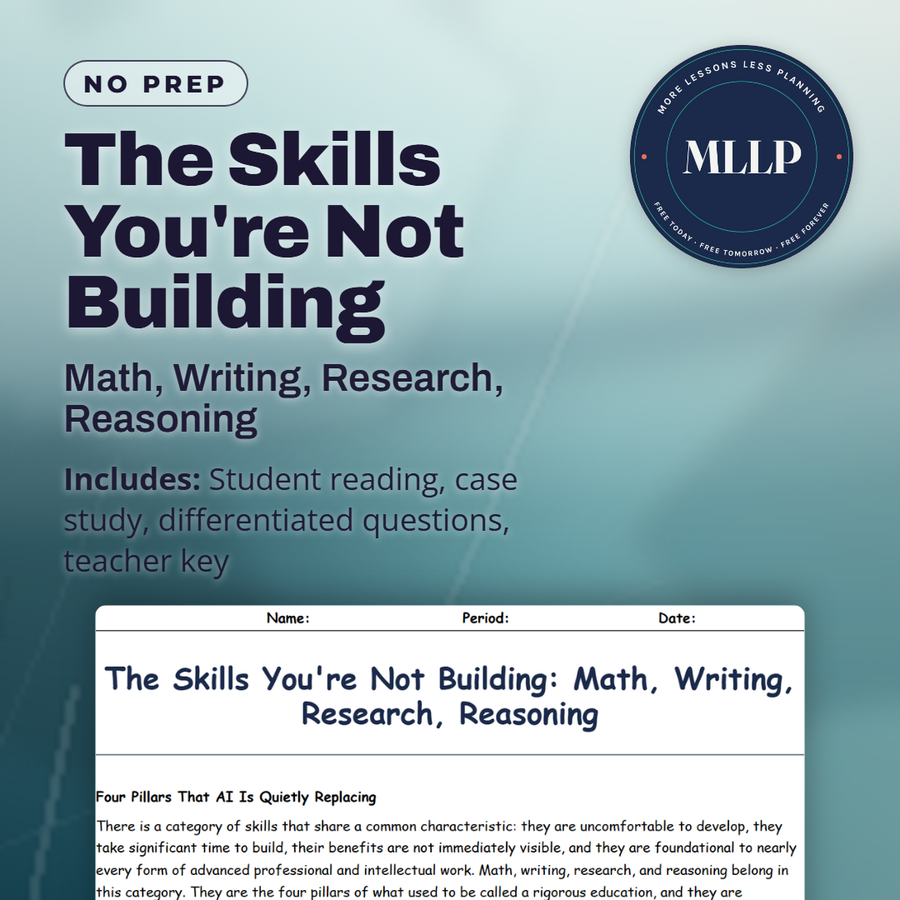
The Skills You're Not Building: Math, Writing, Research, Reasoning
Quality reviewed September 2026
Facts verified September 20, 2026
- Subject
- Career & Life Skills
- Grades
- Grades 9-12
- Length
- 10-page student worksheet
- Time
- About one 50-minute class period
- Great for
- Sub plans and independent work
- Includes
- Reading passage, comprehension questions + full answer key
- Format
- Print-and-go PDF
What students do
- Five terms, including mathematical fluency and augmented reasoning, get matched to their definitions
- Fill in three blanks drawn from the reading's sections on math, writing, and reasoning
- Kwame's case study, a strong student who fails a timed research assessment despite a 3.6 GPA, gets read and analyzed
- Explain in short answer form why reading an AI summary and actually researching a topic feel the same but are not
What it covers
- Four skills AI quietly replaces, quantitative reasoning, writing, research, and argument evaluation
- A case study on a high-GPA student who fails a no-AI research assessment
- The difference between AI-polished writing and writing that reflects genuinely clear thinking
Start reading this worksheet
Four Pillars That AI Is Quietly Replacing
There is a category of skills that share a common characteristic: they are uncomfortable to develop, they take significant time to build, their benefits are not immediately visible, and they are foundational to nearly every form of advanced professional and intellectual work. Math, writing, research, and reasoning belong in this category. They are the four pillars of what used to be called a rigorous education, and they are precisely the four areas where AI tools have become most capable of handling the work for you. The convenience is not incidental. It is a product of targeting the most effortful and highest-value cognitive tasks. None of these skills disappears instantly when AI handles the work instead of you. The process is gradual. A student who lets AI handle a few essays does not notice any cognitive change. A student who has AI handle essentially all of their academic writing over two or three years will find, upon reflection, that constructing an argument in writing has become unusually difficult. The change is not dramatic. It is incremental and often invisible until it is tested under conditions where AI is not available. By that point, the skill deficit is real and the remediation path is expensive in time and effort. Understanding specifically what each of these skills does for you, why it matters beyond the classroom, and how AI offloading specifically undermines each one is the first step toward making intentional choices about which cognitive work to preserve.
Math: More Than Calculation
The case for maintaining math skills in the age of AI calculators is often misunderstood. The argument is not that you need to be able to multiply large numbers in your head. It is that mathematical reasoning, the ability to think quantitatively, recognize patterns, estimate magnitudes, and understand how numerical relationships work, is a cognitive mode that has broad application beyond any specific calculation. A person who has practiced quantitative reasoning regularly can look at a financial projection, a research statistic, or a budget estimate and intuit whether the numbers make sense before relying on them. A person who has always outsourced calculation cannot. This matters because data now drives decisions in nearly every professional field. A marketing manager who cannot look at an A/B test result and understand what the numbers actually mean is dependent on others to interpret information that directly affects their decisions. A healthcare worker who cannot quickly assess whether a drug dosage calculation is within a reasonable range is relying entirely on tools and systems that can fail. A business owner who cannot mentally estimate whether a proposed deal is financially viable before running it through a spreadsheet is operating with a meaningful handicap. Research on mathematical fluency, the ease and automaticity with which a person can work with numerical information, consistently finds that fluency is developed through extensive practice and degrades significantly without it. Students who move through math courses with calculator assistance for all computations often develop procedural knowledge, the ability to follow steps, without developing numerical fluency. When AI handles the calculations entirely, even the procedural knowledge may not be built. The result is a generation of workers who can describe mathematical concepts but cannot apply them efficiently under real-world conditions.
Writing: Thinking Made Visible
The case for developing genuine writing skill has been addressed elsewhere in this unit, but it deserves examination from the angle of professional communication. Written communication is the primary channel through which professional decisions are made, documented, challenged, and defended. Emails, reports, proposals, briefs, assessments, policies, and strategic memos are the actual documents that run organizations. The quality of thinking in those documents determines the quality of the decisions they inform. An organization full of people who cannot write clearly produces documents that obscure thinking, allow poor decisions to pass unchallenged, and create legal and operational risk. The argument is sometimes made that AI writing tools will simply improve the written output of people who cannot write well. This is partially true for certain kinds of polishing. The problem is that AI tools improve the surface quality of writing, the sentences and structure, while leaving the underlying thinking untouched. A well-written memo that presents a bad idea clearly is not an improvement on a badly written memo that presents the same bad idea. Clear writing exposes weak reasoning to scrutiny. AI-polished writing can make weak reasoning harder to detect by making it sound more confident and professional. The skill of writing clearly is also the skill of thinking clearly. A person who has practiced translating their thinking into precise written language has practiced precision in their thinking itself. The feedback loop between the two is real and well-documented in communication research. Students who develop that feedback loop, who learn to notice when their writing is vague because their thinking is vague, develop stronger analytical reasoning as a result. Students who skip the writing practice skip the reasoning practice as well.
Like what you read? The full reading, the case study, and every question set are in the free download below, along with the answer key.
Why this matters
Grades feel like proof to my students, so this reading's most useful move is showing a student with a strong GPA walking into a real assessment and discovering the grades did not mean what he thought they meant. It matters because employers are already building these no-AI assessments into hiring, according to the reading, which means the gap Kwame hits in a research center interview is a gap some of my students will hit too if they never practice math, writing, research, and reasoning without a tool doing it for them. I want them to read this and ask honestly which of the four skills they are actually still building.
From one teacher to another
Math, writing, research, and reasoning get treated here as four separate skills, each with its own passage explaining what it actually builds and how AI offloading undermines it differently. The math section argues fluency is about intuiting whether numbers make sense, not mental arithmetic. The writing section makes a sharper point: AI can polish sentences while leaving weak thinking underneath just as weak, only harder to spot. Kwame's case study ties it together. He has a 3.6 GPA and still fails a timed, no-AI research assessment for a job he wanted, because his grades reflected AI performance rather than his own.
What you get
Download
Where should I send the next one?
Everything here is free and it stays that way. Leave your email and I'll send you the new lessons as they go up. You can unsubscribe from any one of them.
Related resources
"Vibe Coders" and Surface Workers: Why Real Skills Still Matter
AI Dependence: When the Tool Becomes a Crutch You Can't Put Down
AI and Inequality: Who Gets Left Behind When Tools Get Smarter
Cognitive Offloading: When You Stop Thinking for Yourself
Skill Atrophy in Real Life: Stories From College and the Workplace
The "Junior Employee Crisis": How Will Anyone Learn the Job?
Every lesson on this site is free to download and use. If one of them saved you a prep period, you can chip in a few bucks toward my three kids' daycare fund. That's genuinely where tips go.