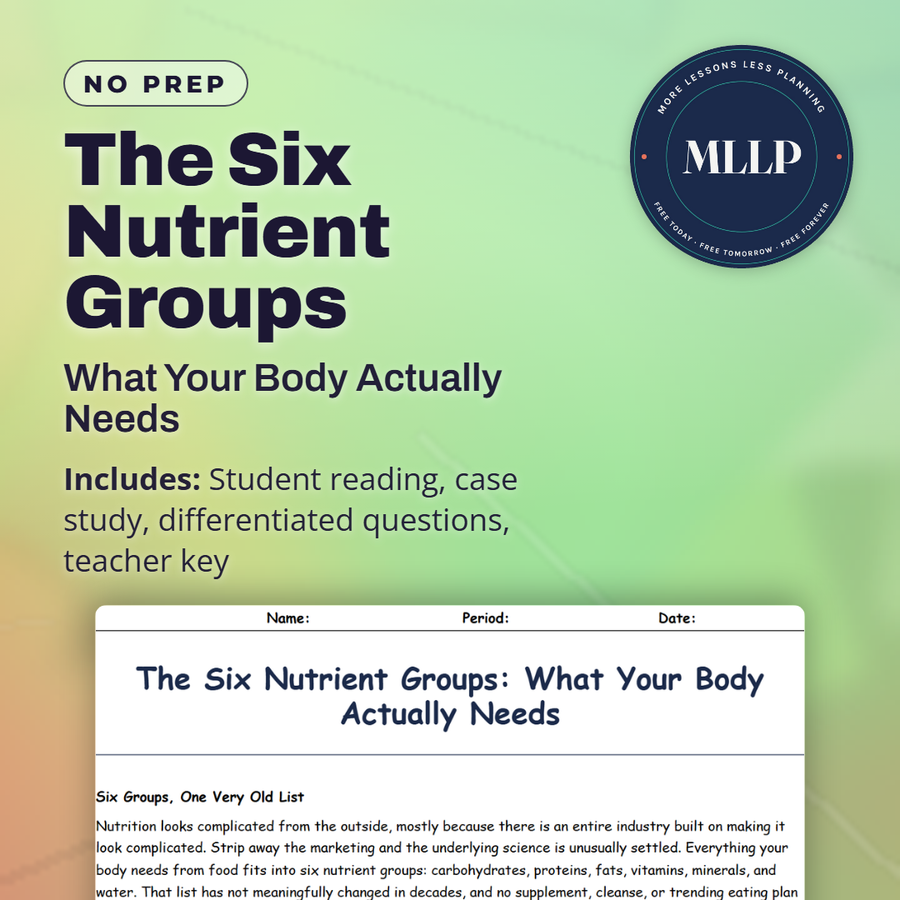
The Six Nutrient Groups: What Your Body Actually Needs
Quality reviewed September 2026
Facts verified September 23, 2026
- Subject
- Career & Life Skills
- Grades
- Grades 9-12
- Length
- 9-page student worksheet
- Time
- About one 50-minute class period
- Great for
- Sub plans and independent work
- Includes
- Reading passage, comprehension questions + full answer key
- Format
- Print-and-go PDF
What students do
- Identify why fat carries more than twice the calories per gram that carbohydrates do
- Trace how a water-soluble vitamin and a fat-soluble one get treated differently by the body
- Dontae's donut breakfast gets set beside a classmate's oatmeal, calorie for calorie
- Iron deficiency gets traced to why it shows up most often in teenage girls
What it covers
- The difference between a macronutrient and a micronutrient and why only one supplies calories
- Why fat-soluble vitamins can reach toxic levels from supplements and vitamin C cannot
- Dontae's donut breakfast matched calorie for calorie against a classmate's oatmeal
Start reading this worksheet
Six Groups, One Very Old List
Nutrition looks complicated from the outside, mostly because there is an entire industry built on making it look complicated. Strip away the marketing and the underlying science is unusually settled. Everything your body needs from food fits into six nutrient groups: carbohydrates, proteins, fats, vitamins, minerals, and water. That list has not meaningfully changed in decades, and no supplement, cleanse, or trending eating plan has ever added a seventh. Nutritionists split those six into two categories based on how much of them a person needs. Macronutrients, which means carbohydrates, proteins, and fats, are needed in large amounts, measured in grams, and they are the only nutrients in food that supply calories. Micronutrients, which means vitamins and minerals, are needed in tiny amounts measured in milligrams or micrograms, and they supply no calories at all. Water sits in a category of its own. It has no calories, but the body needs it by the liter. The two categories do two completely different jobs, and confusing them is where most bad nutrition advice begins. Macronutrients are fuel and building material. They power muscles, run the brain, and provide raw material for tissue the body rebuilds constantly. Micronutrients are not fuel. They are the tools and switches that let the fuel get used, acting as helpers in chemical reactions, as signals, and as structural pieces. A vitamin does not hand over energy the way a candy bar wrapper implies. It helps the body release energy from food already eaten. That single distinction explains a great deal. It is why a person can take in plenty of calories and still be poorly nourished, and it is why a multivitamin has never once substituted for a meal.
The Three That Come With Calories
Carbohydrates, protein, and fat are the only things in food that supply energy, and they do not supply it equally. Carbohydrates provide four calories per gram. Protein also provides four calories per gram. Fat provides nine calories per gram, more than twice as much as either of the others. That one number explains why fat-heavy foods are so calorie-dense in a way that regularly surprises people. A single tablespoon of oil, which barely coats the bottom of a pan, carries roughly 120 calories, while a full cup of raw spinach carries about seven. Carbohydrates are the body's preferred fuel, and the brain in particular runs almost entirely on glucose under ordinary conditions. They arrive as sugars, starches, and fiber. Fiber is the odd member of that group, because humans cannot digest it, which is exactly what makes it useful. It slows digestion, feeds the bacteria living in the large intestine, and adds bulk without adding usable calories. Protein is the one macronutrient the body cannot stockpile for later in any meaningful way, which is why it needs to show up regularly rather than all at once. Protein is assembled from twenty amino acids, nine of which are called essential because the body cannot manufacture them and has to get them from food. Fat has been the most unfairly treated nutrient of the last fifty years. It carries the fat-soluble vitamins into the body, builds every cell membrane a person owns, insulates nerves, and makes food taste good enough to actually eat. Dietary fat is not optional. This is also where the phrase empty calories comes from. A food with empty calories delivers macronutrients, usually sugar or fat, with almost no vitamins, minerals, or fiber attached. The calories are real. The nutrition is missing.
Vitamins: Tiny Amounts, Loud Consequences
Vitamins are organic compounds the body needs in very small amounts in order to run chemical reactions it cannot run without them. There are thirteen of them, and they split into two groups based on what they dissolve in, which turns out to matter far more than it sounds like it should. Water-soluble vitamins, meaning the eight B vitamins and vitamin C, dissolve in water, travel freely in the bloodstream, and are not stored in any significant quantity. Whatever is not used is generally excreted. That has two practical consequences. A person needs them regularly, more or less daily, and overdosing on them through ordinary food is close to impossible. It also means they leach out into cooking water, which is why boiled vegetables surrender more nutrition than steamed or roasted ones. Fat-soluble vitamins, meaning A, D, E, and K, dissolve in fat and are stored in the liver and in body fat. They are not required every single day, because the body keeps a reserve. But storage cuts both ways. Because these vitamins accumulate, it is genuinely possible to reach toxic doses of vitamin A or vitamin D through supplements. Nobody has ever been poisoned by eating too many carrots, but people have been hospitalized by high-dose pills. Deficiencies are where vitamins earned their reputation. Scurvy, the disease that killed sailors for centuries, is nothing more complicated than a vitamin C deficiency, and it is cured with citrus. Rickets, which softens and bows the growing bones of children, is a vitamin D deficiency. Neither is a historical curiosity, because both still appear today. The amounts involved are almost absurdly small. A deficiency measured in milligrams can end a life.
Like what you read? The full reading, the case study, and every question set are in the free download below, along with the answer key.
Why this matters
A student can hit a calorie target and still be running on empty in exactly the way Dontae was, and that gap between energy and nourishment is the whole point of separating macronutrients from micronutrients in the first place. Iron deficiency showing up disproportionately in teenage girls is worth naming directly, since the tiredness it causes is so easily mistaken for an ordinary teenage complaint that it gets missed. Six nutrient groups is a short enough list to actually remember, and once a student can name what each one does, a nutrition label stops being a wall of unrelated numbers.
From one teacher to another
Dontae ate a donut and a soda for breakfast and figured he was eating plenty, until his foods teacher put his log beside a classmate's oatmeal and eggs at almost the same calorie count. That comparison is where this reading ends, after walking through all six nutrient groups, carbohydrates, protein, fat, vitamins, minerals, and water, and why only the first three actually supply energy. Students read why fat carries nine calories per gram against four for carbohydrate and protein, why water-soluble vitamins need to show up daily while fat-soluble ones get stored, and why iron deficiency is the most common nutrient gap in the world. The reading defines empty calories directly through Dontae's own breakfast.
What you get
Download
Where should I send the next one?
Everything here is free and it stays that way. Leave your email and I'll send you the new lessons as they go up. You can unsubscribe from any one of them.
Related resources
Building a Balanced Plate with MyPlate
Carbs, Protein, and Fat in the Kitchen
Decoding the Nutrition Facts Label
Food Allergies and Intolerances
Food Marketing and Nutrition Misinformation
Nutrition Across the Lifespan
Every lesson on this site is free to download and use. If one of them saved you a prep period, you can chip in a few bucks toward my three kids' daycare fund. That's genuinely where tips go.