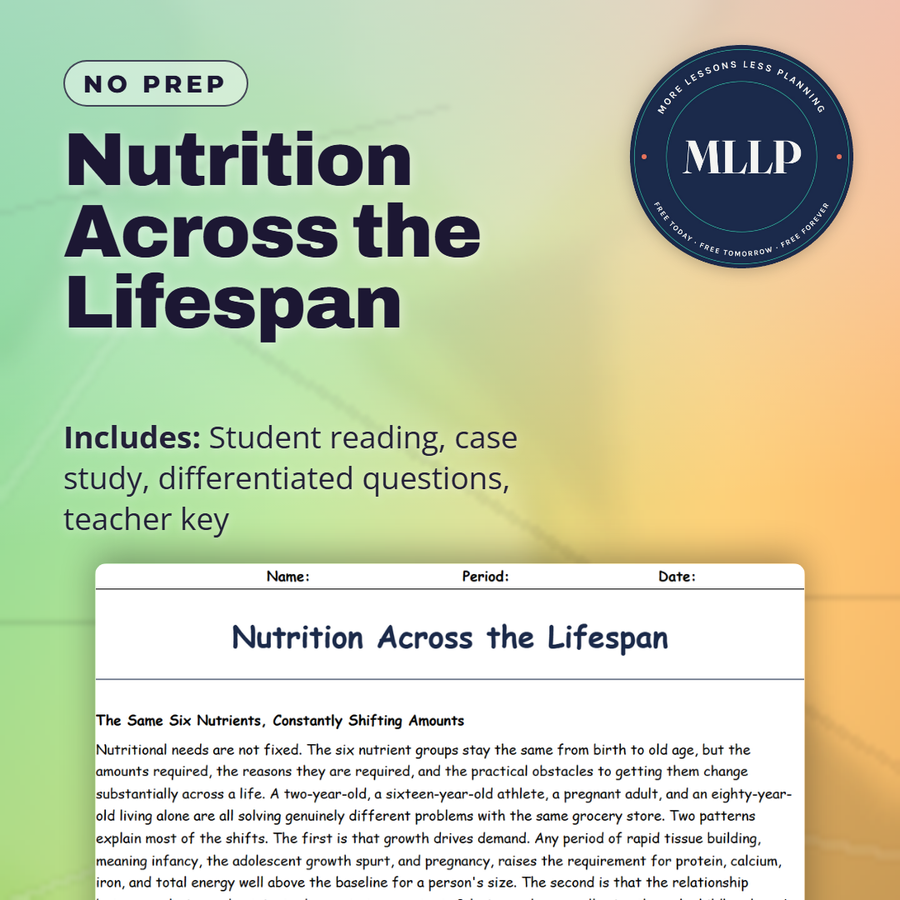
Nutrition Across the Lifespan
Quality reviewed September 2026
Facts verified September 23, 2026
- Subject
- Career & Life Skills
- Grades
- Grades 9-12
- Length
- 9-page student worksheet
- Time
- About one 50-minute class period
- Great for
- Sub plans and independent work
- Includes
- Reading passage, comprehension questions + full answer key
- Format
- Print-and-go PDF
What students do
- Explain why calcium needs stay high for a seventy-eight-year-old even as his calories drop
- Trace why the bone bank window closes at the end of the teen years
- Selena's shared kitchen gets worked through for what changed between her meals and her grandfather's
- Nutrient density, folic acid, sarcopenia, and the bone bank get paired with what each term means
What it covers
- Why an infant cannot have honey or cow's milk before twelve months
- The bone bank concept and why adolescent calcium does not come back later
- Selena's case study cooking one kitchen for two very different sets of needs
Start reading this worksheet
The Same Six Nutrients, Constantly Shifting Amounts
Nutritional needs are not fixed. The six nutrient groups stay the same from birth to old age, but the amounts required, the reasons they are required, and the practical obstacles to getting them change substantially across a life. A two-year-old, a sixteen-year-old athlete, a pregnant adult, and an eighty-year-old living alone are all solving genuinely different problems with the same grocery store. Two patterns explain most of the shifts. The first is that growth drives demand. Any period of rapid tissue building, meaning infancy, the adolescent growth spurt, and pregnancy, raises the requirement for protein, calcium, iron, and total energy well above the baseline for a person's size. The second is that the relationship between calories and nutrients does not stay constant. Calorie needs generally rise through childhood, peak in adolescence and early adulthood, and decline with age as activity and muscle mass decrease. Micronutrient needs, meanwhile, mostly hold steady or increase. That divergence produces the single most important concept in later-life nutrition, which is nutrient density, meaning the amount of nutrition delivered per calorie. A teenager burning through 2,800 calories a day has room for some nutritionally empty food and still meets every requirement. A seventy-five-year-old eating 1,700 calories does not have that margin, because every low-nutrient calorie displaces a nutrient the day still needs. Understanding this is what makes a Family and Consumer Sciences class practical rather than theoretical, because most students will at some point cook for a small child, a pregnant family member, or an aging relative.
Infancy: The Year With the Most Rules
The first year of life carries more firm nutritional rules than any other period, because an infant's digestive and immune systems are still developing. Breast milk or iron-fortified formula supplies complete nutrition for roughly the first six months, and major health organizations recommend exclusive feeding that way for about that long. Solid foods generally begin around six months, when an infant can sit with support and has lost the reflex that pushes food out of the mouth, and early foods supplement rather than replace milk or formula. Two rules are absolute and worth knowing precisely. No honey before twelve months, because honey can carry spores of Clostridium botulinum, which an infant's immature digestive system cannot suppress, causing infant botulism. No cow's milk as a main drink before twelve months, because it is low in iron, high in protein and minerals that stress developing kidneys, and can irritate the intestinal lining. Guidance on allergens moved in the opposite direction from what many parents expect. Earlier advice recommended delaying peanuts and other allergenic foods, and research showed that delay increased rather than decreased allergy risk. Pediatric guidelines have recommended introducing age-appropriate forms of peanut and other common allergens early, often around six months, for most infants, with a physician consulted first for high-risk infants. Choking hazards are the other constant concern, and whole grapes, nuts, popcorn, hot dog rounds, and hard raw vegetables all require modification or avoidance in the early years.
Childhood and Adolescence: The Bone Bank Closes
Toddlers and preschoolers eat in a way that alarms adults and is usually normal. Appetite becomes erratic after the first year because growth slows dramatically, food refusal and suspicion of new foods peak between roughly two and six, and intake tends to balance out across a week even when a single day looks impossible. Repeated neutral exposure works better than pressure, and it commonly takes eight to fifteen exposures before a child accepts a new food. A widely used framework divides the job: the adult decides what food is offered, when, and where, and the child decides whether to eat and how much. Adolescence is the second period of rapid growth and the one with the highest total nutrient demand of any stage after infancy. Calorie and protein needs climb sharply. Calcium requirements are higher for ages nine through eighteen than for adults, at 1,300 milligrams a day, because roughly ninety percent of adult bone mass is built by the end of the teen years. That window does not reopen, which is why the phrase bone bank is useful. Deposits made in adolescence are what remains available decades later against age-related bone loss. Iron needs rise for everyone during the growth spurt, from expanding muscle mass and blood volume, and rise further and permanently for teens who begin menstruating. This all lands during the years when eating gets least supervised, most rushed, and most social, which is precisely the tension a health or FACS class exists to address.
Like what you read? The full reading, the case study, and every question set are in the free download below, along with the answer key.
Why this matters
Most students in a FACS class will end up cooking for someone at a different life stage than their own long before they expect to, whether that is a younger sibling, an aging relative, or eventually their own child. Selena's case study works because nothing about her grandfather's food changed, only the choices inside meals they were already sharing, like fortified cereal instead of plain and water left on the table without being asked for. Understanding why the same six nutrients demand different amounts at different ages turns a confusing grocery aisle into a set of decisions that actually make sense.
From one teacher to another
A toddler, a sixteen-year-old athlete, a pregnant adult, and an eighty-year-old are all shopping from the same grocery store with genuinely different requirements, and that is the idea this reading works from. It covers infancy's firm rules, including why honey and cow's milk are off the table before twelve months, then moves through the adolescent calcium window that will not reopen and the folic acid timing that matters before a pregnancy is even confirmed. Older adulthood gets its own passage on shrinking calorie budgets next to steady or rising nutrient needs. The case study follows Selena, who is cooking for herself and her grandfather out of the same kitchen.
What you get
Download
Where should I send the next one?
Everything here is free and it stays that way. Leave your email and I'll send you the new lessons as they go up. You can unsubscribe from any one of them.
Related resources
Building a Balanced Plate with MyPlate
Carbs, Protein, and Fat in the Kitchen
Decoding the Nutrition Facts Label
Food Allergies and Intolerances
Food Marketing and Nutrition Misinformation
Planning a Week of Meals
Every lesson on this site is free to download and use. If one of them saved you a prep period, you can chip in a few bucks toward my three kids' daycare fund. That's genuinely where tips go.