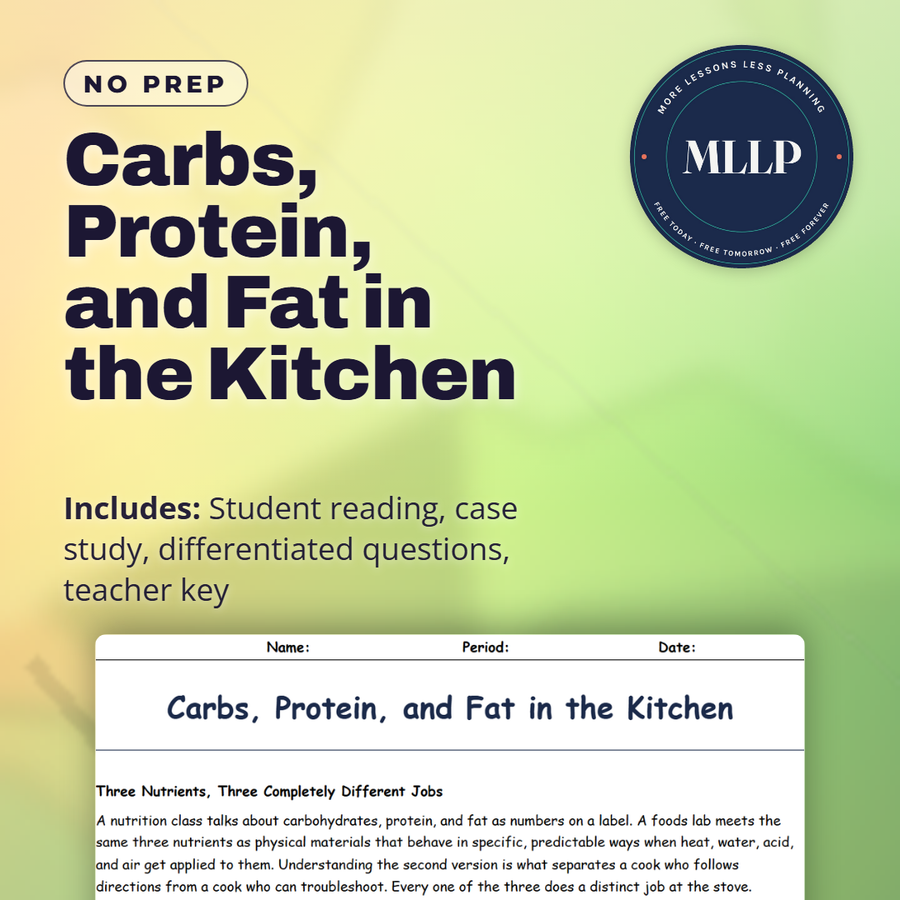
Carbs, Protein, and Fat in the Kitchen
Quality reviewed September 2026
Facts verified September 23, 2026
- Subject
- Career & Life Skills
- Grades
- Grades 9-12
- Length
- 8-page student worksheet
- Time
- About one 50-minute class period
- Great for
- Sub plans and independent work
- Includes
- Reading passage, comprehension questions + full answer key
- Format
- Print-and-go PDF
What students do
- A tough cake and rubbery eggs trace back to the same protein problem while a broken vinaigrette is a separate fat and water problem
- Fiber, denaturation, and smoke points get defined in the five term matching set
- Fiber gets explained as a carbohydrate even though the body cannot digest it
- Kayla's fat-free salad experiment gets picked apart for what the oil was actually doing
What it covers
- What carbohydrates, protein, and fat each do to food under heat, water, and acid
- Complete versus incomplete protein and why beans and rice complement each other
- Kayla's vinaigrette experiment and what the missing oil cost her salad
Start reading this worksheet
Three Nutrients, Three Completely Different Jobs
A nutrition class talks about carbohydrates, protein, and fat as numbers on a label. A foods lab meets the same three nutrients as physical materials that behave in specific, predictable ways when heat, water, acid, and air get applied to them. Understanding the second version is what separates a cook who follows directions from a cook who can troubleshoot. Every one of the three does a distinct job at the stove. Carbohydrates thicken, brown, gel, and provide the structure that holds baked goods together. Protein sets, firms, browns, and traps air. Fat carries flavor, transfers heat, tenderizes, and keeps things from sticking to each other and to the pan. When a dish fails, one of those three is usually the reason, and knowing which one narrows the problem immediately. A cake that came out tough is a flour and gluten problem, which is a protein problem. Scrambled eggs that turned rubbery and wept water on the plate are an overcooked protein problem. A vinaigrette that separated in thirty seconds is a fat and water problem. A cookie that spread into one enormous flat sheet is a fat and sugar problem. None of these require guessing once a person knows what each nutrient does under heat. The label version of these nutrients matters for health, and the kitchen version matters for whether dinner works. They are the same molecules either way. A foods class is one of the few places where students get to see nutrition science happen in real time rather than reading about it, which is a genuine advantage worth using.
Carbohydrates: Simple, Complex, and the Fiber Exception
Carbohydrates come in two broad forms, and the difference is essentially a matter of chain length. Simple carbohydrates are short. They include single sugars such as glucose, fructose, and galactose, and double sugars such as sucrose, which is table sugar, lactose, which is milk sugar, and maltose. Simple sugars digest quickly and reach the bloodstream fast. Complex carbohydrates are long chains of glucose units and include starch and fiber. Starch is what a potato, a grain of rice, and a piece of bread are mostly made of, and the body breaks it down into glucose more slowly than it breaks down a spoonful of sugar. Fiber is the exception that makes carbohydrates interesting. Fiber is also a long chain of sugar units, but humans lack the enzymes to break the bonds, so it passes through largely intact. That failure to digest is the whole point. Soluble fiber, found in oats, beans, barley, and apples, dissolves into a gel that slows digestion, blunts the rise in blood glucose after a meal, and helps lower blood cholesterol. Insoluble fiber, found in wheat bran, vegetable skins, and whole grains, does not dissolve. It adds bulk and keeps things moving through the digestive tract. The recommended daily value for fiber is 28 grams, and most Americans take in roughly half that, which is one of the more consistent gaps in the national diet. In the kitchen, carbohydrates are also the browning nutrient. Sugars caramelize when heated past about 320 degrees Fahrenheit, turning brown and developing hundreds of new flavor compounds that were not present in the raw ingredient at all.
Protein: Complete, Incomplete, and What Heat Does to It
Protein is built from twenty amino acids strung together in specific sequences, and nine of those amino acids are essential, meaning the body cannot build them and has to take them in from food. A protein source that supplies all nine essential amino acids in useful amounts is called a complete protein. Animal foods, meaning meat, poultry, fish, eggs, and dairy, are complete, and so are soy and quinoa. Most plant proteins are incomplete, meaning they are low in one or more essential amino acids. Beans run low in methionine and grains run low in lysine, which is why beans and rice, or hummus and pita, or peanut butter on bread, complete each other. These are called complementary proteins. An older idea held that complementary proteins had to be eaten in the same meal, and that turned out to be unnecessary. The body maintains a pool of amino acids, so getting the full range across a day is sufficient. In the kitchen, protein behaves in a way that is easy to watch. Heat, acid, and mechanical force all cause denaturation, which means the folded protein molecule unravels and then bonds with its neighbors. That is exactly what happens when a clear, runny egg white turns opaque and firm in a pan, and it is also what happens when citrus juice firms up raw fish in ceviche without any heat at all. Denaturation is not damage and it does not destroy nutritional value. Overdoing it, however, squeezes water out and produces tough meat, rubbery eggs, and dry chicken, which is the single most common protein failure in a school foods lab.
Like what you read? The full reading, the case study, and every question set are in the free download below, along with the answer key.
Why this matters
Foods class is one of the only places a student watches nutrition science happen instead of reading about it, and that is worth using deliberately. Knowing that a rubbery scrambled egg is an overcooked protein problem, or that a broken dressing is a fat and water problem, turns a ruined dish into something a student can actually fix next time instead of a mystery. The same three nutrients that show up on a label are the ones doing the work in the pan, and seeing both sides at once is what makes the connection stick.
From one teacher to another
A cookie that spreads into one flat sheet and a cake that turns out tough are different failures, and this reading is built around telling them apart. It walks through what carbohydrates, protein, and fat each do at the stove, covering caramelization, denaturation, and the emulsions that hold a vinaigrette together. Students read why fiber counts as a carbohydrate even though the body cannot digest it, why beans and rice complete each other's amino acids, and why butter smokes before a refined oil does. The case study follows Kayla, who cut all the oil from her dressing and found out what a fat-soluble vitamin actually needs to be absorbed.
What you get
Download
Where should I send the next one?
Everything here is free and it stays that way. Leave your email and I'll send you the new lessons as they go up. You can unsubscribe from any one of them.
Related resources
Building a Balanced Plate with MyPlate
Decoding the Nutrition Facts Label
Food Allergies and Intolerances
Food Marketing and Nutrition Misinformation
Nutrition Across the Lifespan
Planning a Week of Meals
Every lesson on this site is free to download and use. If one of them saved you a prep period, you can chip in a few bucks toward my three kids' daycare fund. That's genuinely where tips go.