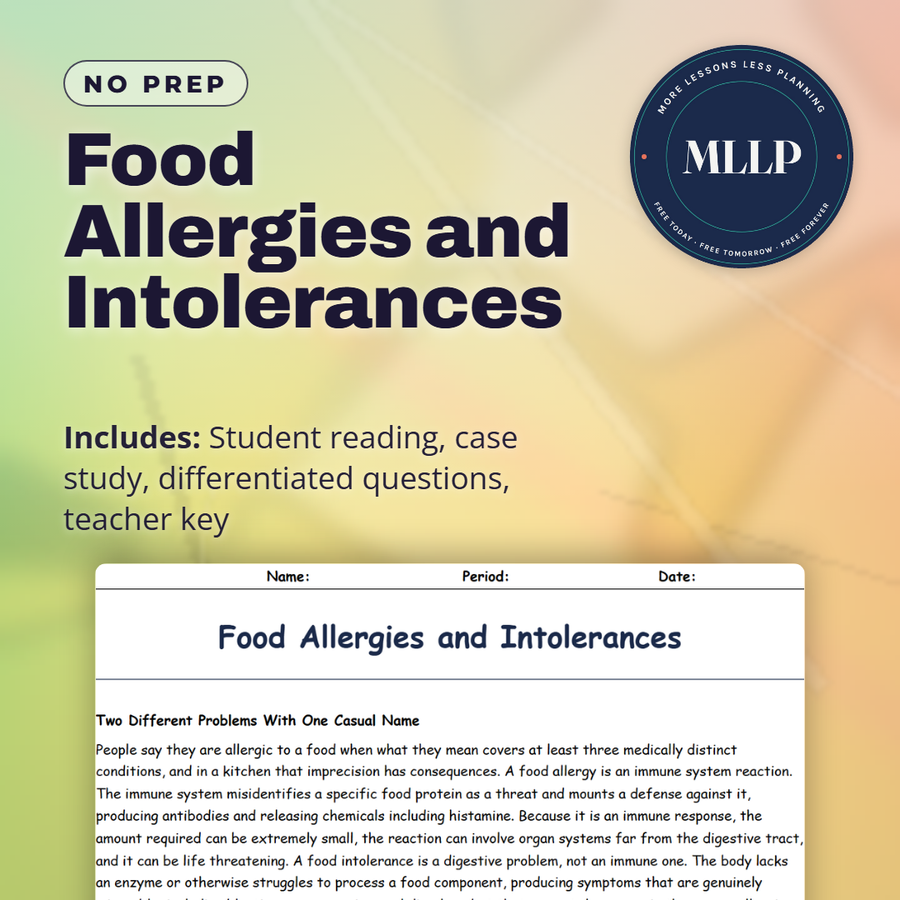
Food Allergies and Intolerances
Quality reviewed September 2026
Facts verified September 23, 2026
- Subject
- Career & Life Skills
- Grades
- Grades 9-12
- Length
- 9-page student worksheet
- Time
- About one 50-minute class period
- Great for
- Sub plans and independent work
- Includes
- Reading passage, comprehension questions + full answer key
- Format
- Print-and-go PDF
What students do
- Compare a food allergy to a food intolerance using how each one actually works in the body
- Identify the correct first response when someone shows signs of anaphylaxis
- Amari's cutting board scenario gets worked through step by step
- Food allergy, food intolerance, anaphylaxis, cross-contact, and lactase get matched to their definitions
What it covers
- The medical difference between a food allergy, an intolerance, and celiac disease
- Why cross-contact survives cooking even though bacteria do not
- Amari's cutting board scenario and why a dry towel was not enough
Start reading this worksheet
Two Different Problems With One Casual Name
People say they are allergic to a food when what they mean covers at least three medically distinct conditions, and in a kitchen that imprecision has consequences. A food allergy is an immune system reaction. The immune system misidentifies a specific food protein as a threat and mounts a defense against it, producing antibodies and releasing chemicals including histamine. Because it is an immune response, the amount required can be extremely small, the reaction can involve organ systems far from the digestive tract, and it can be life threatening. A food intolerance is a digestive problem, not an immune one. The body lacks an enzyme or otherwise struggles to process a food component, producing symptoms that are genuinely miserable, including bloating, gas, cramping, and diarrhea, but that are not dangerous in the way an allergic reaction is dangerous. Intolerances are usually dose dependent, meaning a small amount may cause no trouble while a large amount causes a great deal. Celiac disease is a third category that fits neither description cleanly. It is an autoimmune disease in which gluten triggers the immune system to damage the lining of the small intestine, and although it involves the immune system it does not produce the rapid, potentially fatal reaction that a true allergy can. The distinction is not academic vocabulary. It determines whether a trace of a food is dangerous or merely uncomfortable, whether a person needs an emergency medication on hand, and how seriously a kitchen has to work to keep two foods apart.
The Nine Foods That Cause Most Reactions
More than 160 foods have been documented as causing allergic reactions, but a short list accounts for the large majority of them. United States law identifies nine major food allergens: milk, eggs, fish, crustacean shellfish, tree nuts, peanuts, wheat, soybeans, and sesame. The first eight were established by the Food Allergen Labeling and Consumer Protection Act of 2004. Sesame was added by the FASTER Act and became the ninth major allergen effective January 1, 2023, after years of advocacy from families who could not reliably identify it on ingredient lists. Together these nine are estimated to account for around ninety percent of documented food allergic reactions in the country. The labeling law is the practical result and it is worth understanding as a shopper. Packaged foods regulated by the FDA must declare the presence of a major allergen in plain English, either within the ingredient list or in a separate Contains statement, so that a parent does not have to know that casein and whey are milk or that albumin is egg. That requirement is genuinely useful. What the law does not regulate is the advisory statement, meaning phrases such as may contain tree nuts or processed in a facility that also processes peanuts. Those statements are entirely voluntary, are not standardized, and their absence does not prove a food is safe. A person managing a serious allergy generally treats advisory language as a warning and its absence as unproven rather than as an all clear.
Anaphylaxis and Why Minutes Matter
Most allergic reactions to food are mild and stay that way, involving hives, an itchy mouth, swelling, or stomach upset. Anaphylaxis is the reaction that makes food allergy a medical emergency rather than an inconvenience. It is a severe, rapid-onset reaction involving more than one body system at once, and it can begin within seconds to minutes of exposure. The signs worth recognizing include swelling of the lips, tongue, or throat, difficulty breathing or a hoarse voice, widespread hives, repetitive vomiting, dizziness or fainting, and a sense that something is very wrong. The first-line treatment is epinephrine, delivered by an auto-injector into the outer thigh, and the timing of that injection is the single largest factor in how the episode goes. Delay is the most common and most serious mistake. Antihistamines such as diphenhydramine are not a treatment for anaphylaxis and should never be used in its place, because they may reduce hives and itching while doing nothing about airway swelling or falling blood pressure. Emergency services should be called after epinephrine is given, every time, even if the person appears to recover completely, because a second wave of symptoms can occur hours later. Many states allow schools to stock undesignated epinephrine and permit trained staff to administer it. For a foods class specifically, the practical lesson is that recognizing the signs and acting quickly matters more than knowing which food caused it, and hesitating in order to be certain is the behavior that turns a survivable reaction into a fatal one.
Like what you read? The full reading, the case study, and every question set are in the free download below, along with the answer key.
Why this matters
A foods lab is a shared kitchen, and at some point nearly every student in it will be cooking around someone else's allergy, whether that is a classmate, a roommate, or their own child years from now. The reading is specific about why a wiped cutting board is not a clean one, which is the kind of detail that only sticks once a student sees the reasoning behind it rather than just the rule. Recognizing the signs of anaphylaxis and knowing to act on them immediately, even before identifying the food, is worth more than any amount of memorized ingredient trivia.
From one teacher to another
Amari carries an epinephrine auto-injector because of a peanut allergy, and his cutting board story is the case study waiting at the end of this reading. Before that, students read through what actually separates a food allergy from a food intolerance, since one is an immune reaction and the other is a digestive one, and neither term should be used loosely in a kitchen. The reading covers the nine major food allergens, what a Contains statement legally means versus a may contain warning, and why searing a pan does not remove peanut protein the way it kills bacteria. It ends on anaphylaxis itself, including why an antihistamine is not a substitute for epinephrine.
What you get
Download
Where should I send the next one?
Everything here is free and it stays that way. Leave your email and I'll send you the new lessons as they go up. You can unsubscribe from any one of them.
Related resources
Building a Balanced Plate with MyPlate
Carbs, Protein, and Fat in the Kitchen
Decoding the Nutrition Facts Label
Food Marketing and Nutrition Misinformation
Nutrition Across the Lifespan
Planning a Week of Meals
Every lesson on this site is free to download and use. If one of them saved you a prep period, you can chip in a few bucks toward my three kids' daycare fund. That's genuinely where tips go.