Food Marketing and Nutrition Misinformation
Quality reviewed September 2026
Facts verified September 23, 2026
- Subject
- Career & Life Skills
- Grades
- Grades 9-12
- Length
- 9-page student worksheet
- Time
- About one 50-minute class period
- Great for
- Sub plans and independent work
- Includes
- Reading passage, comprehension questions + full answer key
- Format
- Print-and-go PDF
What students do
- Why reduced fat on a label does not mean the food is low in fat gets explained
- Decide whether a reduced sodium soup claim guarantees a genuinely low sodium food
- Reyna's viral video gets run through the reading's own red flag checklist
- The disclaimer under a structure or function claim gets read for what it actually admits
What it covers
- How product placement and package design work on a shopper who is not paying attention
- Which front of package words are legally regulated and which ones mean nothing
- Reyna's video and the red flags it hit on the reading's own checklist
Start reading this worksheet
The Front of the Package Is an Advertisement
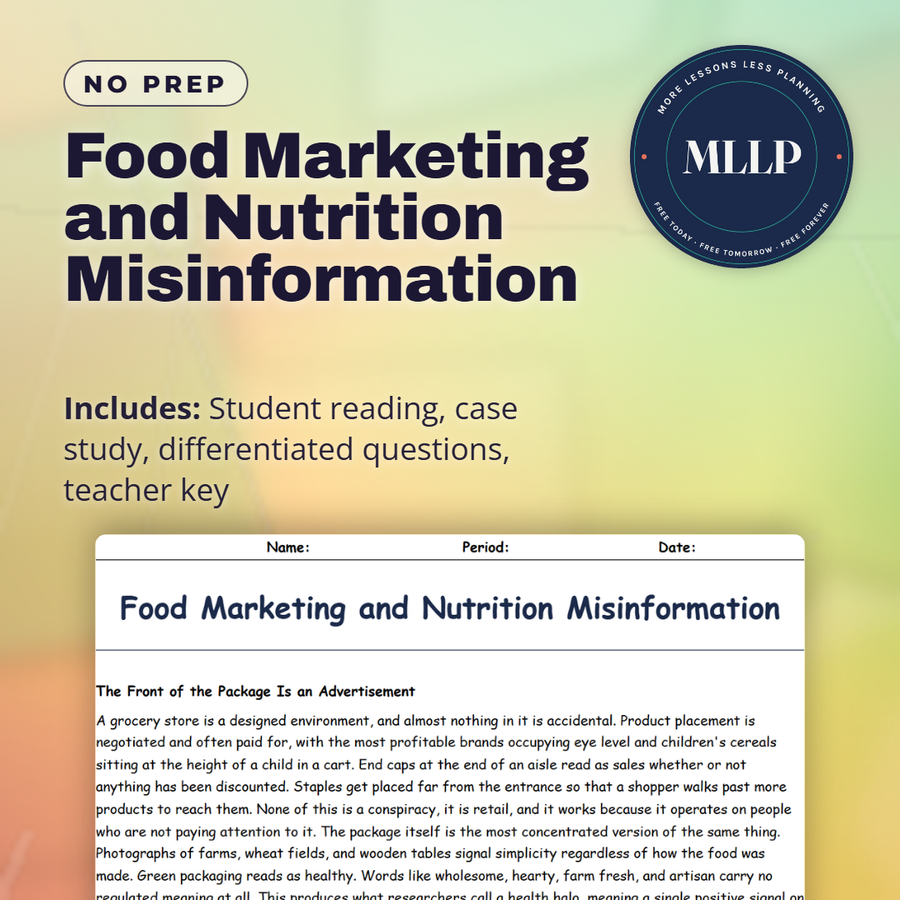
A grocery store is a designed environment, and almost nothing in it is accidental. Product placement is negotiated and often paid for, with the most profitable brands occupying eye level and children's cereals sitting at the height of a child in a cart. End caps at the end of an aisle read as sales whether or not anything has been discounted. Staples get placed far from the entrance so that a shopper walks past more products to reach them. None of this is a conspiracy, it is retail, and it works because it operates on people who are not paying attention to it. The package itself is the most concentrated version of the same thing. Photographs of farms, wheat fields, and wooden tables signal simplicity regardless of how the food was made. Green packaging reads as healthy. Words like wholesome, hearty, farm fresh, and artisan carry no regulated meaning at all. This produces what researchers call a health halo, meaning a single positive signal on a package causes shoppers to assume other positive qualities that were never claimed. A cereal labeled a good source of fiber gets judged as lower in sugar than an identical cereal without the claim, even when the panel says otherwise. The defense is simple to state and takes practice to actually do, which is to treat the front of a package as advertising and the Nutrition Facts panel and ingredient list as information. The front is designed to be persuasive. The back is required to be accurate.
The Claims That Mean Something and the Ones That Do Not
A useful surprise is that many front-of-package claims are legally defined, and knowing the definitions turns marketing language back into data. The Food and Drug Administration regulates nutrient content claims with specific thresholds per serving. Low fat means three grams or less. Fat free means less than half a gram. Low sodium means 140 milligrams or less, while sodium free means less than five milligrams. Low calorie means forty calories or less. Good source of a nutrient means the serving supplies ten to nineteen percent of the Daily Value, while excellent source, high in, or rich in all mean twenty percent or more. Reduced or less means at least twenty five percent less than the regular version of that product, which is a comparison rather than an absolute, so reduced sodium soup can still be a high sodium food. Light or lite means one third fewer calories or fifty percent less fat than the reference. Those are real, checkable standards. Other prominent words are not. Natural has no formal FDA definition for most foods, and the agency has generally treated it as meaning nothing artificial or synthetic was added, without formal rulemaking behind it. Organic, by contrast, is genuinely regulated by the USDA with certification requirements. Made with whole grains promises only that some whole grain is present, in any amount. Multigrain promises more than one grain, all of which may be refined. Learning which words are measurements and which are decoration is most of the work.
Claims About Health, and the Fine Print Under Them
A second category of claim concerns health rather than nutrients, and the rules differ sharply depending on which kind is being made. An authorized health claim links a food or nutrient to a reduced risk of a disease, such as the relationship between calcium and osteoporosis or between sodium and hypertension. These require significant scientific agreement and FDA authorization, and the permitted wording is constrained. A structure or function claim says a substance affects the structure or function of the body, using phrasing like supports immune health, promotes digestive health, or helps maintain energy. These do not require FDA approval before use, and on supplements they must carry a disclaimer stating that the claim has not been evaluated by the FDA and that the product is not intended to diagnose, treat, cure, or prevent any disease. That disclaimer is printed in the smallest legible type on the package and is the most informative sentence on it. Dietary supplements are worth understanding as their own regulatory category. Under a 1994 federal law, supplements are not reviewed or approved by the FDA for safety or effectiveness before they go on sale. The manufacturer is responsible for their own safety and labeling claims, and the FDA generally acts after a problem appears rather than before a product ships. This is the opposite of how prescription drugs are handled, and it explains how a shelf of products promising detoxification, metabolism support, or immune defense can exist without any of them having been demonstrated to do those things.
Like what you read? The full reading, the case study, and every question set are in the free download below, along with the answer key.
Why this matters
Every student in this class will be a shopper for the rest of their life, and most of the persuasion aimed at them in a store or on a phone is built to work below the level of conscious notice. Learning that natural has no legal definition while organic does, or that a structure or function claim gets away with saying almost nothing, changes how a label reads permanently once it clicks. Reyna's video is useful precisely because nothing in it was an outright lie, which is closer to how misinformation actually spreads than an obvious scam would be.
From one teacher to another
A grocery store is not a neutral place to stand, and this reading opens by explaining why, from where a children's cereal sits on the shelf to what a green package is designed to signal. It moves into the claims that actually mean something, since low fat, good source, and reduced all have specific FDA thresholds, next to words like natural and multigrain that carry no regulated meaning at all. A passage on supplements explains why the FDA does not review them for safety before they reach a shelf. The reading ends with Reyna's video, an eleven million view clip her class checks against a list of red flags including the seller pitching her own cure.
What you get
Download
Where should I send the next one?
Everything here is free and it stays that way. Leave your email and I'll send you the new lessons as they go up. You can unsubscribe from any one of them.
Related resources
Building a Balanced Plate with MyPlate
Carbs, Protein, and Fat in the Kitchen
Decoding the Nutrition Facts Label
Food Allergies and Intolerances
Nutrition Across the Lifespan
Planning a Week of Meals
Every lesson on this site is free to download and use. If one of them saved you a prep period, you can chip in a few bucks toward my three kids' daycare fund. That's genuinely where tips go.