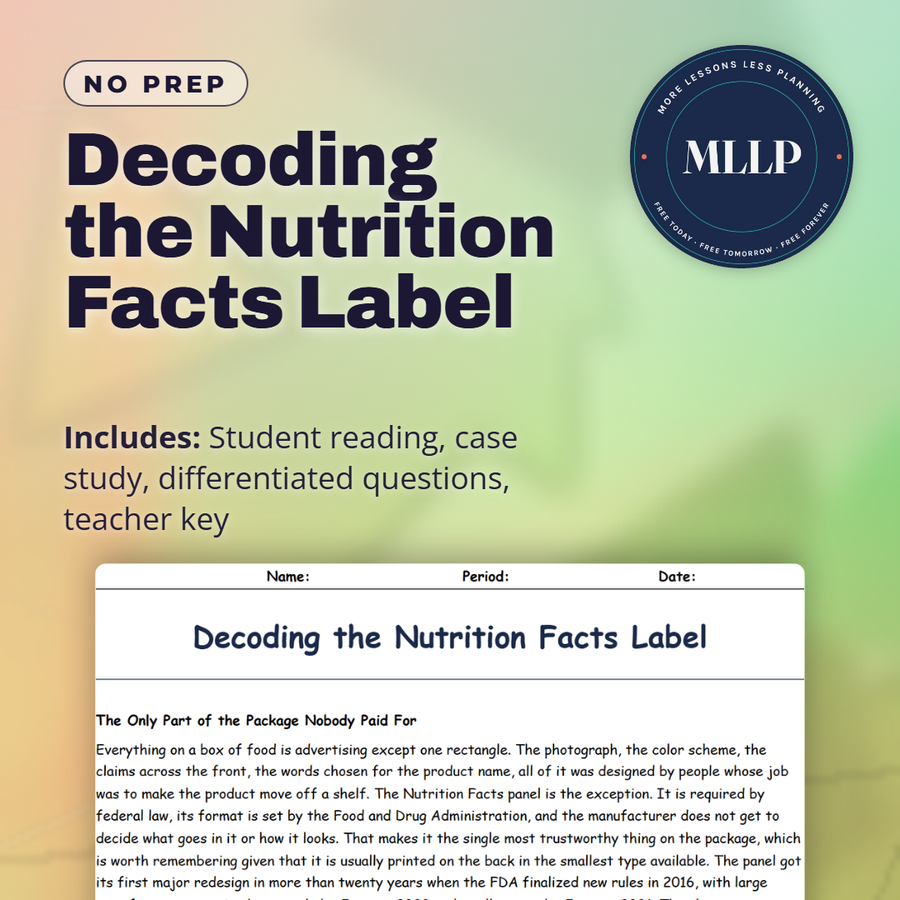
Decoding the Nutrition Facts Label
Quality reviewed September 2026
Facts verified September 23, 2026
- Subject
- Career & Life Skills
- Grades
- Grades 9-12
- Length
- 9-page student worksheet
- Time
- About one 50-minute class period
- Great for
- Sub plans and independent work
- Includes
- Reading passage, comprehension questions + full answer key
- Format
- Print-and-go PDF
What students do
- Identify why a bottle listing 2.5 servings supplies more than the number on top suggests
- Explain the five and twenty percent rule for reading any nutrient on the panel
- Two granola bags get compared on serving size, added sugars, and fiber before the ingredient lists get checked
- Added sugars and total sugars get separated out using what each one actually counts
What it covers
- The order to read a Nutrition Facts panel in, starting with servings per container
- How percent Daily Value works and the five and twenty percent shortcut
- Jordan's side by side comparison of two granola bags at the same serving size
Start reading this worksheet
The Only Part of the Package Nobody Paid For
Everything on a box of food is advertising except one rectangle. The photograph, the color scheme, the claims across the front, the words chosen for the product name, all of it was designed by people whose job was to make the product move off a shelf. The Nutrition Facts panel is the exception. It is required by federal law, its format is set by the Food and Drug Administration, and the manufacturer does not get to decide what goes in it or how it looks. That makes it the single most trustworthy thing on the package, which is worth remembering given that it is usually printed on the back in the smallest type available. The panel got its first major redesign in more than twenty years when the FDA finalized new rules in 2016, with large manufacturers required to comply by January 2020 and smaller ones by January 2021. The changes were not cosmetic. Calories are now printed in large bold type. Servings per container is displayed prominently at the top. A separate line for added sugars was created, distinct from total sugars. Vitamin D and potassium became mandatory listings, while vitamins A and C were dropped from the required list because deficiencies of those two had become rare in the United States. Several Daily Values were updated to match current science, and some serving sizes were revised upward to reflect what people actually eat rather than what an older regulation imagined they ate. Reading the panel well takes about fifteen seconds once a person knows the order to read it in, and reading it in the wrong order is how shoppers get misled by a label that never told them anything untrue.
Start at the Top or Everything Below It Lies
The first two lines are servings per container and serving size, and they are first for a reason. Every single number underneath them describes one serving, not the package. On an older label from before the 2016 redesign, a bottle of iced tea listing 90 calories could contain two and a half servings, which made the bottle 225 calories, and the label never said otherwise. This is the most common way a shopper misreads a panel, and it is not a trick so much as a failure to start at the top. Serving size is also frequently misunderstood in a second way. It is not a recommendation and it never was. Serving sizes are standardized reference amounts set by the FDA so that competing products can be compared fairly, and they are based on how much people typically consume in one sitting. That standardization is the entire value of the panel, because it means a shopper comparing two cereals is comparing the same amount of each. It says nothing at all about how much any particular person should eat. Calories come next, in the largest type on the panel, and they describe energy in one serving. Below that the panel splits into two informal halves that are worth reading differently. The upper block lists nutrients most Americans should limit: saturated fat, trans fat, cholesterol, sodium, and added sugars. The lower block lists nutrients most Americans should get more of: dietary fiber, vitamin D, calcium, iron, and potassium. Reading top-down without knowing which half is which turns the panel into an undifferentiated wall of numbers, which is roughly how most people experience it.
The Percent Daily Value Column and the Five and Twenty Rule
The right-hand column, labeled percent Daily Value, is the part shoppers skip most often and the part that does the most work. It converts every raw gram and milligram figure into a share of a full day, which spares a person from memorizing what 480 milligrams of sodium means. Percent Daily Value is calculated against a 2,000 calorie reference diet, and the panel prints a footnote saying exactly that. The reference is a standard for comparison, not a personal target, and an active teenage athlete and a sedentary adult are both reading numbers built on the same 2,000 calorie assumption. The quick interpretation rule is worth memorizing because it works on every nutrient on the panel. Five percent Daily Value or less is low. Twenty percent Daily Value or more is high. Whether low or high is good news depends entirely on which nutrient is being read. Twenty percent of the day's fiber in one serving is excellent. Twenty percent of the day's sodium in one serving means three more servings like it would fill the entire day's allowance. That single rule lets a shopper evaluate an unfamiliar product without doing arithmetic. The Daily Values behind the percentages are set amounts worth knowing for the nutrients that matter most: 2,300 milligrams of sodium, 50 grams of added sugars, 20 grams of saturated fat, 28 grams of dietary fiber, and 300 milligrams of cholesterol. Protein normally shows no percentage at all, which confuses people. The FDA does not require one unless a protein claim is made on the package, because protein deficiency is genuinely rare in the United States.
Like what you read? The full reading, the case study, and every question set are in the free download below, along with the answer key.
Why this matters
Reading a label is a fifteen second skill once a student knows the order to read it in, and it works on any processed food in a kitchen, whether or not it was assigned in class. Jordan's case study lands because both bags were labeled honestly and the flashier one was still the worse choice, which is the exact situation a shopper runs into at a real store. A panel a teenager can actually read is one of the few nutrition skills that pays off the same week it is taught.
From one teacher to another
Only one rectangle on a food package was not designed to sell anything, and that is the Nutrition Facts panel this reading is built around. It covers the 2016 redesign, why servings per container has to be read before anything else on the label, and the five and twenty percent rule for judging whether a nutrient is high or low. Added sugars gets its own passage, including the fact that the panel measures it against a 50 gram Daily Value, a figure that predates the 2025-2030 Dietary Guidelines. Students finish by comparing two bags of granola with Jordan, who found the plainer bag was the better one once the serving sizes actually matched.
What you get
Download
Where should I send the next one?
Everything here is free and it stays that way. Leave your email and I'll send you the new lessons as they go up. You can unsubscribe from any one of them.
Related resources
Building a Balanced Plate with MyPlate
Carbs, Protein, and Fat in the Kitchen
Food Allergies and Intolerances
Food Marketing and Nutrition Misinformation
Nutrition Across the Lifespan
Planning a Week of Meals
Every lesson on this site is free to download and use. If one of them saved you a prep period, you can chip in a few bucks toward my three kids' daycare fund. That's genuinely where tips go.