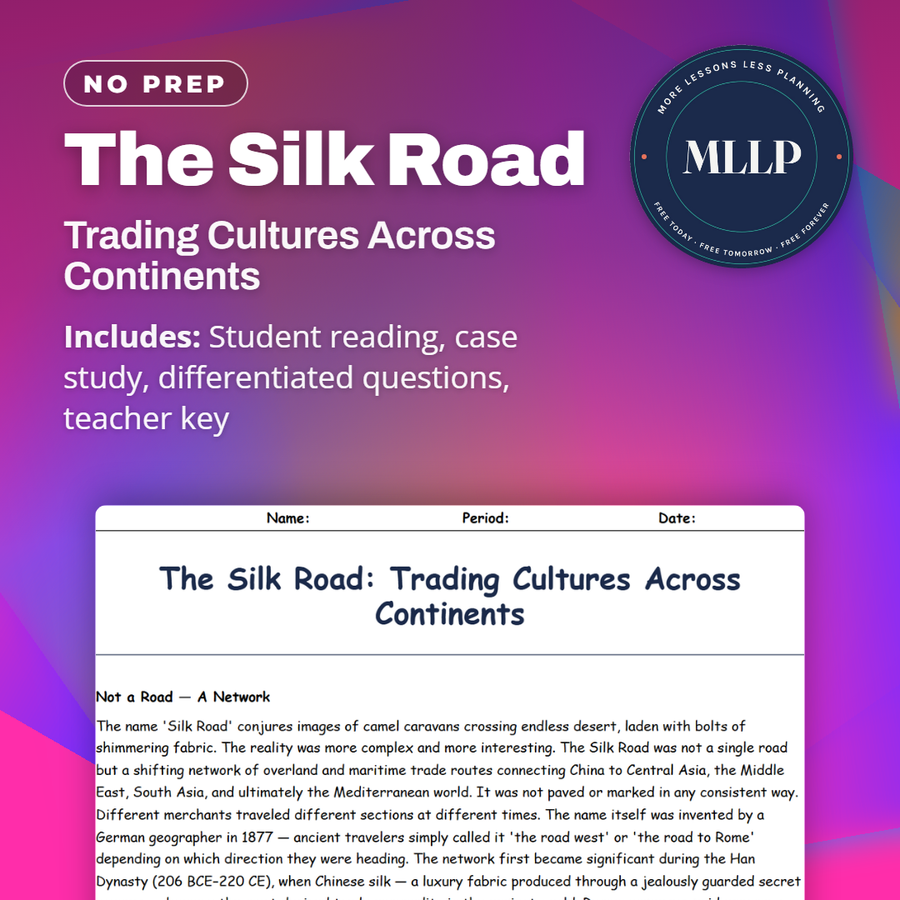
The Silk Road: Trading Cultures Across Continents
Quality reviewed September 2026
Facts verified September 21, 2026
- Subject
- Social Studies
- Grades
- Grades 9-12
- Length
- 9-page student worksheet
- Time
- About one 50-minute class period
- Great for
- Sub plans and independent work
- Includes
- Reading passage, comprehension questions + full answer key
- Format
- Print-and-go PDF
What students do
- Silk did not travel one paved road, but a shifting network a German geographer named in 1877
- Sort what moved along Silk Road routes into goods, ideas, and diseases
- A sealed cave at Dunhuang held the world's oldest dated printed book alongside business contracts
- Explain why Sogdian merchants were valuable middlemen that no border official could easily categorize
What it covers
- Sogdian merchants and their role as middlemen across the Silk Road network
- The Dunhuang caves, the Diamond Sutra, and what a sealed library preserved
- How Silk Road trade routes also carried plague westward toward Europe
Start reading this worksheet
Not a Road: A Network
The name 'Silk Road' conjures images of camel caravans crossing endless desert, laden with bolts of shimmering fabric. The reality was more complex and more interesting. The Silk Road was not a single road but a shifting network of overland and maritime trade routes connecting China to Central Asia, the Middle East, South Asia, and ultimately the Mediterranean world. It was not paved or marked in any consistent way. Different merchants traveled different sections at different times. The name itself was invented by a German geographer in 1877. Ancient travelers simply called it 'the road west' or 'the road to Rome' depending on which direction they were heading. The network first became significant during the Han Dynasty (206 BCE–220 CE), when Chinese silk, a luxury fabric produced through a jealously guarded secret process, became the most desired trade commodity in the ancient world. Roman emperors paid enormous sums for Chinese silk; it was literally worth its weight in gold in parts of the Roman Empire. In exchange, China received horses (critical for military power), glass, wool, linen, spices, and eventually Buddhism. The routes that carried silk also carried diseases, ideas, technologies, religions, and people in both directions.
Archaeological Evidence Along the Route
How do archaeologists know what traveled along the Silk Road? The evidence comes from many sources. In China, Roman coins and glassware have been found in Han Dynasty tombs. In Rome, silk garments and fragments of Chinese lacquerware have been recovered. Along the desert routes of Central Asia, preserved campsites, abandoned caravanserais (roadside inns), and ruined trading towns have yielded physical evidence of the goods that moved between East and West. The most spectacular finds come from the Tarim Basin in what is now Xinjiang, China, where the extreme aridity of the desert has preserved organic materials (textiles, leather, wood, paper, even human bodies) in extraordinary condition. The 'Tarim Mummies,' some dating to 2000 BCE, wore plaid woolen textiles and had distinctly non-Chinese physical features, suggesting that the western reaches of China had contact with Central Asian and possibly European populations long before the Han Dynasty formalized trade routes.
The Dunhuang Caves: A Library in the Desert
One of the most important Silk Road archaeological discoveries came in 1900 when a Taoist monk named Wang Yuanlu discovered a sealed cave at Dunhuang containing tens of thousands of manuscripts, paintings, and religious objects. The Dunhuang caves, a complex of Buddhist temples carved into sandstone cliffs, had been an important oasis stop on the Silk Road for centuries. The sealed cave, apparently walled up around 1000 CE, preserved a library of documents in multiple languages: Chinese, Tibetan, Sanskrit, Sogdian, Uyghur, and others. Among the documents was the Diamond Sutra, printed in 868 CE using woodblock printing: the earliest dated printed book in the world, predating Gutenberg by nearly 600 years. The Dunhuang manuscripts revealed the cultural and religious diversity of the Silk Road: Buddhist sutras, Confucian classics, Taoist texts, business contracts, personal letters, and medical recipes all found in the same archive, reflecting a trading community where multiple cultures and belief systems coexisted in close proximity.
Like what you read? The full reading, the case study, and every question set are in the free download below, along with the answer key.
Why this matters
The Silk Road is a clear early example of how connecting the world speeds up everything moving through it, goods and ideas, but also disease, and that same tradeoff plays out today every time global travel or shipping gets discussed in the news. Sogdian merchants also give students a useful model for thinking about people who work between cultures rather than fully inside one, since their value came from being trusted by multiple sides who did not trust each other. The Dunhuang documents about women running businesses and enforcing contracts are worth noting too, since they show economic roles that official histories of the period usually leave out entirely.
From one teacher to another
Silk did not travel down one paved road, it moved along a shifting network of desert and sea routes that a German geographer only named the Silk Road in 1877, long after the fact. Students read about the Sogdians, Iranian-speaking merchants from cities like Samarkand who carried goods and culture between empires without fully belonging to any of them, and about the sealed cave at Dunhuang, discovered in 1900, which held tens of thousands of documents including the Diamond Sutra, the oldest dated printed book in the world. The reading also traces a darker side of the same routes, since the Antonine Plague, the Plague of Justinian, and eventually the Black Death all appear to have spread westward along Silk Road trade networks. A case study follows a Sogdian trader named Nanaivandak through bandit trouble outside Kashgar and a report he dictates home from Dunhuang.
What you get
Download
Where should I send the next one?
Everything here is free and it stays that way. Leave your email and I'll send you the new lessons as they go up. You can unsubscribe from any one of them.
Related resources
Ancient China: An Overview of Dynasties, Power, and the Archaeological Record
Ancient Chinese Inventions: What Archaeology Proves
Han Dynasty Tombs: Buried Treasure and Beliefs About the Afterlife
Oracle Bones: Fortune-Telling That Became History
Sanxingdui: The Mysterious Bronze Civilization That Doesn't Fit
The Great Wall: Myth vs. Archaeological Reality
Every lesson on this site is free to download and use. If one of them saved you a prep period, you can chip in a few bucks toward my three kids' daycare fund. That's genuinely where tips go.