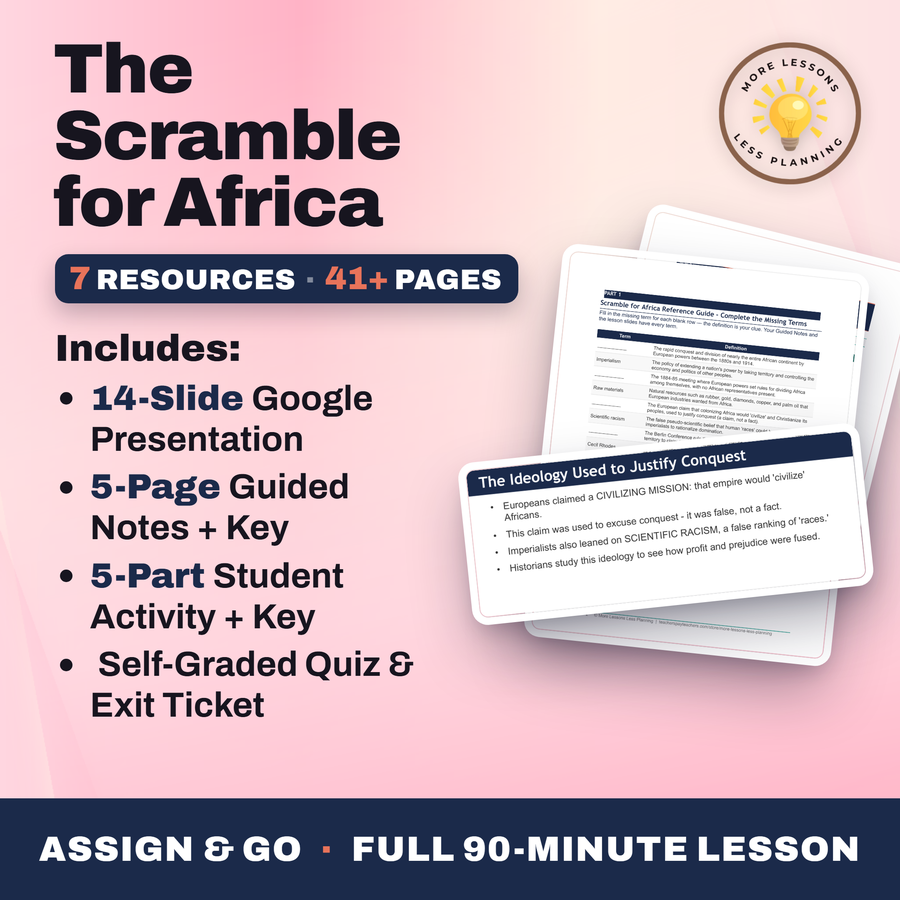

The Scramble for Africa
Quality reviewed September 2026
- Grades
- Grades 9-12
- Time
- About two 50-minute class periods
- Includes
- 11 ready-to-teach files
- Format
- Word (.docx) · PowerPoint (.pptx)
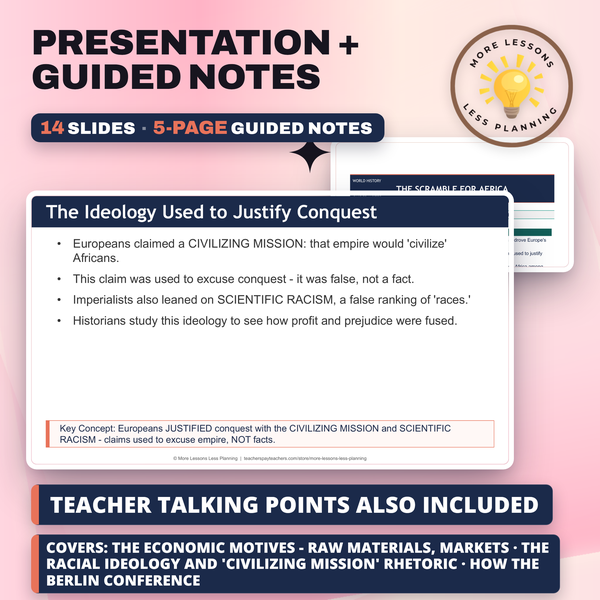
- Slide deck
- Guided notes
- Guided notes teacher key
- Activity + answer key
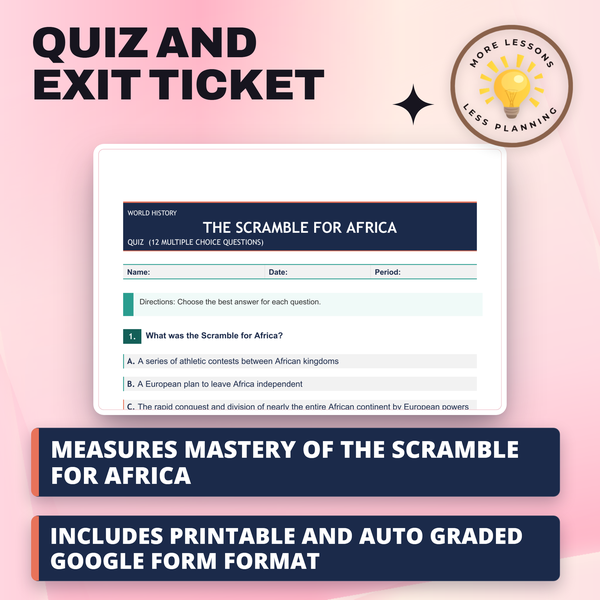
- Quiz + answer key
- Exit ticket + answer key
- Teacher guide
- Teacher presentation notes
What students do
- Explain the economic motives - raw materials, markets, and prestige - that drove Europe's conquest of Africa
- Read Cecil Rhodes's own 1877 "Confession of Faith" and source it as a wealthy imperialist's documented belief, not fact
- Sort four claims about the Scramble as supported or not supported, including that Africa was empty before Europeans arrived
- Write a source-based verdict on whether profit, ideology, or both drove the Scramble, naming the human cost to Africans
What it covers
- The organized African kingdoms and trade networks, like the Sokoto Caliphate and Asante, that existed before the Scramble
- The 1884-85 Berlin Conference, where European powers divided Africa under the rule of effective occupation with no African rulers present
- Cecil Rhodes's own words fusing profit and racial ideology, read as evidence to analyze rather than a claim to accept
- The human cost of exploitation and forced labor alongside African resistance, including Ethiopia's 1896 victory at Adwa
Learning targets
- Explain the economic motives - raw materials, markets, and prestige - that drove Europe's Scramble for Africa.
- Analyze the racial ideology and 'civilizing mission' rhetoric that Europeans used to justify imperial conquest.
- Describe how the Berlin Conference (1884-85) let European powers divide Africa among themselves.
- Evaluate the human cost of the Scramble for African peoples, and recognize African resistance and agency.
Peek inside
Not an Empty Land
Before the Scramble, Africa was not ; it held organized societies.
African and empires, such as the Sokoto Caliphate and Asante, governed millions.
Long-distance routes carried gold, salt, ivory, and cloth across the continent.
Europeans later imposed on these existing African societies.
1. Q1. What do we call the rapid conquest and division of nearly the entire African continent by European powers between the 1880s and 1914?
Why this matters
Cecil Rhodes put his reasoning in writing in 1877, calling the Anglo-Saxon race the finest in the world in the same breath as arguing Africa was lying ready for the taking, and that document is evidence of profit and ideology fused together. States like the Sokoto Caliphate and Asante governed real populations before any of that writing existed.
Treating Rhodes's words as something to analyze rather than accept is harder than it sounds, since students want to dismiss him or take him at his word, and I push them to do neither. By the time they weigh his claims against Ethiopia's victory at Adwa, they've built a verdict instead of inherited one.
From one teacher to another
Africa never gets pictured as empty land waiting to be taken in this lesson, so before any talk of conquest students name real states like the Sokoto Caliphate and Asante that governed millions. From there the lesson builds two engines side by side, the economic motives of raw materials and new markets, and the ideology Europeans used to justify grabbing them, and I keep both strictly framed as documented claims to analyze, never as fact. Cecil Rhodes carries that fusion in his own words: students read his actual 1877 "Confession of Faith," where he calls the Anglo-Saxon race "the finest race in the world" in the same breath as arguing "Africa is lying ready for us," and I have them source it exactly for what it is, a wealthy imperialist's documented belief being examined, not endorsed. The Berlin Conference gets the same treatment, dividing a continent under a rule called effective occupation with not one African ruler in the room. I don't let the lesson end on conquest alone either - Ethiopia's 1896 victory over an invading Italian army at Adwa sits right alongside the exploitation and forced labor, so the closing verdict has to weigh profit, ideology, and resistance together rather than settle for a single tidy answer.
Every file in this toolkit
Download
Where should I send the next one?
Everything here is free and it stays that way. Leave your email and I'll send you the new lessons as they go up. You can unsubscribe from any one of them.
Related resources
Cities and Slums
Life in the Factory
Railroads and the Transportation Revolution
Sparks of the Industrial Revolution
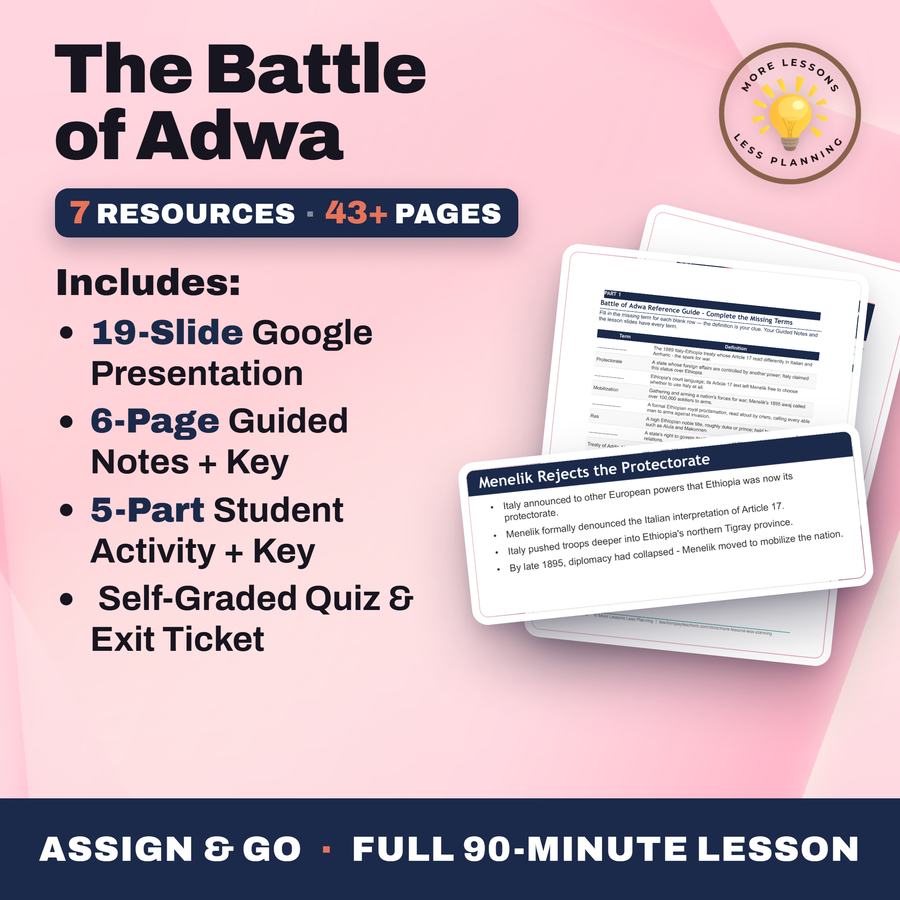
The Battle of Adwa
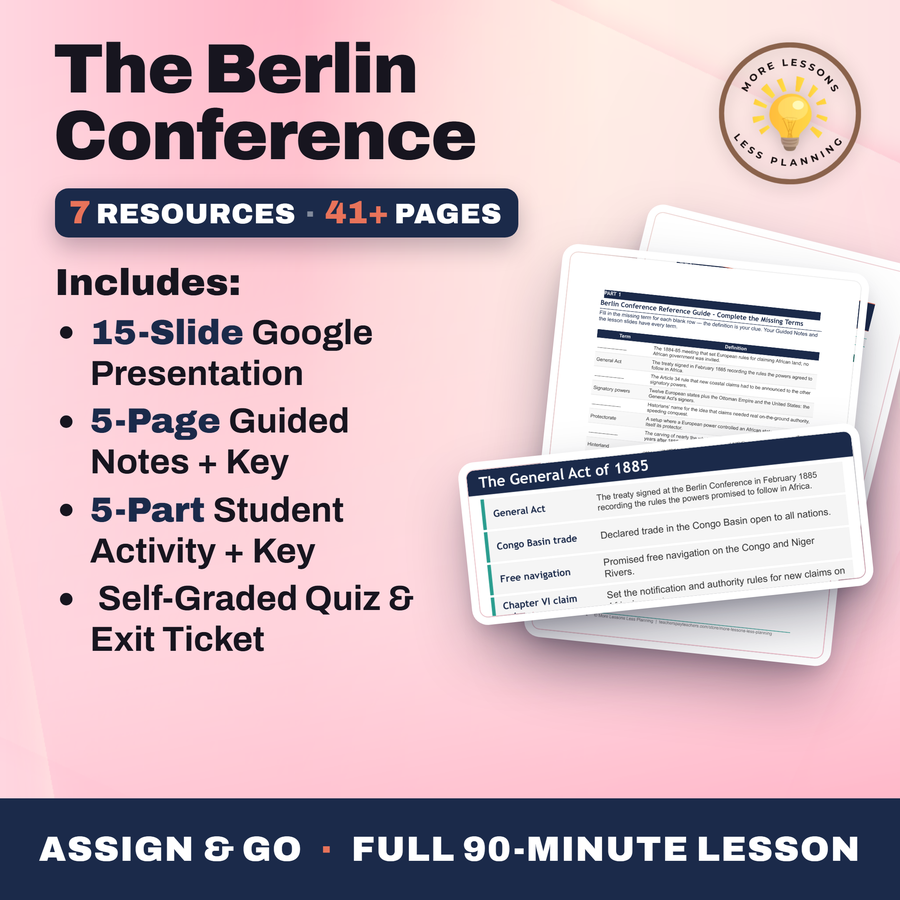
The Berlin Conference
Every lesson on this site is free to download and use. If one of them saved you a prep period, you can chip in a few bucks toward my three kids' daycare fund. That's genuinely where tips go.