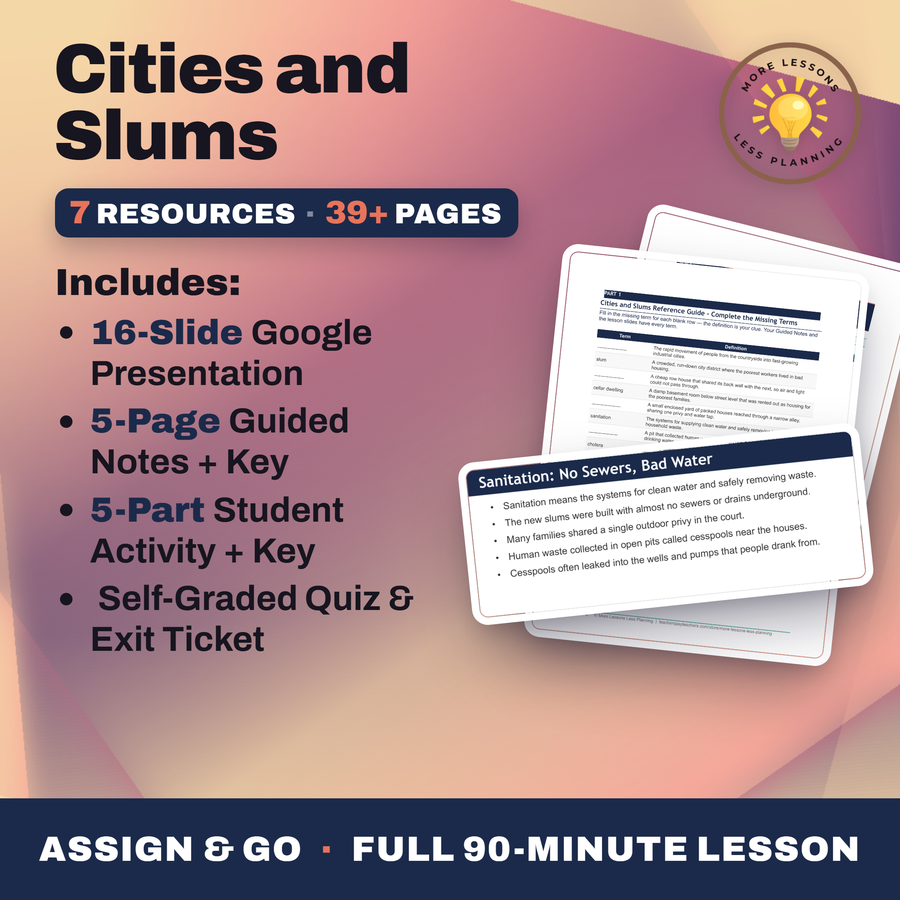

Cities and Slums
Quality reviewed September 2026
- Grades
- Grades 9-12
- Time
- About two 50-minute class periods
- Includes
- 11 ready-to-teach files
- Format
- Word (.docx) · PowerPoint (.pptx)
- Slide deck
- Guided notes
- Guided notes teacher key
- Activity + answer key
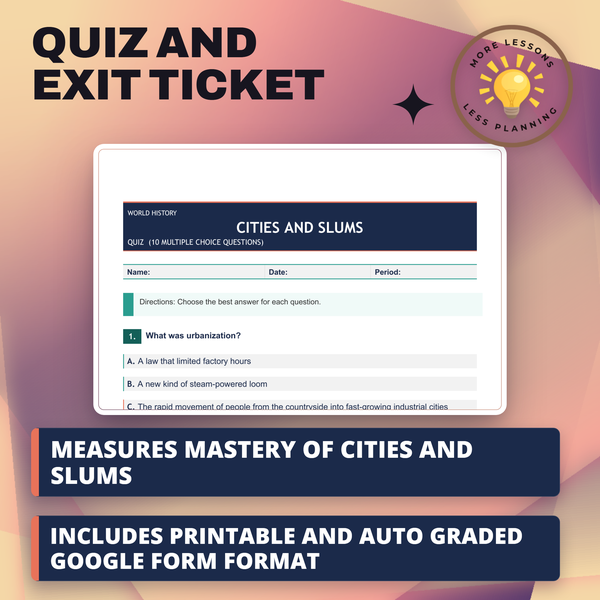
- Quiz + answer key
- Exit ticket + answer key
- Teacher guide
- Teacher presentation notes
What students do
- Define urbanization and describe the housing of industrial slums, including back-to-back houses, cellar dwellings, and courts
- Explain how the collapse of sanitation led to the spread of diseases like cholera in fast-growing factory cities
- Read an excerpt from Friedrich Engels's 1845 account of Manchester and identify what he says about the river Irk and the city's housing
- Explain how eyewitness accounts like Engels's helped push reformers toward laws like the Public Health Act of 1848
What it covers
- Rapid urbanization into overcrowded factory cities, and the slum housing workers lived in
- The collapse of sanitation, the spread of cholera, and the sharp divide between factory owners and workers
- A primary source excerpt from Friedrich Engels's 1845 description of the slums of Manchester, with sourcing, comprehension, and analysis questions
- How eyewitness evidence helped build the case for public-health reform
Learning targets
- Explain what urbanization was and why people moved to the new factory cities.
- Describe the crowded housing the poor lived in: slums, back-to-back houses, cellars, and courts.
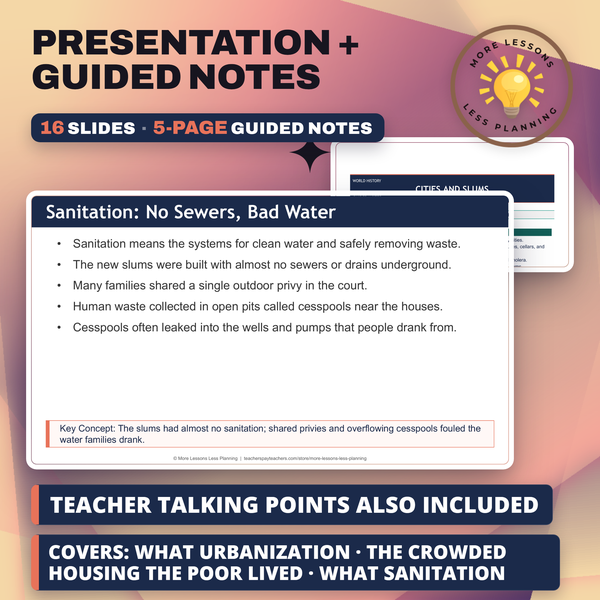
- Explain what sanitation was like in the slums and how dirty water spread cholera.
- Describe the class divide between the rich suburbs and the poor worker slums.
- Explain how reformers used evidence to win the Public Health Act of 1848.
Peek inside
Before the change, most people lived and worked on farms out in the countryside.
New machines and larger farms meant fewer hands were needed to work the land.
Factories in the growing cities offered new jobs and steady wages.
This rapid move from the countryside into cities is called urbanization.
Cities like Manchester and London grew faster than anyone had planned.
From the Farms to the Factory Cities
Before the change, most people lived and worked on out in the countryside.
New machines and larger farms meant fewer were needed to work the land.
Factories in the growing cities offered new and steady wages.
The rapid movement of people from the countryside into cities is called by historians.
Cities like Manchester and grew faster than anyone had planned.
Why this matters
One privy served an entire court of families packed into the back-to-back houses and cellar dwellings of industrial Manchester, and Friedrich Engels wrote that housing down street by street in 1845, including the filthy river Irk running through it. Collapsed sanitation like that let cholera move through a fast-growing factory city so easily.
Engels wasn't a neutral narrator, he was a factory owner's son turned reformer, and I make students weigh that before trusting a word of his description. Once they've done that sourcing work, his account of the Old Town explains why laws like the Public Health Act of 1848 eventually passed better than a statistic ever could.
From one teacher to another
I built this lesson around a single eyewitness account because it does more work than any textbook summary could. The guided notes cover how fast industrial cities grew and what the housing actually looked like - back-to-back houses, cellar dwellings, whole families in a court sharing one privy - before students hit the primary source: Friedrich Engels's real 1845 description of Manchester's Old Town, one bridge, one filthy river, one court at a time. I make sure students weigh who Engels was and why that matters, since he was the son of a factory owner and a reformer writing to expose what he saw. The activity has them connect his description straight to the disease and reform side of the lesson, tracing how conditions like these built the case for laws like the Public Health Act of 1848. Guided notes, activity, quiz, and exit ticket all come with answer keys, along with a teacher guide.
Every file in this toolkit
Download
Where should I send the next one?
Everything here is free and it stays that way. Leave your email and I'll send you the new lessons as they go up. You can unsubscribe from any one of them.
Related resources

Life in the Factory
Railroads and the Transportation Revolution
Sparks of the Industrial Revolution

The Battle of Adwa

The Berlin Conference
The Labor Movement and Strikes
Every lesson on this site is free to download and use. If one of them saved you a prep period, you can chip in a few bucks toward my three kids' daycare fund. That's genuinely where tips go.