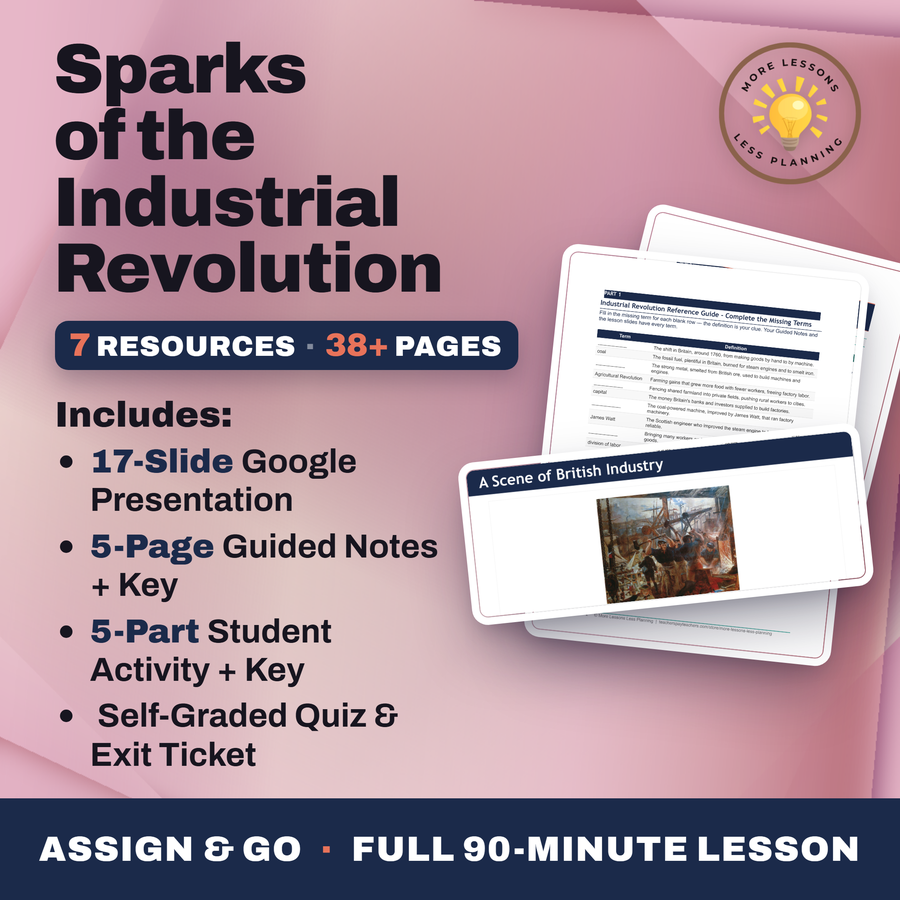

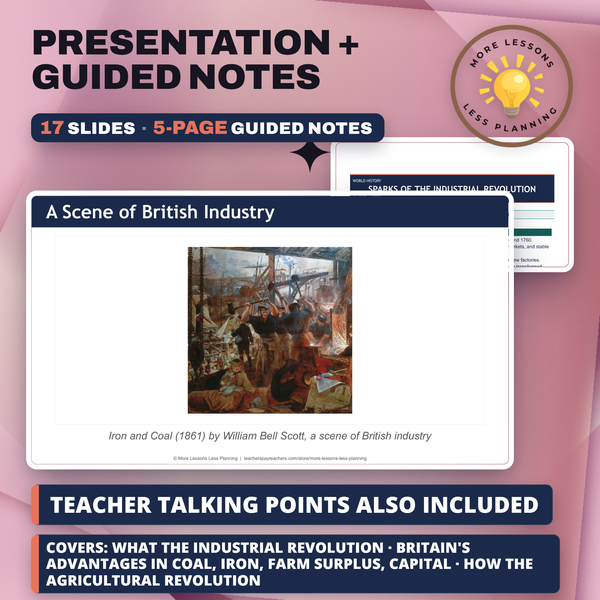
Sparks of the Industrial Revolution
Quality reviewed September 2026
- Grades
- Grades 9-12
- Time
- About two 50-minute class periods
- Includes
- 11 ready-to-teach files
- Format
- Word (.docx) · PowerPoint (.pptx)
- Slide deck
- Guided notes
- Guided notes teacher key
- Activity + answer key
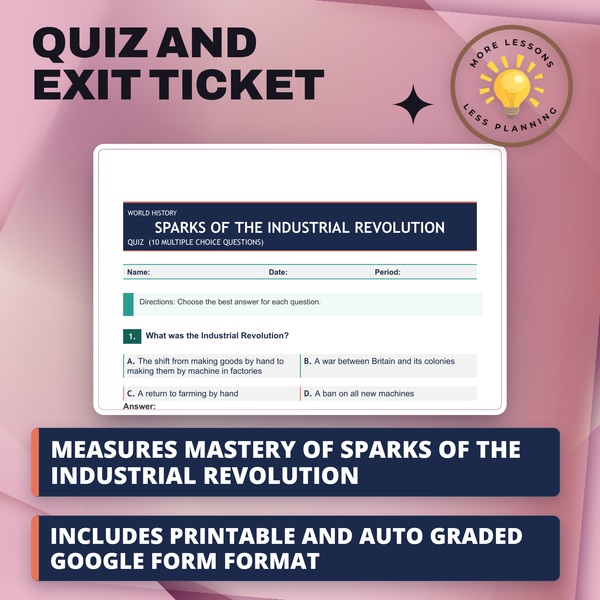
- Quiz + answer key
- Exit ticket + answer key
- Teacher guide
- Teacher presentation notes
What students do
- Identify Britain's advantages going into industrialization: coal, iron, farm surplus, capital, and colonial markets
- Explain how enclosure and the Agricultural Revolution freed up labor for factory work
- Read Adam Smith's 1776 pin-factory passage and calculate the productivity gain from dividing labor into steps
- Argue which factor mattered most in making Britain the first industrial nation, using evidence from the lesson
What it covers
- Britain's coal, iron, farm surplus, capital, colonial markets, and stable government as advantages for industrializing first
- James Watt's steam engine and the rise of the factory system
- Core vocabulary: Industrial Revolution, enclosure, capital, steam engine, factory system, division of labor
- Adam Smith's 1776 pin-factory passage from The Wealth of Nations, showing ten workers making 48,000 pins a day
Learning targets
- Explain what the Industrial Revolution was and why it began in Britain around 1760.
- Identify Britain's advantages in coal, iron, farm surplus, capital, colonial markets, and stable government.
- Explain how the Agricultural Revolution and enclosure freed labor for the new factories.
- Describe how James Watt's improved steam engine and the factory system transformed production.
- Explain how the division of labor, as Adam Smith described in his 1776 pin factory, multiplied output.
Why this matters
Coal in the ground and farmland freed by enclosure don't sound like the start of a revolution, but Britain had both before any other nation, along with the capital and colonial markets to put them to work. That combination, not any single invention, let James Watt's steam engine turn into a factory system rather than a curiosity.
It's tempting to hand students one cause and let them stop there, so I built this lesson to make them weigh several advantages against each other before they're allowed to argue which mattered most. Adam Smith's own pin-factory numbers give them something concrete to point to once they've done that weighing.
From one teacher to another
I built this one around a single, very concrete number: ten workers in Adam Smith's 1776 pin factory, dividing the job into about eighteen small steps, making roughly 48,000 pins a day between them - work one untrained person alone couldn't come close to matching. That passage from The Wealth of Nations does the heavy lifting for explaining division of labor, and everything else in the lesson builds around it: why Britain specifically had the coal, iron, farm surplus, and capital to put that kind of organized labor to work, how enclosure pushed rural workers toward cities and factories, and how James Watt's steam engine let factories run on coal instead of rivers. Students finish by weighing which factor mattered most and building a case for it, using Smith's numbers as their strongest piece of evidence. It's a natural opener for an Industrial Revolution unit since it explains the "why Britain, why then" question before moving into factory conditions or later effects.
Every file in this toolkit
Download
Where should I send the next one?
Everything here is free and it stays that way. Leave your email and I'll send you the new lessons as they go up. You can unsubscribe from any one of them.
Related resources
Cities and Slums
Life in the Factory
Railroads and the Transportation Revolution

The Battle of Adwa

The Berlin Conference
The Labor Movement and Strikes
Every lesson on this site is free to download and use. If one of them saved you a prep period, you can chip in a few bucks toward my three kids' daycare fund. That's genuinely where tips go.